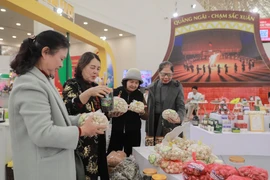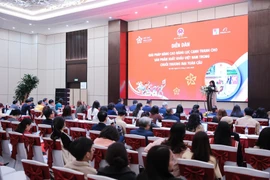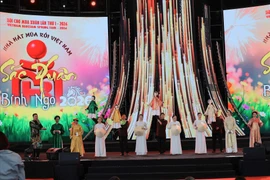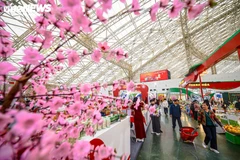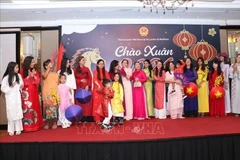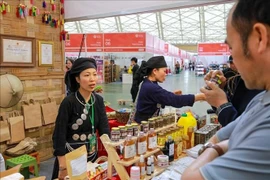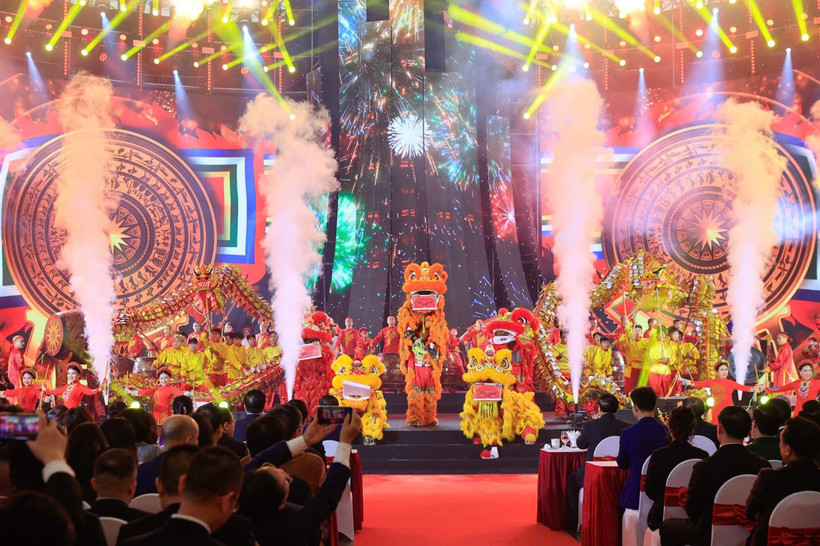
Hanoi (VNA) – The first Glorious Spring Fair 2026 in Hanoi is bringing together a wide range of distinctive cultural products from localities across the country, creating an exhibition space that blends tradition with modernity. A notable highlight of this year’s event is the strong participation of young people in craft demonstrations and in sharing stories of heritage preservation.
Young man reviving Lai Thieu pottery
At this year’s fair, the Ho Chi Minh City exhibition area stands out with the presence of Huynh Xuan Huynh, a young artisan dedicated to reviving Lai Thieu pottery. As the founder of Nang Ceramics, Huynh has chosen a challenging path: rebuilding kilns, rediscovering traditional glazing techniques, and bringing back to contemporary life a pottery line that had seemingly faded into memory. At the fair, he directly demonstrates the process of creating a ceramic product, from shaping to decorative painting.
The Lai Thieu pottery village dates back to the late 18th and early 19th centuries, closely linked to the early settlement of southern Vietnam. Benefiting from abundant, fine and pliable clay, along with a favourable location along the Sai Gon river, the craft flourished and became one of the most renowned pottery centres in the South. At its peak, the rustic and familiar Lai Thieu ceramics were found in every aspect of daily life, from household items and garden ornaments to ancestral altars throughout the region.
At this year’s fair, the image of young artisans like Huynh introducing Lai Thieu pottery to the public illustrates that traditional culture can only endure when people live with it, practise it and believe in its value. As he himself has said: “Heritage does not lie in the past, but in how we continue to live with it.”
For Huynh, each ceramic piece sold is not merely a product, but also an export of cultural heritage. He believed Vietnamese ceramics can reach the international market precisely through these local, indigenous values.
Young artisan carries forward the sound of Loc Hoa lithophone
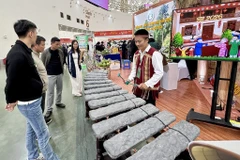
Elsewhere at the fair, the resonant sound of the Loc Hoa lithophone has drawn many visitors to the southern province of Dong Nai’s booth. Here, young artisan Nguyen Duy Thao performs on a reconstructed version of the Loc Hoa lithophone, an artefact of the one discovered in 1996 in Loc Hoa commune, Loc Ninh district (now Loc Thanh commune). The instrument is considered one of the oldest percussion instruments known to humanity, dating back nearly 3,000 years.
Then Loc Ninh district once decided to bring the lithophone, recognised as a national treasure, into schools as part of the local education curriculum. As a result, nearly 40 schools in the area have included lithophone instruction, with many establishing art clubs centred on the instrument.
The presence of the Loc Hoa lithophone at the expo goes beyond performance, reflecting efforts to bring heritage closer to the public. Many visitors, especially young people, have had the opportunity for the first time to closely observe the structure of each stone bar, the striking techniques employed by the artisan, and how sound varies according to the size and thickness of the material.
According to Thao, who has spent eight years performing and teaching the instrument, the most important aspect of introducing the lithophone is helping audiences understand that it is not merely a museum artefact displayed behind glass, but a living musical instrument that can continue to thrive through performance, teaching and everyday practice.
The participation of young people like Huynh and Thao at the fair reflects a new approach to heritage: rather than static display, cultural values are “activated” through practice, performance, dialogue and direct interaction. This approach not only deepens public understanding of traditional crafts and arts, but also opens up opportunities for craft villages and heritage forms to find a meaningful place in contemporary life. This, indeed, is the most significant message conveyed by this year’s Glorious Spring Fair, which is creating a space where culture can live, be passed on, and expand through the active engagement of the younger generation./.
VNA