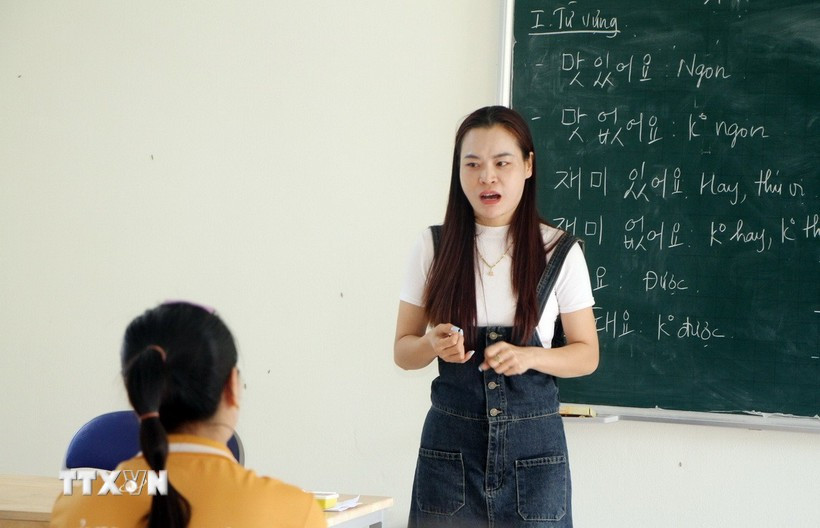
Hanoi (VNA) – Major newspapers in the Republic of Korea (RoK) on February 4 expressed surprise at the rapid surge in Korean-language learning in Vietnam, after the Vietnamese government decided to recognise TOPIK (Test of Proficiency in Korean) scores in the national university admissions system from 2026.
Under Vietnam’s current high school graduation and university entrance framework, candidates are required to take compulsory exams in Mathematics and Literature and choose two additional subjects from a list of nine options, including foreign languages and history. From this year, holders of TOPIK Level 3 or higher are allowed to use their TOPIK results to replace the foreign-language subject, with the converted score counted for both graduation and university admission.
Vietnam has gradually institutionalised Korean-language education in recent years. After approving Korean as a second foreign language in 2020, it was upgraded to a first foreign language in 2021 and included among subjects for the national high school graduation examination.
To ensure the credibility of the test, the RoK Ministry of Education has dispatched personnel from Korean education institutes in Hanoi and Ho Chi Minh City to directly supervise TOPIK administration in Vietnam, while anti-cheating systems at test centres have also been tightened.
Vietnam is now one of the world’s largest TOPIK test markets. Of the 566,665 candidates registered globally in 2025, 85,896 candidates came from Vietnam, accounting for 15.2% of the total and ranking first among overseas test locations outside the RoK.
Across the country, 169 primary, secondary and high schools now offer Korean-language classes, with about 33,000 students enrolled. Vietnam also ranks second in the number of foreign students in the RoK, with 75,144 students in 2025, just behind China with 76,541.
The Korean-language boom in Vietnam is closely linked to labour-market demand. As RoK companies continue to expand investment and turn Vietnam into a key production base, demand for Korean-speaking professionals in interpretation, business, quality management, procurement and human resources remains strong. In the domestic labour market, candidates with Korean skills are often prioritised and offered language allowances.
Vietnam is also a major source of workers sent to the RoK under the Employment Permit System (EPS), further boosting interest in learning Korean. At the global level, the Korean Wave and the growing popularity of Korean culture have also fuelled demand. According to Duolingo, Korean was the sixth most studied language worldwide last year, after English, Spanish, French, Japanese and German.
Data from the RoK Ministry of Education show that 47 countries now teach Korean in their formal primary and secondary school systems. Of these, 24 countries have designated Korean as a second foreign language, while 11 countries use it as a criterion in university admissions.
RoK Minister of Education Choi Kyo-jin said the adoption of TOPIK results for overseas university admissions reflects the rising status of the Korean language and the growing credibility of the test.
“The ministry will continue to work closely with governments around the world to promote Korean language education overseas and provide full support for its expansion,” he said./.
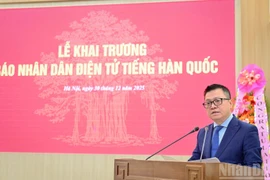
Korean-language version of Nhan Dan Online launched
The launch of the Korean-language version of Nhan Dan Online is a concrete step in implementing the Party’s and State’s policy on strengthening external information work, meeting the requirement on building an official information channel in a widely used language.