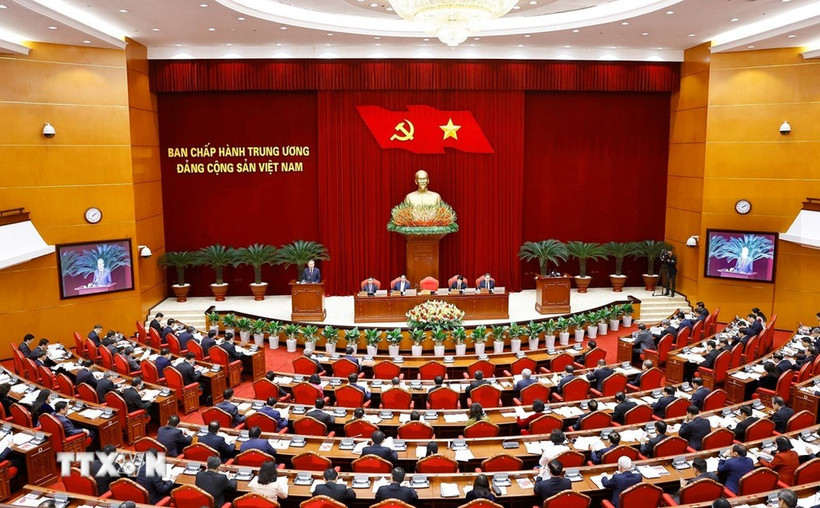
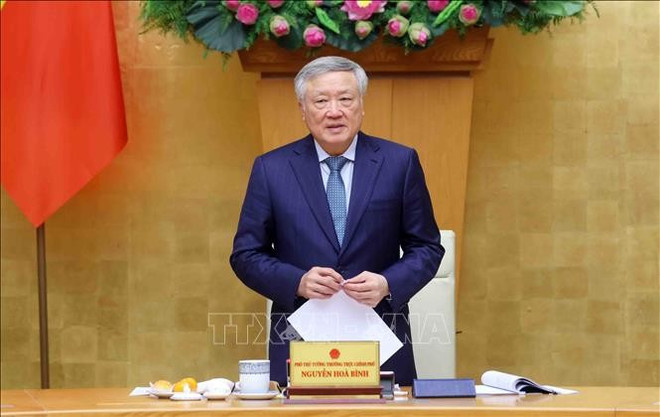
Hanoi (VNA) - The 13th National Party Congress’s term (2021–2026) is coming to a close with historic milestones. Ahead of the 14th National Party Congress, the Vietnam News Agency conducted an interview with Nguyen Hoa Binh, Politburo member, Standing Vice Secretary of the Government Party Committee, and Permanent Deputy Prime Minister, on the achievements of the 13th Congress’s term and the orientations, key tasks and solutions to successfully bring the 14th National Party Congress’s Resolution to life.
Reporter: The 13th National Party Congress’s term began under exceptionally harsh circumstances, with difficulties and challenges being more numerous, greater and more intense than opportunities and advantages. Could the Deputy PM provide an overview of comprehensive results the country has achieved during this “trial by fire” term, and identify the key factors behind these remarkable achievements?
Permanent Deputy PM Nguyen Hoa Binh: The 13th National Party Congress’s term was a special one, beginning with extremely difficult tests, particularly for the mettle and wisdom of our Party, State and people. We entered this term as the COVID-19 pandemic broke out, spread widely and severely affected the global, regional and Vietnamese economies; this was followed by disruptions to supply chains, sharply rising global inflation, and geopolitical conflicts that weakened many economies worldwide.
Yet it was precisely amid these hardships that the mettle and brainpower of the Vietnamese people shone even more brightly. With the spirit of turning adversity into opportunity, under the Party’s sound and comprehensive leadership, the Government’s resolute management, and the unity and solidarity of the entire population, we overcame difficulties and challenges, fulfilled socio-economic development targets and tasks, and achieved comprehensive results across many fields, marked by 10 notable highlights:
First, macroeconomic stability was firmly maintained, growth made strong breakthroughs, and major economic balances were ensured. In 2025, GDP grew an impressive 8.02%, bringing the average growth rate for the entire term to one of the highest in the region (6.3%). Economic size exceeded 514 billion USD (ranking 32nd globally), while per capita income surpassed 5,000 USD. Inflation was kept under control (3.31%), public debt fell to 34.4% of GDP, and state budget revenue reached a record 2.65 quadrillion VND or 100.85 billion USD (up 34%), affirming the strong internal strength of the economy.
Second, a revolution in reorganising apparatus and restructuring administrative units was a success, ensuring streamlining, efficiency, effectiveness and efficacy. This stands as a special hallmark of the entire 13th Congress term. The restructuring opened up new development space, with a two-tier local administration model closer to the people and better serving them, and sharply reduced the number of administrative units by eliminating intermediate layers: cutting 100% of general departments, more than 1,000 departments and divisions, and around 145,000 staff positions; saving around 39 trillion VND per year in recurrent expenditure, allowing resources to be redirected to development investment and social welfare.
Third, institutional framework were fine-tuned with breakthrough thinking to foster development. Legislative work shifted strongly from a management mindset to a facilitative, development-oriented approach, removing bottlenecks. During the term, the Government submitted a record number of legal documents for National Assembly approval (178 laws, resolutions and ordinances), including key laws such as the Land Law, the Housing Law and the Law on Real Estate Business. At the same time, decentralisation and delegation of authority were carried out thoroughly under the principle of "localities decide, localities act, localities take responsibility” while nearly 3,000 business regulations were cut or simplified, placing Vietnam among countries with an open, transparent and attractive investment and business environment.
Fourth, strategic infrastructure saw remarkable progress. A total of 3,345km of expressways and over 1,700km of coastal roads were completed, exceeding the targets set by the 13th Congress and forming a North–South backbone. Telecommunications networks, key digital infrastructure and other economic infrastructure were gradually completed, laying the groundwork for the commencement of high-speed railway construction in the next term.
Fifth, the growth model was renewed, creating new drivers for an era of national rise. The economy has undergone a strong qualitative shift from extensive to intensive growth, increasingly driven by science, technology, innovation and digital transformation. Green economy and energy transition have become dominant trends, with strong commitments to net-zero emissions. Total registered foreign direct investment (FDI) during the term exceeded 184 billion USD, with leading global technology corporations (such as Samsung, Amkor and NVIDIA) investing in semiconductors and artificial intelligence, gradually establishing Vietnam as an important link in the global supply chain.
Sixth, difficulties and bottlenecks were resolutely removed to unlock resources for the economy. Following the Party Central Committee’s resolution, the Government drastically led and directed the handling of long-delayed issues, untangling legal obstacles for numerous loss-making energy and industrial projects, weak banks, and thousands of real estate projects. To date, 3,289 projects and land plots with a total investment of some 1.67 quadrillion VND and a land base of about 70,000 ha have been unleashed, allowing continued investment, job creation and tangible contributions to growth.
Seventh, culture truly illuminated the path forward, becoming an intrinsic strength and a growth engine. Fine traditional cultural, family values and conduct of the Vietnamese people in the new era were revived and widely spread. Cultural industries took shape and flourished, while Vietnam’s cultural heritage and identity gained global recognition, not only contributing to economic growth but also becoming a source of pride that nurtures patriotism, self-reliance and the aspiration to devote among each citizen.
Eighth, social welfare work proved effective. The Party and State paid special attention to social welfare in the spirit of leaving no one behind. All temporary and dilapidated housing nationwide was eliminated five years ahead of schedule; the multidimensional poverty rate fell sharply to 1.3%. More than 1 quadrillion VND was allocated annually to social welfare. Incomes and well-being improved, and the national happiness index rose by 37 places.
Ninth, education and health care made great strides, leading to better life quality. The healthcare system expanded nationwide, with grassroots health care bolstered. In the fight against COVID-19, the lives and health of residents were successfully protected; although Vietnam did not produce vaccines, free vaccinations were provided to the entire population. Universal health insurance coverage exceeded 95%, ensuring all residents gained equitable access to basic services and shared benefits of development. Average life expectancy reached 74.8 years. Fundamental education reform progressed, with positive improvements in workforce quality. Appropriate resources were allocated to build 248 multi-level boarding schools for students in border communes to improve educational standards and workforce, contributing to national defence-security; tuition fee exemption and reduction roadmaps were rolled out for students from preschool to high school.
Tenth, national defence-security was firmly reinforced, safeguarding the country early and from afar; diplomacy and global integration achieved important, strategic accomplishments. We built a lean, streamlined, strong and modernity-targeted army capable of responding to both traditional and non-traditional security challenges. Political security and social safety and order were maintained. Complex and unusual international relations were handled wisely, preserving a peaceful environment for development. To date, Vietnam has established diplomatic ties with 194 countries, and maintained comprehensive strategic partnerships and strategic partnerships with most major powers and key partners worldwide. Vietnam’s standing and prestige on the global stage have continued to rise, affirming its role as an active and responsible member of the international community, a trusted partner, and a positive contributor to peace, stability and development in the region and the world.
There are three key factors behind these impressive achievements. First and most decisive is the Party’s sound leadership, mettle and strategic vision, especially the strong, close direction of the Party Central Committee's Politburo and Secretariat, headed by the General Secretary. Second is the Government’s resolute, dynamic and creative governance, marked by bold thinking, bold action and accountability, staying closely aligned with reality and responding flexibly, promptly and effectively to all developments and situations. Third, and most importantly, is the unity, solidarity and absolute support of the people, with the strength of the great national unity bloc being fully upheld during the most difficult moments.
Reporter: During the implementation of the Resolution of the 13th National Party Congress, many new and unprecedented issues that went beyond forecasts posed extremely complex challenges. The Government addressed these issues in a timely and effective manner. From that vivid and arduous reality, could you please share the most profound lessons learned in leadership, direction and governance?
Permanent Deputy PM Nguyen Hoa Binh: Handling matters that have precedents is relatively easy, but dealing with unprecedented issues, particularly those that are difficult, sensitive and affect the interests of many people, is extremely challenging. From the fight against the COVID-19 pandemic to the revolution in reorganising the state apparatus, every decision had to be carefully weighed in terms of gains and losses, short-term interests versus long-term ones. From practical experience, six key lessons in leadership and governance can be drawn as follows:
First, it is essential to adopt new thinking and a strategic vision, remain firmly grounded in reality, and place the interests of the nation and the people above all. In a world of unpredictable changes, leaders must not follow worn paths of thinking or be satisfied with past experience. All policies must originate from reality, respect reality and take reality as the benchmark for evaluation. At the same time, there must be a long-term strategic vision that transcends short-term, localised interests in order to pursue the sustainable development of the nation and the people.
Second, there must be high determination, great effort, and decisive, effective action. Once the right policy is identified, it must be implemented resolutely and promptly, ensuring solid results at every step, without retreat. The Government must take the lead, spreading the spirit of daring to think and daring to act to every locality and grassroots level. Hesitation that causes the loss of development opportunities is, in effect, a disservice to the people.
Third, the people must always be placed at the centre and regarded as the subjects of development; all policies must aim to protect the people, care for the people, and help develop a prosperous and happy life for the people. Our Party has no higher goal than safeguarding national independence and sovereignty while continuously improving the well-being and happiness of the people. During the pandemic, the health and lives of the people were the top priority; in times of storms and floods, the safety of the people came first; and in economic development, eliminating temporary housing, reducing poverty, and increasing people’s incomes are the central tasks. Only when the people truly benefit from development outcomes can the Party leadership and the Government governance be genuinely successful and sustainable.
Fourth, leadership and must be close to reality and specific, following the principle of the “six clarities”: clear person in charge, clear tasks, clear timelines, clear responsibilities, clear outputs, and clear authority. In practice, wherever leaders are hands-on, decisive and willing to take responsibility in line with these six clarities, work gets done and bottlenecks are effectively removed.
Fifth, it is crucial to correctly identify key priorities and focal points, avoid scattered investment and follow a clear roadmap with rational sequencing. Given the country’s still limited resources and vast investment needs, lessons on resource allocation are of utmost importance. Breakthrough areas and projects with strong spillover effects that can create driving momentum must be selected for concentrated, decisive investment.
Sixth, ideological and communications work must be strengthened to build consensus among the people. Policy dissemination should go one step ahead, providing official information, guiding public opinion and fostering social consensus. When people deeply understand that all Government policies serve the interests of the nation and the people, and their own lives, they are ready to share, accompany and support. Policy formulation and enforcement must be both reasonable and empathetic, ensuring the legitimate and lawful rights and interests of citizens and businesses are properly addressed.
Reporter: On the eve of the 14th National Party Congress - a historic juncture ushering the country into a new era of development, what strategic breakthroughs and key governance solutions will the Government prioritise in the coming period in order to successfully realise the strategic goals set out?
Permanent Deputy PM Nguyen Hoa Binh: Looking towards the 14th National Party Congress and the visions to 2030 which marks the 100th founding anniversary of the Party, and to 2045 - the 100th anniversary of the founding of the nation, the Government has identified the following 10 key task groups:
The first one is to accelerate sustainable economic development to lay a solid foundation for the new era. Vietnam will mobilise all resources and remove all bottlenecks to strive for double-digit annual growth. We will renew traditional growth drivers and fully tap new ones (the digital economy, green economy and circular economy), taking science, technology, innovation and digital transformation as the primary engines; make the state-owned economy truly play a leading role, while recognising the private sector as one of the most important drivers of the national economy.
Second, we will continue to renew thinking in institution building and improvement, considering this the breakthrough of breakthroughs. We will strongly reform thinking in law-making to enable development and unleash productive resources. Vietnam will further promote decentralisation and delegation of authority in the spirit of "localities decide, localities do, localities take responsibility", while the central level focuses on institution-building, supervision and inspection. It will immediately eliminate overlapping regulations, sub-licenses, and the ask–give mechanism that constrains resources; resolutely give up the mindset of “if those cannot be managed, then prohibit them”
Third, Vietnam will step up the renovation of growth model, based on science and technology, innovation and digital transformation. It will build a comprehensive, paperless digital Government; develop the green and circular economies, and vigorously roll out the carbon credit market; increase investment in new growth drivers such as AI, chips, semiconductors, renewable energy and nuclear energy; modernise smart power grids, strongly develop renewable energy, gas-fired power and offshore wind power, ensuring absolute national energy security to serve high growth.
Fourth, we will focus on investing in, completing and putting into operation regional and inter-regional connectivity infrastructure projects; concentrate resources to commence construction of the North–South high-speed railway; complete and bring Long Thanh International Airport into operation as soon as possible; study and restart the nuclear power programme to ensure a clean and stable energy foundation for industrialisation and modernisation.
Fifth, we will develop science, technology and innovation as the top national policy; promote research and development (R&D) models; build regional-scale national data and innovation centres; study special and superior mechanisms to attract and retain leading global technology corporations in Vietnam. We will further promote innovation-driven start-ups across society; encourage enterprises to invest in the development and application of science and technology, especially new and high technologies.
Sixth, we will create breakthroughs in high-quality human resources; fundamentally and comprehensively reform higher education and vocational education; proactively prepare the workforce to master technologies in nuclear energy, high-speed railway, the digital economy, international financial centre development, the semiconductor industry and AI in the shortest possible time. At the same time, it is necessary to implement substantive talent-attraction policies with exceptional incentives to attract and retain leading scientists and overseas Vietnamese talents to contribute to the Fatherland.
Seventh, Vietnam will continue to streamline the apparatus and reform administrative procedures; continue reviewing to reduce units within ministries, agencies and localities; digitise 100% of dossiers and outcomes of administrative procedures; resolutely remove from the system officials who harass, evade responsibility or fear accountability, replacing them with those who dare to think and dare to act.
Eighth, we will place cultural development on par with economic development, fostering comprehensive development of Vietnamese culture and people; effectively implement the National Target Programme on Cultural Revitalisation; build and develop an advanced Vietnamese culture imbued with national identity, synchronised on the foundation of national value systems, family value systems and standards of the Vietnamese people in the new era; strongly develop cultural industries, turning culture into an endogenous strength and an important economic resource.
Ninth, we will promote sustainable social development, ensure social security, manage and use resources efficiently, protect the environment and adapt to climate change; implement a roadmap to waive tuition fees for general education students and strive to provide free basic medical services for all citizens in accordance with a defined roadmap; accelerate and soon complete the project to build one million social housing units, enabling workers to settle down and build their livelihoods; build a universal social safety net, ensuring no one is left behind in the country’s development journey; proactively prepare measures to respond to various types of natural disasters; and fundamentally address environmental pollution, flooding and landslides.
Tenth, Vietnam will elevate foreign affairs and consolidate national defence and security; protect the Fatherland early and from afar. At the same time, it will proactively and actively pursue deep, substantive international integration, turning international commitments into concrete economic benefits; build a lean, streamlined and strong army and public security forces, towards modernity, self-reliance and dual-use capabilities; maintain a peaceful environment and political stability for economic development, while resolutely and persistently safeguarding independence, sovereignty and territorial integrity.
Reporter: Thank you very much!/.