Hanoi (VNA) – Hanoi has steadily expanded its economic scale, improved growth quality, and reinforced its role as a national growth engine.
Building on these achievements, the capital is now moving to establish a new growth model and unlock modern development drivers to create a breakthrough for the next phase in its rise.
Since the launch of the Doi moi (Renewal) process, Hanoi has undergone four decades of both extensive and intensive development. A major milestone came with the 2008 administrative boundary expansion under the National Assembly's Resolution No. 15/2008/QH12, which significantly enlarged the city’s development space. Hanoi’s area increased from 920.97 sq.km to 3,348.5 sq.km, with a population exceeding 8 million, laying a strong foundation for socio-economic advancement.
During 2008–2013, the city’s gross regional domestic product (GRDP) grew by an average of 9.59% annually. Over the years, economic restructuring has seen stronger participation from all sectors, with total disbursed social investment accounting for about 25% of the national figure, affirming Hanoi’s central role in mobilising and efficiently utilising resources.
By 2020, services made up 55.5–56.6% of the local economy, industry – construction 41–42%, and agriculture just 2–2.5%. Export turnover also expanded steadily, by 14–15% annually during 2011–2015 and 13–14% during 2016–2020, reflecting deeper international integration.
In the 2021–2025 period, Hanoi’s GRDP grew by an estimated 6.57% annually, about 1.1 times the national average, with its economy reaching roughly 63 billion USD, equivalent to 12.6% of the country’s total. GRDP per capita stood at about 175 million VND (7,200 USD). State budget revenues consistently exceed targets, contributing around 25% of the national total. Meanwhile, disbursed social investment totalled 2.5 quadrillion VND, 1.5 times higher than the previous term. Total factor productivity contributes approximately 53% to growth, statistics show.
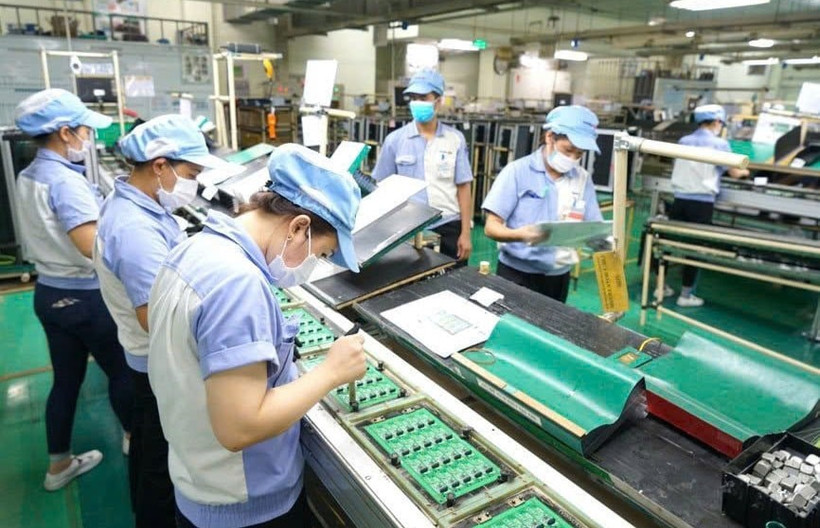
Foreign direct investment (FDI) inflows have remained robust. Since 1986, Hanoi has attracted about 71.7 billion USD in FDI, ranking second nationwide after Ho Chi Minh City. The capital currently hosts more than 7,600 valid FDI projects from 117 countries and territories. During 2021–2025 alone, total registered FDI reached about 11.3 billion USD, with additional capital poured into existing projects accounting for over half of the total—evidence of investors’ long-term confidence, according to Deputy Director of the municipal Department of Finance Le Trung Hieu. Notably, the registered FDI surged to 4.44 billion USD in 2025, more than doubling year-on-year and placing Hanoi third nationwide, a result considered highly positive amid global economic uncertainties.
Infrastructure development has also been prioritised, with key transport projects accelerated, including ring roads, major interchanges, and bridges across the Red River, alongside the operation of urban rail lines such as Cat Linh – Ha Dong and the elevated section of Nhon – Hanoi Station.
These achievements underscore Hanoi’s position as the country’s economic locomotive and a key growth pole for the northern region. Looking ahead, the city has set ambitious targets in the Resolution of its 18th Party Congress for the 2025–2030 term, including annual GRDP growth of 11% or higher and per capita GRDP exceeding 12,000 USD.
To realise these goals, Hanoi is shifting towards a knowledge-based and innovation-driven growth model, underpinned by science, technology, digital transformation, and high-quality human resources. New economic models such as the green, digital, circular, sharing, and night-time economies will be promoted.
A core focus will be building an innovation ecosystem centred on the Hoa Lac Hi-Tech Park, and strengthening links between universities, research institutes, enterprises, and financial institutions. The city also plans to develop digital infrastructure, smart governance, and a digital economy targeting at least 40% of GRDP by 2030.
With comprehensive measures, Hanoi is expected to sustain its leading economic role while emerging as a dynamic regional innovation hub in the near future./.
VNA