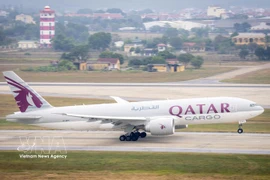
Hanoi (VNA) – The Civil Aviation Authority of Vietnam (CAAV) has issued an update on some active notices to air missions (NOTAMs) in the Middle East conflict zones.
These notices may impact flight operations, air traffic management, and flight planning for airlines, flight crews, and relevant agencies.
According to consolidated data from active NOTAMs in Bahrain, Iran, Qatar, the UAE, Saudi Arabia, Oman, and Jordan, several flight information regions (FIRs) in the region are implementing high-level restrictive measures. These include full or partial FIR closures, transit flight restrictions, air traffic flow management (ATFM), suspension of specific air routes, and requirements for increased fuel reserves and operational risk assessments.
In Bahrain, the Bahrain FIR is closed to all flight operations from 15:35 UTC on March 16 until an estimated 04:00 UTC on March 17. Exceptions apply to pre-approved flights departing from Bahrain International Airport (OBBI) and exiting the region via the NARMI waypoint.
In Iran, the Tehran FIR remains closed until an estimated 08:30 UTC on March 22. All flight operations are suspended, except for medical, search and rescue, state, military, and pre-authorised flights. Additionally, the Iranian NOTAM warns that the conflict zone could extend to international waters within the Tehran FIR in the Persian Gulf and the Gulf of Oman.
In Qatar, the Doha FIR has implemented two consecutive levels of restrictions. From 14:00 UTC on March 16 to 02:59 UTC on March 17, this FIR is closed, except for pre-authorised state, medical evacuation, and search and rescue aircraft. From 03:00 UTC to 14:00 UTC on March 17, it is closed to transit flights while arrivals and departures are permitted only via LAEEB and DATRI waypoints with prior approval.
In the United Arab Emirates (UAE), the Emirates FIR is enforcing multiple stringent controls, including a partial FIR closure until 12:00 UTC on March 23, arrivals/departures restricted to designated waypoints, and transit flights permitted only westbound via the LUDID waypoint. Traffic flow management is in effect for departures exiting via ULBIS, TANSU, and PEKEM waypoints, while air routes M318, M550, and L710 are temporarily closed or restricted. Furthermore, all foreign operators must conduct risk assessments and obtain a "No Objection" notice from the UAE General Civil Aviation Authority (GCAA) before operating, with the exception of private, medical evacuation, and state flights.
In Saudi Arabia, the Jeddah FIR has implemented contingency measures, rendering all air routes within specified coordinates unavailable until 23:59 UTC on March 24. Aircraft arriving or operating within the FIR are advised to carry sufficient fuel for potential holding or diversions.
In Oman, the Muscat FIR is maintaining alternative routing for traffic from the UAE via the TARDI and MIDGU waypoints, with potential flow management and air traffic control clearance requirements. Additionally, a temporary restricted area has been established in the Suhar region from ground level to FL150, effective until the end of March 31.
In Jordan, flights to Jordanian airports may face operational delays until 06:00 UTC on March 18. Aircraft are advised to carry additional contingency fuel.
In light of these developments, the CAAV recommends that airlines, air navigation service providers, and relevant units closely monitor regional NOTAMs. Stakeholders are urged to proactively review operational plans, select appropriate alternative routes, enhance safety risk assessments, and ensure regulatory fuel reserves are met to minimise the impact on international flights arriving, departing, or transiting the region./.
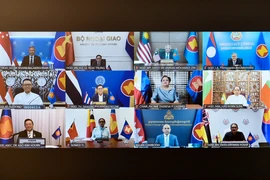
Vietnamese embassies in Middle East ready to assist ASEAN citizens: FM
Foreign Minister Le Hoai Trung stressed that ASEAN members should prioritise maintaining energy supplies for one another, particularly oil and gas, and make effective use of cooperation agreements with partners, including Gulf Cooperation Council (GCC) countries, to diversify energy sources.