HCM City embraces digital technologies to curb IUU fishing

Across the city’s coastal communities, local authorities are adopting specialised digital applications to manage fishing vessels, monitor catch data, and support traceability efforts.

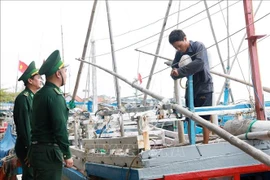
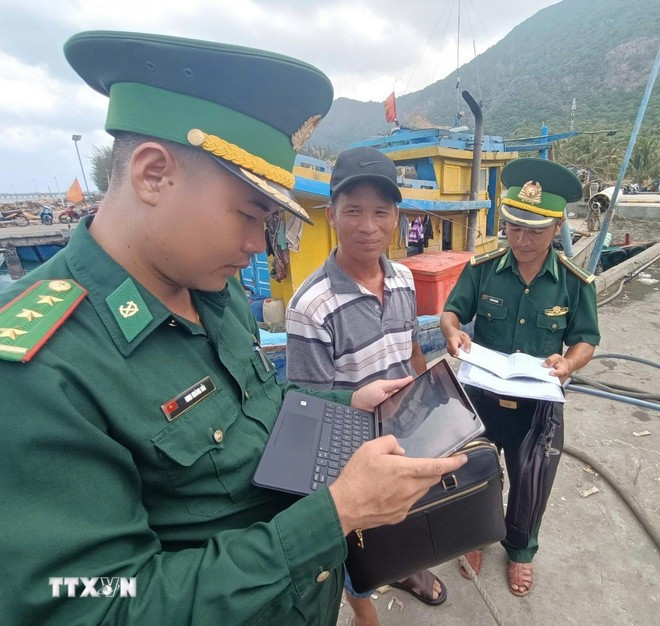
An officer of Con Dao Border Guard Station checks documents and status of fishing vessels on the national database at Ben Dam port, Con Dao special zone. (Photo: VNA)

HCM (VNA) – As Vietnam intensifies efforts to have the European Commission's (EC) "yellow card" warning against Vietnamese seafood exports for illegal, unreported, and unregulated (IUU) fishing lifted, Ho Chi Minh City is making strides in applying digital technologies to improve fisheries management and transparency.

Across the city’s coastal communities, local authorities are adopting specialised digital applications to manage fishing vessels, monitor catch data, and support traceability efforts.

These tools not only streamline administrative procedures but also help fishermen comply with national regulations and EC recommendations.

In Long Hai commune – part of former Ba Ria-Vung Tau province – vessel owners are now equipped with apps that allow real-time tracking of their boats and digital submission of catch logs.

Nguyen Van Quang, a local boat owner, shared that after a weather-related disruption disabled his vessel’s monitoring device, he received hands-on guidance from local officials on how to install and use a mobile app to restore connection and report the incident digitally.

“Once I got used to it, everything became more convenient. I can now monitor and declare my fishing activities without visiting the commune office,” Quang said.

Zalo groups have also been created to connect boat owners, captains, and authorities, serving as a rapid information channel to share updates on fishing regulations, report violations, and offer assistance in case of emergencies at sea.

These groups now include representatives from the city's Fisheries Sub-Department, Border Defence Forces, and local police, strengthening coordination and transparency.

Fishermen also use advanced tools such as electronic fishing diaries and violation reporting apps. Despite initial challenges for older or less tech-savvy fishermen, local authorities have provided thorough, step-by-step training. “Now I can report from home or at sea using my phone,” said fisherman Le Minh Nhat from Phuoc Hai commune.

According to the Ho Chi Minh City Department of Agriculture and Rural Development, key digital platforms such as the national eCDT (Electronic Catch Documentation and Traceability) system are now fully implemented across the city’s fishing ports. Data is updated daily and synced with Vietnam’s national fisheries database, aligning with EC recommendations for IUU fishing prevention.

At Cat Lo Port in Phuoc Thang ward, 100% of offshore vessel owners now use the eCDT system which also facilitates export certification and streamlines customs clearance for EU markets.

“This digital tool allows us to record every catch, making everything transparent,” Tran Van An, an offshore fisherman said, adding that it saves time as data is updated to the system, so fishing crew don’t need to report when they return a port.

Huynh Van Minh, another fisherman from Phuoc Hai commune, echoed the benefits: “It’s much easier now. No more paperwork. Everything from catch volume to species and buyers is declared through the app.”

By promoting digital transformation in fisheries, HCM City is contributing to nationwide efforts to improve transparency, protect marine resources, and regain the trust of international partners, especially the European Union./.

VNA

See more

A biotechnology laboratory of the International University at Vietnam National University-Ho Chi Minh City. (Photo: VNA)

Resolution 57: Role of intellectuals in advancing science and technology research

Prof. Dr. Tran Dai Lam, Director of the Institute of Materials Science at the Vietnam Academy of Science and Technology (VAST), emphasised that intellectuals should nurture national responsibility and ambition, be ready to take on challenges, evaluate research outcomes by international standards, and engage in collaboration across different sectors.

Professor Vu Minh Khuong, of the Lee Kuan Yew School of Public Policy (right), talks to a Vietnam News Agency correspondent in Singapore. (Photo: VNA)

Resolution 57 - catalyst for scientific and technological breakthroughs

The resolution also seeks to create stronger mechanisms to mobilise social and private resources and support an innovation ecosystem; link digital transformation in the public sector with the modernisation of national governance; and prioritise the development of elite human resources and internationally-standard research infrastructure.

Workers produce electronic components (Photo: VNA)

Science, technology drive Vietnam’s rising global profile: expert

Assoc. Prof. Le Duc Anh from Tokyo University held that for fast and sustainable development, Vietnam should prioritise science – technology and innovation as the main driver of productivity, focusing on sectors with high spillover effects such as semiconductors, AI, data, new energy and materials, biomedical technology, automation – robotics, and cybersecurity.

An overview of the workshop. (Photo: nafosted.gov.vn)

National portal expected to transform innovation into reality

The portal, which can be accessed at sangkien.gov.vn, was built to address the urgent need to mobilise collective intelligence and unlock the creativity of the entire population, in accordance with the directives of the steering committee for the implementation of the Politburo’s Resolution No. 57-NQ/TW on creating breakthroughs in science, technology, innovation and national digital transformation.

Sucker-mouthed minnow (Supradiscus varidiscus). (Photo: researchgate.net)

Vietnamese fish, bee named among 70 species newly identified in 2025

One of the most notable “hidden” finds is a small sucker-mouthed minnow endemic to Vietnam’s highlands, discovered in the Lo River. Scientifically named Supradiscus varidiscus, the specimen was collected and shelved some 25 years ago but has only now been studied and formally described.

The Ministry of Science and Technology launches a centralised one-stop-shop unit on December 19. (Photo: VNA)

Vietnam pushes sci-tech, innovation as growth drivers under Resolution 57

The Ministry of Science and Technology (MoST) bears the responsibility of “paving the way”, guided by a consistent spirit of transitioning from a management-oriented mindset to a facilitative one, from “input-based management” to “output-based evaluation”, and from fragmented investment to a focused approach centred on strategic technologies.

Prime Minister Pham Minh Chinh visits a display of science and technology development, innovation and digital transformation. (Photo: VNA)

Gov't leader requests greater efforts to step up development of sci-tech, innovation

Emphasising three strategic digital breakthroughs - digital institutions, digital infrastructure and digital human resources - PM Chinh called for close integration of science and technology development, innovation, administrative reforms, digital transformation and Project 06 with efforts to streamline the organisational apparatus and modernise leadership, management and working styles.

Doctors from Cho Ray Hospital (Ho Chi Minh City) and Vinh Long General Hospital (Vinh Long province) test the operation of a linear accelerator radiotherapy system for cancer treatment (Photo: VNA)

Vietnam sets orientations for applying nuclear energy across sectors

The plan aims to ensure the effective implementation of Decision No. 245/QD-TTg dated February 5, 2025, which approved the national master plan, while concretising objectives, orientations, solutions and resources for applying radiation and radioisotopes across sectors. It also assigns responsibilities to ministries, sectors and localities, and sets roadmaps and priorities for key programmes and projects.