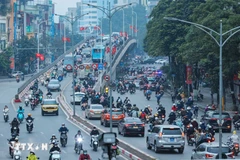
A tree fell recently in HCM City’s Tan Binh district after a heavy rain (Photo: VNA)
 HCM City (VNS/VNA) - Ho Chi Minh City plans to conduct research and identify trees resilient tonatural disasters and suited to the local soil.
The city will then compile a list of various kinds of trees to be plantedacross the city in the near future.
The process of selecting trees requires extensive research and a pilot scheme,according to the city's administration.
In recent years, the city has piloted planting many species of trees, but somespecies have not been strong enough to withstand heavy rains or strong winds,and have been hit by disease.
The city has also asked the Ministry of Construction to identify the mostsuitable trees for the city.
The selected trees must also conform to urban planning standards andregulations.
HCM City has thousands of century-old trees that pose management as well assafety challenges, according to experts.
More than 158,200 trees belong to 180 species, including more than 6,760 treesthat are 150 years old, according to the city authorities.
However, infrastructure development and construction of high-rise buildingshave affected the growth of tree roots.
Groundwater depletion and pollution are also major factors affecting tree rootsand branches.
Many of the city’s trees are unsuited for urban areas and have fallen overduring bad weather.
The city’s sidewalks constantly need to be repaired in the city, especiallybecause of motorbikes illegally travelling on them, and frequent undergroundwork.
Sudden rainstorms, flooding, high tides and other effects of climate changehave all causes damages to the trees.
Many trees in the city have also been torn down for infrastructure work andconstruction of new buildings and skyscrapers.
Besides their beauty, trees have important functions to absorb rainwater,prevent flooding, and conserve groundwater.
Tree canopies are becoming critical in the city as temperatures rise as aresult of global warming, experts have said.
The Department of Transport has worked with the Department of Science andTechnology for more than a decade to draft a master plan on creating a treecanopy in the city, but it has never been completed.
During the rainy season in HCM City, which usually starts in May and ends inNovember, many trees are affected.
The three main types of trees planted on city streets include phuong(flamboyant or royal poinciana), xa cu (African mahogany) and me tey (Albiziasaman).
Nguyen Khac Dung, head of Green Tree and Park Company, said that many treeswere infected with disease and their roots were not planted deep into theground.
During the past two years, abnormal weather conditions and other adverseconditions have caused many trees to fall or be uprooted, particularly duringheavy rains, causing damage to people and property.
According to the municipal People’s Committee, in 2017 and 2018 about 1,260 treesfell and nearly 2,000 trees had branches broken, killing one and injuring 17,as well as damaging dozens of cars, motorbikes and people’s houses./.
VNA