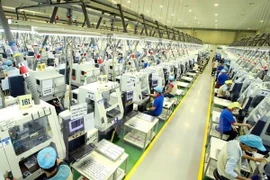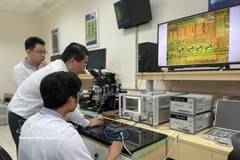
Hanoi (VNA) - For Vietnam to thrive in the new era, safe and stable policies alone are not enough, the country needs strategic and revolutionary decisions to create breakthroughs in science and technology development. This means shifting the focus of innovation onto businesses, rather than relying on or waiting for the State.
According to the Politburo’s Resolution No. 57-NQ/TW, dated December 22, 2024, on making breakthroughs in the development of science, technology, innovation, and national digital transformation, this is considered a decisive factor in the development of nations. It is seen as a prerequisite and the best opportunity for Vietnam to become prosperous and powerful in the new era of the nation’s rise.
This resolution outlines the guiding viewpoint of the Politburo: The development of science, technology, innovation, and national digital transformation is a profound and comprehensive revolution that must be implemented resolutely, persistently, concertedly, consistently, and over a long term with breakthrough solutions.
The people and businesses are the centre, the key actors, the main resources, and driving forces. Scientists are the pivotal factor. The State plays a leading role — guiding, promoting, and creating the most favourable conditions for the development of science, technology, innovation, and national digital transformation.
Thus, both Resolution No. 57 and the Politburo's Resolution No. 68-NQ/TW, dated May 4, 2025, on the development of the private economic sector reflect a bold and breakthrough mindset.
While Resolution No. 68 identifies the private economic sector as one of the most important driving forces of the national economy, Resolution No. 57 affirms that businesses are at the centre of innovation.
However, the Politburo assesses that the pace and breakthroughs in the development of science, technology, innovation, and national digital transformation remain slow, while the scale, capacity, and level still lag far behind that of developed countries. Research and application in science, technology, and innovation have yet to achieve significant breakthroughs, and the country has not yet mastered strategic or core technologies.
Not only does Resolution No. 57 present a bold guiding perspective, but it also sets out breakthrough targets. Accordingly, by 2030, Vietnam aims to achieve an advanced level of capacity and development in science, technology, and innovation across many key sectors, ranking among the leading countries in the upper middle-income group. The technological capability and innovation capacity of Vietnamese enterprises are expected to reach above the global average, and several fields of science and technology will attain international standards.
Vietnam is set to rank among the top three Southeast Asian countries and among the top 50 countries globally in digital competitiveness and e-government development index. It also aims to enter the top three in Southeast Asia for artificial intelligence (AI) research and development and become a development hub for certain digital technology industries where Vietnam has competitive advantages.
The contribution of total factor productivity (TFP) to its economic growth is projected to exceed 55%. The export share of high-tech products is to account for at least 50% of the total export value. The digital economy is targeted to make up at least 30% of GDP. The use of online public services by citizens and businesses is expected to surpass 80%, and cashless transactions should reach 80%. Over 40% of businesses will engage in innovation activities.
A new and daring solution to encourage businesses to focus on innovation is the adoption of an open and creative approach that allows the pilot implementation to address newly emerging issues, the acceptance of risks and venture investment, and delays in scientific research and technological development.
Vietnam will carry out pilot mechanisms that allow enterprises to test new technologies under the State's supervision. There will be policies offering liability exemptions for businesses, organisations, and individuals in cases where economic losses are resulted from objective factors during the trial of new technologies or business models. The country will also establish venture capital funds to support innovative startups, technology incubation, and digital transformation.
Macro-level mechanisms will be accompanied by specific policies. These include highly practical incentives and support, especially for small- and medium-sized enterprises (SMEs), to invest in digital transformation, research, application of science, technology, and innovation to enhance business efficiency and corporate governance. There will be efforts to accelerate knowledge transfer and workforce training in these fields through foreign direct investment (FDI) enterprises, as well as support for domestic technology companies to invest abroad.
Vietnam will issue robust policies to encourage entrepreneurship in science, technology, innovation, and digital transformation, including mechanisms and policies to support the establishment and development of large-scale digital technology enterprises, aimed at developing digital infrastructure, leading national digital transformation, and enhancing international competitiveness.
In addition to incentives related to human resources, financial and non-financial support, experts also emphasise the importance of building culture and mindset of innovation within businesses.

Accordingly, the Government is advised to design and implement programmes and campaigns to raise awareness and foster habits and understanding of the importance of innovation among both people and businesses. For example, the Government could develop a set of comprehensive, sustainable evaluation indicators to encourage corporate innovation, as well as establish mechanisms to multiply and share successful innovation models and experiences.
For their part, businesses must overcome resistance to change within organisational culture. They need to foster internal motivation, encourage creativity, and build a flexible environment that can adapt to market fluctuations. They should be unafraid to experiment, ready to take risks, and willing to learn from failure.
Science, technology, and innovation are expected to contribute 4–5% to Vietnam’s annual GDP growth, of which innovation alone will account for up to 3%, while science and technology will contribute around 1%. This highlights the crucial role of innovation in the modern economy, thereby indirectly affirming the key position of businesses in driving the country’s GDP growth.
In line with the spirit of Resolution No. 57, a draft Law on Science, Technology, and Innovation, which is currently developed, includes a dedicated chapter on policies to promote research, development, and innovation activities within enterprises.
Under this draft law, Vietnamese businesses are empowered and strongly encouraged to invest in R&D — not only using their own resources but also receiving support from the state budget through financial policies.
While these favourable conditions are being created, globalisation also presents significant challenges for Vietnamese enterprises as they must compete with foreign companies. In this context, innovation is regarded as a critically important driving force for the development of domestic businesses./.