Hanoi (VNS/VNA) - Data collected from 10,000 farmers not only provides a comprehensive picture of current rice farming practices, but also serves as a critical foundation for developing context-specific recommendations tailored to each locality and crop season, according to findings from the International Rice Research Institute (IRRI).
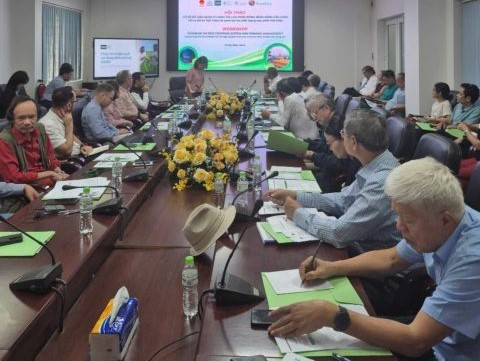
The IRRI’s senior expert and Head of Mechanisation and Post-Harvest Dr Nguyen Van Hung spoke about emissions reduction and rice farming at a seminar titled 'Database on the rice cropping system and farming management in the Mekong Delta – supporting the One Million Hectares of High-Quality, Low-Emission Rice Programme', which took place in Hanoi on May 13.
“From this data, we can propose effective investment strategies for the One Million Hectares Programme and devise technical solutions aligned with the actual conditions of the value chain including land, water, infrastructure, mechanisation, services and markets in a region-specific, specialised manner,” Hung said.
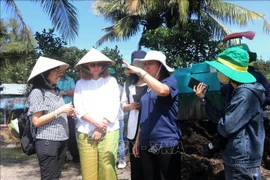
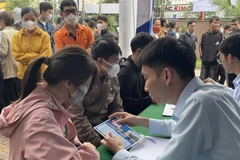
At the seminar held by the Department of Crop Production and Plant Protection, leading domestic and international scientists exchanged views on how to use data gathered from the research project that surveyed 10,000 rice farmers across twelve Mekong Delta provinces between 2022 and 2024 – the largest household-level investigation that IRRI has conducted in 30 years.
The IRRI representative Dr Jongsoo Shin told seminar attendees that this 10,000-household survey has provided incredibly valuable insights into rice cultivation practices in the Mekong Delta.
"Through this workshop, we hope to share our findings and encourage multi-stakeholder participation in realising the goals of Vietnam’s One Million Hectares Programme," he said.
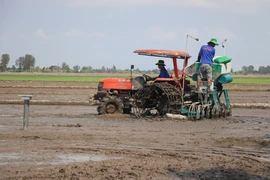
The expert team from IRRI identified a wide range of data correlations across interventions such as mechanisation, fertiliser management, straw collection, alternate wetting and drying, and more.
In terms of rice cultivation, the research team proposed several emissions reduction scenarios.
Their analyses found that extending straw incorporation into soil to 30 days in Tra Vinh province, collecting straw in Dong Thap province and avoiding straw burning in Kien Giang province were among the most effective measures for cutting emissions.
However, the data still requires further in-depth analysis and validation with real-world production practices to accurately assess emissions reduction potential by region.
The IRRI intends to integrate this dataset into a compatibility map for irrigation, straw management and other farming activities across the Mekong Delta.
Initial findings have revealed the importance of behavioural, production and economic factors, as well as mechanisation efficiency, fertiliser use effectiveness, greenhouse gas emissions and cost-benefit outcomes.
Regarding fertiliser use, most farmers apply chemical fertilisers more than four times per crop – significantly exceeding optimal recommendations. Overuse of nitrogen fertiliser degrades soil quality and leads to water contamination.
Additionally, the survey found a correlation between seed use and nitrogen application: reducing seed density increases nitrogen use efficiency. This is because when rice clumps are spaced out, individual plants compete less for nutrients.
Experts identified that seed density, the number of fertiliser applications and water submergence duration before planting are key factors affecting nitrogen use efficiency. In-depth analysis of fertiliser efficiency and its drivers will serve as a basis for formulating strategies to reduce input and boost output in rice production.
This would, in turn, inform effective investment strategies for the One Million Hectares Programme and facilitate technical solutions aligned with local conditions across the rice value chain – from land and water to infrastructure, mechanisation, services and markets.
Dr Cao Duc Phat, chairman of the IRRI Board of Trustees, praised the household survey conducted by the scientific team.
“It has been more than 30 years since we have seen such a broad and in-depth survey. This dataset is a true goldmine for research,” he said.
“We should seek resources to implement similar efforts for other rice-producing regions in Vietnam,” Phat added, highlighting the potential of the dataset to inform policymaking, smart production systems and rice extension efforts.
IRRI leadership also recommended that the research team establish a mechanism for sharing this data with both domestic and international research institutions. Such a mechanism would help maximise the dataset’s value in promoting the sustainable transition of farming in the Mekong Delta.
The seminar also witnessed the signing of a Memorandum of Understanding between the Vietnam Food Association, the Vietnam Soil Science Association and the Vietnam Fertiliser Association. The event signalled a strong commitment to cooperation among these organisations to promote sustainable rice production in the Mekong Delta.
Bui Ba Bong, representing the Vietnam Food Association, said: “The development of a comprehensive database on rice farming in the Mekong Delta is a vital foundation for the sustainable and environmentally friendly growth of the rice sector. We believe that with strong cooperation among stakeholders, the One Million Hectares Programme will achieve its targets and enhance the value and reputation of Vietnamese rice in the international market.”
The seminar marked a significant step forward in building a robust data system for rice cultivation in the Mekong Delta.
The data and analysis presented at the seminar not only offer an overall picture of the current production landscape, but also inform region- and season-specific technical guidance.
The findings from the survey are expected to be translated into actionable farming guidelines and policy recommendations to support farmers in adopting sustainable practices – ultimately helping to realise the goals of the One Million Hectares Programme./.
VNA