Thailand’s exports benefit from growing use of FTA privileges

Thailand’s use of export privileges under free trade agreements (FTAs) continued to expand in April 2026, with shipments claiming preferential treatment valued at 31.77 billion USD, said the Thai Ministry of Commerce as cited by The Nation.

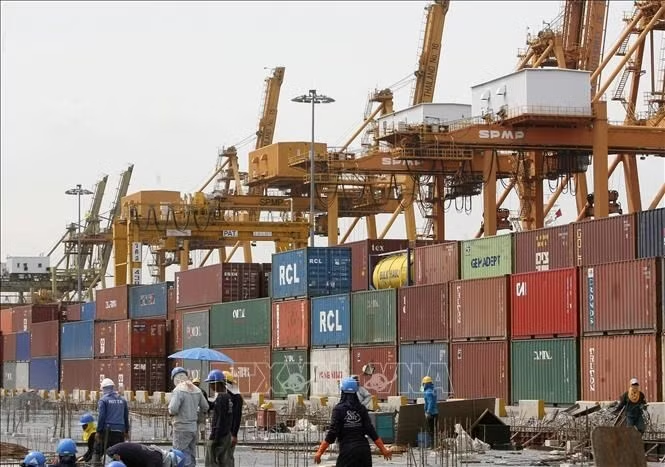
Cargo handling at a port in Bangkok, Thailand. (Photo: VNA)

Bangkok (VNA) – Thailand’s use of export privileges under free trade agreements (FTAs) continued to expand in April 2026, with shipments claiming preferential treatment valued at 31.77 billion USD, said the Thai Ministry of Commerce as cited by The Nation.

The figure represented a 10.19% increase from a year earlier and accounted for 81.41% of the total value of exports eligible for preferential treatment.

Arada Fuangtong, Director-General of the Department of Foreign Trade under the Ministry of Commerce, said the figures underscored the role of FTAs in helping Thai exporters cut costs, enter new markets and strengthen their competitiveness in global trade.

The Association of Southeast Asian Nations (ASEAN), China and India remained the leading destinations, while motor vehicles and fresh durian were among the products making the greatest use of preferential tariffs.

The five agreements recording the highest export values under FTA privileges were the ASEAN Trade in Goods Agreement (ATIGA), at 10.62 billion USD; the ASEAN-China Free Trade Area (ACFTA), 8.51 billion USD; the ASEAN-India Free Trade Area (AIFTA), 5.01 billion USD; the Japan-Thailand Economic Partnership Agreement (JTEPA), 2.39 billion USD; and the Thailand-Australia Free Trade Agreement (TAFTA), 1.98 billion USD.

The five product categories with the highest use of FTA privileges in April were motor vehicles for transporting goods; fresh durian; jewellery and other articles made from other precious metals; goldware, silverware and related precious-metal components; and synthetic rubber mixed with natural rubber.

Arada said Thai small and medium-sized enterprises (SMEs) were being encouraged to expand into FTA markets. The Department of Foreign Trade will continue holding workshops nationwide to help businesses make better use of trade preferences.

The programmes are designed to improve companies’ understanding of FTAs, rules of origin and procedures for claiming preferential tariffs, while helping them identify new business opportunities overseas.

In fiscal year 2026, the department provided training and business development support to more than 1,400 entrepreneurs, with a particular focus on SMEs.

Its latest workshop, titled “FTA GO! Driving Trade and Strengthening Thai Entrepreneurs,” was held in Chonburi province on July 6-7. It provided detailed guidance on FTA privileges and compliance with rules of origin while supporting businesses through a programme aimed at helping SMEs enter FTA markets.

The initiative targets three high-potential markets, including Switzerland, Norway and India which are considered strategic export destinations where Thai companies can leverage existing FTAs to expand sales and increase export value./.


VNA

See more

Foreign tourists take part in the Songkran Festival in Chiang Mai, Thailand, on April 13, 2026. (Photo: Xinhua/VNA)

Thailand welcomes 17.36 million foreign visitors

Minister of Tourism and Sports Surasak Phancharoenworakul said China was the largest source market, with 2.86 million visitors, followed by Malaysia with 2.25 million, India with 1.31 million, Russia with 1.06 million and the Republic of Korea with 631,777.

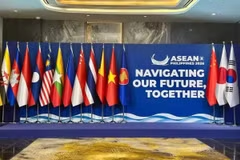
Ambassador highlights Philippines' priorities for ASEAN Chairmanship

Ambassador highlights Philippines' priorities for ASEAN Chairmanship

Speaking ahead of Indian Minister of External Affairs S. Jaishankar's visit to Manila for the ASEAN Foreign Ministers' Meeting and related meetings, Philippine Ambassador to India Josel F. Ignacio praised India for its role in advancing ASEAN's goals and its consistent support for the bloc's unity and centrality in the regional architecture.

Indonesia bets on AI to drive 600-billion-USD digital economy

Indonesia bets on AI to drive 600-billion-USD digital economy

AI has the potential to generate around 400 billion USD in value for Indonesia’s economy by 2030 under a business-as-usual scenario. If implemented alongside the regional digital economy framework, that figure could climb to 2 trillion USD, an official has said.

Malaysian Prime Minister Anwar Ibrahim (second from left) presents the highest award at the event (Photo: Malaysian Prime Minister's Office)

Malaysia highlights importance of ethical journalism in AI era

Malaysian Prime Minister Anwar Ibrahim highlighted the importance of ethnical journalism in artificial intelligence (AI) era while addressing the Malaysia Journalism Night 2026 and the MPI-PETRONAS Malaysian Journalism Awards 2025 held in Kuala Lumpur on July 17.

Heads of ASEAN diplomatic missions in Mexico pose for a group photo. (Photo: VNA published)

ASEAN at 59: Growing role and global standing

Thai Ambassador to Mexico Rooge Thammongkol, rotating Chair of the ASEAN Committee in Mexico City (ACMC) for July-December, said ASEAN has grown into one of the world’s most successful regional organisations and plays a central role in promoting peace, stability and cooperation in the Asia-Pacific region.

New Singapore-Malaysia rail link expected to boost cross-border spending

New Singapore-Malaysia rail link expected to boost cross-border spending

Singaporean consumers are expected to spend an additional 1.05 billion SGD (about 810 million USD) annually in Johor Bahru, Malaysia's southernmost city bordering Singapore, according to a study conducted jointly by the Singapore Business Federation (SBF), the Restaurant Association of Singapore, and the Singapore Retailers Association.

Indonesia restarts research reactor after nearly 14 years

Indonesia restarts research reactor after nearly 14 years

Under its national energy development plan, Indonesia aims to commission its first nuclear power plants with a combined capacity of about 500 MW in the early 2030s, before expanding nuclear generation to 7-8 GW in the 2040s and 35-37 GW by the 2060s to diversify energy supplies and meet growing electricity demand.