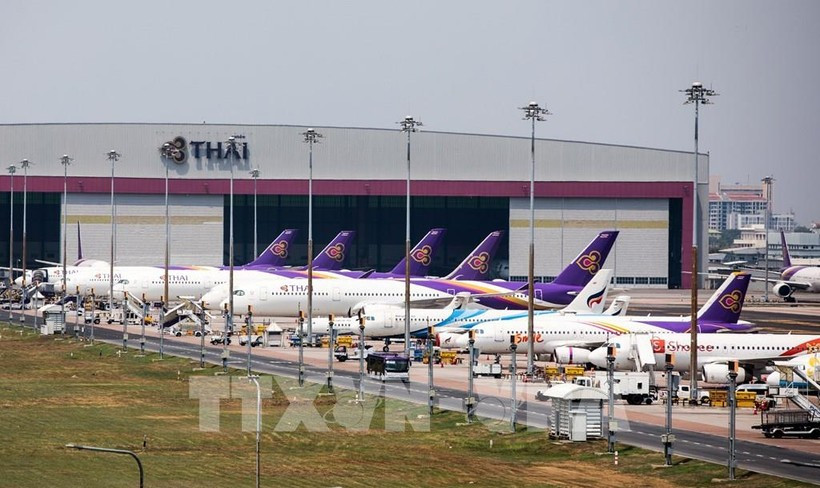
Bangkok (VNA) - Airports of Thailand (AOT), the company managing Thailand’s chain of international airports, has reported robust growth in the first nine months of the fiscal year, with flights up 9.79% and passenger volume up 7.87%, generating a net profit of 14.26 billion THB (440 million USD).
The company is expanding its network by adding seven new airlines and 11 new routes in the upcoming winter schedule, supported by a discount incentive programme to attract new services.
AOT is pursuing a long-term strategy to diversify income by developing land around airports for non-aeronautical purposes, aiming to reach a capacity of 240 million passengers per year by 2032.
According to Acting President Paweena Jariyathitipong, the six airports managed by AOT handled 602,195 flights from October 2024 to June 2025, up 9.79% from the same period last year. Passenger numbers also rose 7.87% to 97.24 million. This growth generated total revenue of 52.32 billion THB and a net profit of 14.26 billion THB.
This upward trend is expected to continue, with the upcoming winter flight schedule from October 2025 to March 2026, introducing seven new airlines to Thailand, including United Airlines, Centrum Air, Air France, Etihad Airways, T’way, Loong Air, and Scoot.
In addition, 11 new routes will be launched, connecting major airports and regional hubs, including United Airlines from Los Angeles to Suvarnabhumi Airport; Thai AirAsia X from Riyadh to Don Mueang Airport; Thai AirAsia from Busan to Don Mueang Airport; Air France from Paris to Phuket Airport; Hainan Airlines: Haikou to Phuket Airport.
To support this expansion, AOT has extended its Incentive Programme for another three years, offering a 50% discount on aeronautical fees for airlines opening new routes.
The company has also established a Marketing Fund to attract international flights to regional airports. This fund offers 300 THB per international passenger to airlines operating new international routes to Hat Yai and Mae Fah Luang–Chiang Rai airports, aiming to spread economic opportunities to regional areas.
In a move to diversify income sources, AOT is focusing on increasing non-aeronautical revenue. Plans include developing prime land around airports into hotels, logistics centres, private jet terminals, and electric vehicle charging stations. These initiatives are part of AOT’s long-term strategy to expand capacity to 240 million passengers annually by 2032 and strengthen its position as a regional aviation hub./.