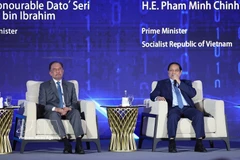
Hanoi (VNA) – The Poliburo’s Resolution 68-NQ/TW on private sector development features policies supporting micro- and small-sized enterprises and household businesses in digital transformation, a right move to help them adapt more quickly to this global trend, heard the Vietnam - Asia DX Summit 2025.
Under the resolution, the enterprises and household businesses will be provided with digital transformation tools free of charge such as shared accounting software, digital platforms, legal consulting services, and training in management, accounting, tax, and human resources.
Discussing at the event, organised by the Vietnam Software and Information Technology Services Association (VINASA) on May 27–28, participants said that this is a right policy that will help to reduce input costs, improve management capacity, and ensure legal compliance for small and household businesses.
Vietnam currently has about 1 million enterprises and more than 5 million household businesses. In Resolution 68, the country aims to have 2 million enterprises by 2030. Therefore, it is necessary to create conditions for business households to increase their scale and transform into enterprises.
Can Van Luc, a member of the Prime Minister's Policy Advisory Council, emphasised that Resolution 68 is considered a turning point in the development mindset as it not only affirms the key position and role of the private sector but also pledges to improve institution frameworks, remove barriers, and create conditions for this sector to make breakthroughs. Under the resolution, business households are encouraged to grow into enterprises through tax exemption and the provision of accounting and business management software, among others.
To realise this goal, Luc said it is necessary to classify small enterprises and business households into groups with appropriate support mechanisms.
Some businesses only need simple accounting software that is suitable for people who are not specialised in accounting or technology, so that they can easily enter data related to revenue, expenses, and goods. While some need training programmes to raise awareness and build digital transformation plans, others want mechanism and policy-related hurdles to be tackled, he pointed out.
Regarding a free shared software for small companies and business households, many participants perceived that comprehensive research and consideration is needed.
Nguyen Xuan Hoang, Vice Chairman of the Board of Directors of the MISA Joint Stock Company, said that during the process of digital transformation, Vietnam has built several shared models but they all failed. The reason is that when building shared software, state agencies organised bidding and selected a number of businesses to create those products and then provide them for free, which unintentionally created a monopoly.
Hoang analysed that the dependence on a few suppliers poses many risks, including data loss, poor service quality and high conversion costs when errors occur.
Using free software may also reduce businesses' motivation to proactively learn and exploit the features to the fullest because they lack initial financial investment and may use the software reluctantly.
Nguyen Viet Duc, CEO of the UNICA Solutions Joint Stock Company, said that small- and medium-sized enterprises need different software as they have very different usage and habits. Therefore, it is difficult to share a single software.
Hoang proposed that state agencies develop technical standards and provide direct financial support to end users. They can support small companies and business households through many other forms such as tax deductions to help them proactively choose suitable software, reduce cost burdens, and optimise digital transformation benefits.
Authorities should also issue preferential policies for domestic technology enterprises to develop innovative solutions that meet technical standards and diverse needs of small firms and business households./.
See more
Startup Flight 2025 boosts Vietnam–India tech, startup cooperation
Innovation and science–technology serve as key pillars to achieving the development goals of both Vietnam and India, while startup acts as a vital bridge to deepen ecosystem linkages and open future industries.
Da Nang invests over 200 billion VND in semiconductor chip design, AI development
With a vision to become an innovation and high-tech hub of central Vietnam, Da Nang has issued several key resolutions and policies to foster human resources, infrastructure and enterprises in the AI and semiconductor sectors.
Vietnam, India boost innovation cooperation
Bui Trung Thuong, Trade Counsellor at the Vietnamese Embassy in India, highlighted the shift in Vietnam–India relations from traditional cooperation to partnerships based on innovation, technology, and digital transformation.
Vietnam emerges as new hotspot for AI data centre investment
A wave of investment in artificial intelligence (AI) data centres is sweeping across Vietnam, with both domestic and international corporations announcing multi-billion-USD projects that are set to transform the country into a rising hub in the regional AI infrastructure map.
PM directs acceleration of scientific-technological development, digital transformation
The rate of end-to-end online public services has reached only 39.98%, far below this year's target of 80%. Data quality across national and sectoral databases remains inconsistent, complicating information sharing and reuse. Cybersecurity and incident response capacity also remain inadequate.
Experts propose anti-scam solutions suited to Vietnam’s conditions
Vietnam’s digital transformation has achieved remarkable progress. However, similar to other countries in the region, online scams and fraud cases are on the rise. Last year, authorities recorded 10,000 online fraud cases, with estimated losses of nearly 759 million USD.
A Generation coded with the AI-First gene
Maya - a virtual HR assistant developed by FPT - sends over 20,000 appointment reminders, answers queries, and compiles feedback within just a few hours.
Lawmakers call for post-implementation review in technology transfer
Lawmakers highlighted the need to introduce a post-implementation review mechanism to enhance transparency and prevent abuse in technology valuation and transfer.
Vietnam looks to develop, master digital technology through open standards
Vietnam has chosen to pursue this direction — developing open technologies, open-source software, and open data — to enable individuals and enterprises to co-create new values. With this approach, it will become a technology-driven nation that both benefits from and contributes to global knowledge.
Vietnam urged to develop high-quality human resources for digital industry
According to statistics, Vietnam currently has nearly 78,000 digital technology companies with approximately 1.9 million workers in the information technology (IT) sector. However, these firms still face difficulties in recruiting high-quality human resources in the current context.
Vietnam, Taiwan (China) promote cooperation in training semiconductor human resources
The forum focused on sharing experience and strategies for building a skilled semiconductor workforce, updating recruitment trends, and promoting university–industry cooperation to establish a sustainable talent ecosystem for Vietnam’s fast-growing semiconductor sector.
Young scientists, female sci-tech students of 2025 honoured
Ten young scientists under 35 years won the 2025 Golden Globe Science and Technology Award while 20 outstanding female students were honoured with. the 2025 Vietnam Female Students in Science and Technology Award
Vietnam learns UK's sci-tech, innovation, digital transformation experience
At the Catapult Network, the delegation learnt about the sustainable public – private partnership, exemplified by the “one-third funding” structure, in which financing is shared equally among the government, commercial contracts, and collaborative R&D projects.
Dong Nai accelerates shift to tech-driven growth model
Dong Nai aims for the digital economy to account for at least 30% of GRDP by 2030, making it a central driver of the province’s exceptional growth trajectory.
Vietnamese Party chief attends seminar on AI, technology in London
With its aspiration to become a pioneer in digital economy, Vietnam seeks to learn from the UK - the cradle of the Industrial Revolution and the homeland of great minds such as Isaac Newton, John Locke, Adam Smith, Alan Turing, William Shakespeare, and Charles Dickens - to build an innovative, human-centred, and sustainable technological ecosystem.
Minister-level roundtable on AI governance held in Ninh Binh
Nearly 300 delegates representing government agencies, international organisations and leading enterprises convened in Ninh Binh province on October 27 for a ministerial roundtable on artificial intelligence (AI) governance.
Int'l press conference highlights key outcomes of Hanoi Convention signing
As many as 72 countries from around the world signed the United Nations Convention against Cybercrime (also known as Hanoi Convention) at the recent Signing Ceremony and High-Level Conference held in Hanoi on October 25–26.
Int'l press conference highlights key outcomes of Hanoi Convention signing
The Ministry of Public Security and the Ministry of Foreign Affairs jointly held an international press conference to announce the outcomes of the Signing Ceremony and High-Level Conference of the United Nations Convention against Cybercrime (also known as Hanoi Convention) in Hanoi on October 26.
Hanoi Convention: Fostering global cooperation in combating cybercrime
A policy discussion focusing on promoting international cooperation in combating cybercrime, with national approaches to implementing the United Nations Convention against Cybercrime (the Hanoi Convention), took place in Hanoi on October 26 on the sidelines of the convention's signing ceremony.
Ecuador Vice President commends Vietnam’s role in global efforts to combat cybercrime
Vice President of Ecuador Maria Jose Pinto Gonzalez Artigas has hailed Vietnam’s leadership role in the global anti-cybercrime efforts as the Southeast Asian country was selected as the host of the signing ceremony of the United Nations Convention against Cybercrime (Hanoi Convention).