Vietnam – Cambodia trade: Path towards 20 billion USD target

Vietnam and Cambodia are enjoying their most dynamic economic period with bilateral trade exceeding 10 billion USD in 2024. This robust momentum brings the ambitious goal of 20 billion USD in trade by 2030, set by senior leaders of both countries, closer than ever.

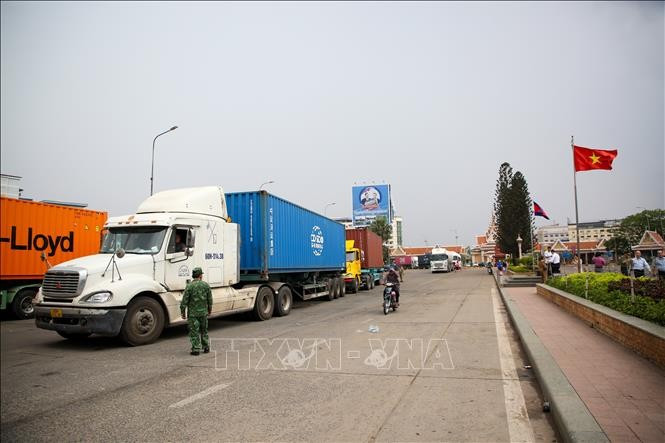
Bustling trade activities along the Vietnam–Cambodia border are contributing to the goal of raising bilateral trade turnover to 20 billion USD. (Photo: VNA)

Tay Ninh (VNA) – With bilateral trade surpassing 10 billion USD in 2024 and continuing robust growth, Vietnam – Cambodia economic relations are enjoying their most dynamic period. The goal of 20 billion USD by 2030, set by the two countries’ senior leaders, is increasingly within reach.

According to Do Viet Phuong, who leads the Vietnam Trade Office in Cambodia, bilateral trade in goods tripled between 2014 and 2024, from 3.3 billion USD to 10.1 billion USD, with an average annual growth rate of about 12%. Growth momentum has continued in 2025, with trade nearly hitting 8 billion USD in the first eight months.

Deputy Minister of Industry and Trade Phan Thi Thang affirmed that Cambodia, a close neighbour with a strategic location, plays the role of a gateway and transit hub in the Mekong subregion. Both countries have built a solid legal framework through key agreements, such as the 2019 memorandum of understanding on border trade infrastructure development and connectivity, the 2024 border trade agreement, and the 2025–2026 action plan to boost bilateral trade.

Cambodian Undersecretary of State for Commerce Tith Rithipol stressed that Cambodia and Vietnam are not only close neighbours but also trusted partners. Cambodia offers Vietnamese businesses attractive opportunities with political stability, a young workforce, a strategic location, and favourable investment incentives, he said.

Experts noted that the two economies are complementary rather than directly competitive. Bui Quang Hung, Deputy Director General of the Vietnam Trade Promotion Agency under the Ministry of Industry and Trade, pointed out that Vietnam has strengths in processed agricultural products, consumer goods, building materials, and machinery, which match Cambodia’s strong import demand.

Bilateral trade is also thriving at the local level. Vice Chairman of the People’s Committee of Tay Ninh province Nguyen Hong Thanh said that trade with Cambodian localities has exceeded 2 billion USD, up 17% year on year. Similarly, Toch Sokhon, Director of the Department of Commerce of Cambodia’s Tbong Khmum province, highlighted diverse exchanges between the two provinces, including bananas, rubber, and cassava from Tbong Khmum, and fresh vegetables and building materials from Tay Ninh, with annual turnover in hundreds of millions of US dollars.

However, challenges remain. According to Hung, underdeveloped transport infrastructure and warehousing at some border gates have increased logistics costs, while differences in technical standards and limited market information hinder long-term strategies. Phuong added that Vietnamese firms in Cambodia face difficulties adapting to different administrative systems, Khmer language barriers, high service costs, and tough competition from Chinese and Thai products.

To overcome these challenges and realise the 20 billion USD target, experts and officials have proposed a comprehensive set of solutions requiring close coordination between both sides.

Deputy Minister Thang called for synchronised investment in border trade infrastructure, logistics, storage facilities, and border markets, alongside accelerating the adoption of smart border gate models to boost exports.

From the Cambodian side, Undersecretary of State Rithipol proposed modernising border trade infrastructure, strengthening cross-border logistics and transport links, and deepening collaboration within regional frameworks such as ASEAN and RCEP. He also invited Vietnamese businesses to invest in Cambodia’s high-value sectors such as modern agriculture, food processing, and digital technology./.

VNA

See more

The upcoming Made-in-Vietnam fair in Hanoi from December 18-22 will feature product display areas, business networking spaces, and food courts. Illustrative photo: VNA)

Vietnam Brand Week to promote e-commerce, Made-in-Vietnam products

Co-organised by the Vietnam E-Commerce and Digital Economy Agency and the Hanoi Department of Industry and Trade, the event series includes a supply-demand connectivity conference to promote the consumption of Vietnamese and local products on e-commerce and digital platforms, alongside a Made-in-Vietnam fair.

Cat Lo Fishing Port in Phuoc Thang ward, Ho Chi Minh City. (Photo: VNA)

HCM City earmarks over 2.54 million USD for fisheries transition

The project targets the conversion of around 6% of the city’s fishing fleet, focusing on nearshore and inshore vessels and part of the offshore trawler fleet, towards fishing methods with lower environmental impact, including hook-and-line, gillnets, purse seines, traps and cages, as well as fisheries logistics services.

LS Eco Energy factory (Photo: Iscns.co.kr)

RoK company expands rare earth metal production in Vietnam

LS Eco Energy, a company specialising in renewable energy and rare earth elements under the Republic of Korea (RoK)'s LS Cable & System, has approved a plan to expand its rare earth metal business in Vietnam, in a bid to seek long-term growth in the strategic materials sector.

Prime Minister Pham Minh Chinh speaks at the fourth meeting of the Central Steering Committee for Housing Policy and Real Estate Market on December 17. (Photo: VNA)

PM calls for stronger efforts to meet housing demand, ensure people's right to housing

PM Chinh noted that the real estate and housing market showed positive changes in 2025. With the engagement of the entire political system and society, Vietnam completed the elimination of temporary and dilapidated housing nationwide with more than 334,000 units, five years ahead of schedule. Nonetheless, continued efforts are needed to ensure no one is left without shelter.

Officers of the Hon Gai port border gate guard station coordinate inspections and handle vessels engaged in illegal fishing activities in Ha Long Bay. (Photo: Quang Ninh Newspaper)

Quang Ninh province strengthens fishing vessel controls

In the coming period, Quang Ninh will continue to implement government and ministerial directives on combating IUU fishing, contributing to efforts to meet the EC’s recommendations and move toward the lifting of the yellow card warning against Vietnam’s seafood exports.

The draft is designed to implement a plan to simplify business regulations for banks, in line with the Government's Resolution No. 66/NQ-CP. (Photo: VNA)

SBV plans to simplify business regulations for banks

Under a draft circular to replace Circular 32/2024/TT-NHNN, now open for public comment, many administrative procedures for establishing and relocating commercial bank branches and transaction offices will be significantly shortened.

Illustrative image (Photo: VNA)

Vietnam consolidates position as one of Asia’s economic bright spots

Next year, Vietnam is expected not only to maintain a high growth rate relative to the region but also to further reinforce its status as one of Asia’s economic bright spots thanks to macroeconomic stability, a dynamic domestic market, and a clear orientation towards attracting strategic investments.

Many vessels have installed additional vessel monitoring systems to ensure uninterrupted information connectivity with shore-based stations during fishing trips. (Photo: VNA)

Decisive moment of fight against IUU fishing violations

Under the close direction of the Prime Minister, coastal localities nationwide, particularly in central Vietnam, are urgently implementing assigned tasks with clear schedules and milestones, delivering tangible weekly progress.