Ho Chi Minh City (VNA) - Credit is flowing increasingly to small and medium-sized enterprises (SMEs) as policymakers seek to support production, trade and economic growth.
But with the economy’s capital needs rising, the test is not just cheaper money. It’s ensuring funds reach the right companies, match their actual needs and fit their business cycles.
Banks ramp up SME lending
Under an August order from the State Bank of Vietnam, commercial banks must develop and announce credit packages targeting growth drivers and SMEs, with VND lending rates at least 1 percentage point below each bank’s average for loans of the same maturity.
Many banks followed with big SME packages, trimming rates by 1-2% percentage points per year.
State-owned Vietcombank, VietinBank and BIDV each rolled out 50 trillion VND (1.91 billion USD) packages with 1 percentage point reductions. Agribank set aside 70 trillion VND for preferential loans to SMEs for production and trade.
Among joint-stock lenders, Nam A Bank allocated 25 trillion VND at rates 1-1.8 percentage point below listed rates, while SHB launched a 45 trillion VND package with cuts of as much as 2 percentage point.
Nguyen Duc Lenh, Deputy Director of the SBV’s Region 2 branch, said access also hinges on cash flow, collateral, financial records and business plans. As a result, some banks are expanding supply chain financing tied to production, inputs and outputs.
Capital needs to reach the right firms
Pham Van Triem, Chairman of the Ho Chi Minh City Association of Small and Medium Enterprises (HCM-SME), said credit access remains a major hurdle for SMEs.
With deposit rates still relatively high, banks’ room to cut lending rates sharply is limited. Lenders must stay efficient and cannot fund at high cost while lending at very low rates.
Meanwhile, production and business costs keep climbing, from labour and machinery to raw materials. For thinly capitalised small firms, rising costs squeeze cash flow and reduce their capacity to absorb new loans.
According to HCM-SME, credit policies should be paired with direct support to ease cost pressures. It backs exempting firms with annual revenue below 10 billion VND from taxes, which would free up resources to sustain and expand operations.
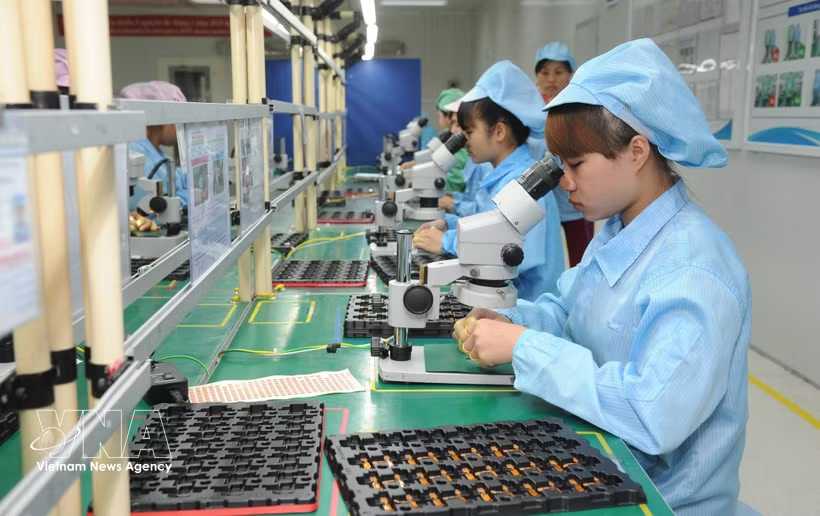
Pham Binh An, Deputy Director of the Ho Chi Minh City Institute for Development Studies, said credit allocation should prioritise production, including contract manufacturing and assembly in Vietnam.
Such activity creates jobs, builds production capacity and underpins capital accumulation, he said. Rate cuts should come with clear prioritisation, funneling more capital into activities that build and expand productive capacity for sustainable growth.
Beyond production, infrastructure should also be prioritised, experts said. The focus should go beyond large projects to systems that directly cut business costs, including roads, seaports and logistics to keep goods moving smoothly.
Lower logistics costs would make Vietnamese products more competitive, helping firms expand markets and lift output, they said./.
See more
Stronger supply chains, transparent origin key to sustainable Vietnam-US trade
Despite fluctuations in trade and tariff policies, Vietnam remains a strategic source for US importers thanks to its diverse production capacity, competitive costs and deeper integration into global supply chains.
Can Tho city aims to expand agricultural and aquaculture trade with Côte d’Ivoire
Can Tho is committed to creating a favourable, safe and transparent environment for Ivorian businesses, investors and partners to explore opportunities for cooperation and investment.
Chinese firms praise Vietnam’s investment environment
Vietnam’s political stability, fast-growing economy, and increasing focus on science and technology, with many policies that promote the sector’s growth, create ideal conditions for Chinese tech firms looking to invest and expand in the country.
New development model expected to unlock resources for Hanoi businesses
For Hanoi, which targets average GRDP growth of at least 11% annually from 2026 to 2030, unlocking resources and improving their allocation will be crucial to enabling businesses, particularly small- and medium-sized enterprises (SMEs), to create more jobs and added value.
SMEs must become solid foundation, steady pipeline for larger enterprises: PM
PM Le Minh Hung said SMEs must nurture greater ambitions and proactively upgrade themselves, advising them to make science and technology, innovation, digital and green transformation, and high-quality human resources key drivers of productivity.
FDI businesses look for deeper administrative reforms
While appreciating the progress, FDI firms said the next stage of reforms should go beyond putting procedures online. They want administrative processes to be simplified on digital platforms, data systems to be better connected, information to be provided only once and regulations to be applied consistently.
Vietnam witnesses surge in Singapore investment inflows
The strong investment flow reflects not only the potential of the Vietnamese market but also the close bilateral relationship, particularly since the two countries upgraded ties to a Comprehensive Strategic Partnership in March 2025.
Vu Lan market sees strong demand for vegetarian offerings, online services
To prepare for the occasion, markets and food shops across Hanoi have increased supplies of fruits, flowers, meat, sticky rice, sweets and vegetarian food for the occasion. Prices of some items have edged up as demand rises, but no shortages have been reported.
Refrence exchange rate up 15 VND on August 25
With the current trading band of +/- 5%, the ceiling rate applicable for commercial banks during the day is 26,896 VND/USD, and the floor rate 24,334 VND/USD.
Mariculture – new growth driver for Vietnam’s ocean economy
Resolution No 20-NQ/TW on building and developing Vietnam into a strong maritime nation identifies marine farming as a new pillar of the marine economy. It targets mariculture production value growing by an average of around 8% annually and accounting for 15% of the total fisheries sector value.
Bac Ninh seeks to attract Chinese investors to high-tech industries
With strengths in technology, manufacturing and new energy, Chinese companies have considerable room to expand investment in Vietnam. Meanwhile, Bac Ninh's strategic location, well-developed infrastructure and dynamic policies make it an attractive destination for Chinese investors.
Vietnam Airlines launches direct flights to Sri Lanka
The new route comes amid a sharp increase in passenger traffic between Vietnam and Sri Lanka, particularly during the first months of 2026.
Vietnam–China economic corridor shifts to integrated cooperation
Officials agreed to strengthen connectivity across the entire corridor and focus on practical projects with clear priorities and concrete results.
Investment for Lao Cai-Hanoi-Hai Phong railway project raised to 11.05 billion USD
The railway was initially approved in February 2025 with an estimated investment of 203.2 trillion VND. The higher figure reflects more detailed calculations at the feasibility study stage, updated construction costs, material prices and compensation and resettlement policies through 2026.
Resolution removes hurdles for APEC 2027 projects in Phu Quoc
The resolution is expected to provide an important legal basis for addressing issues arising during the implementation of projects subject to particularly urgent deadlines, while maintaining strict oversight and accountability.
Seaport profits surge as trade growth supports positive second-half outlook
Profit contributions from joint ventures and associates rose 58%, with Gemalink alone increasing 43%. The improvement provided a clearer indication of core operating performance, while Gemadept also recorded an extraordinary gain of more than 600 billion VND from a divestment move in the second quarter.
Consumer trust key to sustainable e-commerce growth
Management agencies should strengthen coordination and data sharing with digital platforms, preserve electronic evidence and prevent sellers whose accounts have been blocked from quickly resuming business under new identities.
Vietnam fine-tuning Extended Producer Responsibility policy to promote circular economy
Vietnam’s revised EPR framework is therefore expected to build a more comprehensive ecosystem covering collection, transportation, sorting, recycling, data management and supervision, making producers’ responsibilities closely linked to actual recycling outcomes. This will help EPR become a genuine driver of the recycling market and Vietnam’s transition toward the circular economy.
Vietnamese firms urged to join global value chains
Vietnam should develop a strong domestic business force capable of absorbing technology, standards, management practices and market access from major corporations. At the same time, it is necessary to issue policies that encourage FIEs to actively seek, develop and use Vietnamese suppliers.
Reference exchange rate unchanged at week’s beginning
With the current trading band of +/- 5%, the ceiling rate applicable for commercial banks during the day is 26,880 VND/USD, and the floor rate 24,320 VND/USD.