Hanoi (VNA) – Compliance with standards, transparent origin, stronger supply chains and expanded two-way trade are becoming key to more balanced, stable and sustainable Vietnam-US trade in the long term.
Despite fluctuations in trade and tariff policies, Vietnam remains a strategic source for US importers thanks to its diverse production capacity, competitive costs and deeper integration into global supply chains.
Do Ngoc Hung, Trade Counsellor and head of the Vietnam Trade Office in the US, said two-way trade between Vietnam and the US reached about 132.4 billion USD in the first six months of 2026, making Vietnam one of the US’s major trading partners.
However, he noted that global supply diversification does not mean orders automatically shift to Vietnam. To win customers, businesses need to build capacity, improve quality, adapt to market changes and comply with increasingly stringent standards.
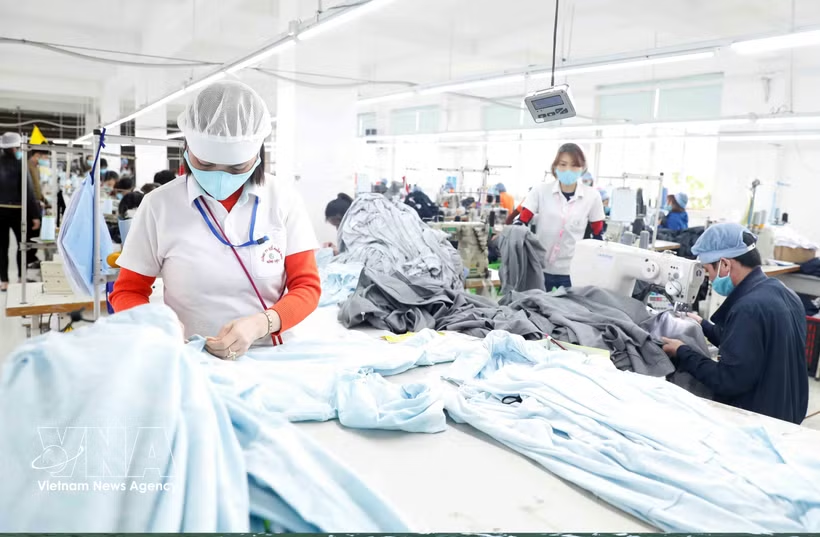
The textile and garment sector illustrates this trend. In the first seven months of 2026, its exports exceeded 27 billion USD, including about 10.5 billion USD to the US. The sector posted a trade surplus of more than 11 billion USD, up about 10% year on year, supported partly by increased domestic sourcing and stronger supplier networks.
Dr. Vo Tri Thanh, Director of the Institute for Brand and Competitiveness Strategy Research, said new requirements on production, the environment, labour and product quality are forcing exporters to adapt to higher standards.
As an export-driven economy, Vietnam must continue to engage with markets that tighten standards and increase protectionism, Thanh said, stressing the need to build sufficient capacity to meet requirements and maximise the benefits of trade ties.
Rising scrutiny of origin
Greater export opportunities in the US market are accompanied by tougher requirements.
Vu Tu Thanh, Acting Managing Director and US-ASEAN Business Council (USABC) Vietnam Chief Country Representative, said Vietnamese businesses face risks related to origin and illegal transshipment, dependence on imported materials, and increasingly stringent requirements on environmental, social and governance (ESG), emissions reduction, clean energy and supply-chain transparency.
Another concern is Vietnam’s large trade surplus with the US. As US authorities step up efforts to combat origin fraud and illegal transshipment, Vietnamese goods and supply chains are likely to face closer scrutiny.
A recent report of the White House Office of Trade and Manufacturing Policy identified 40 countries and territories as high-risk for transshipment and divided them into three groups based on economic size, integration with China-related supply chains and specific market advantages.
Vietnam was placed in Group 2 alongside Brazil, Indonesia, Malaysia, Türkiye and Thailand. It means that Vietnamese goods are likely to remain under close US scrutiny, particularly in sectors heavily dependent on imported materials and components.
The US is also using AI-powered systems to detect unusual trade patterns and origin discrepancies.
Trade experts note that the concept of “China-linked goods” is relatively broad, potentially creating risks for many export sectors. Inspections are also shifting from traditional document checks towards analysis of trade data, production data and entire supply chains.
This requires businesses to demonstrate genuine production capacity, the sources of raw materials, manufacturing processes and the value added in Vietnam.
Ann Ha, CEO of Defenova Global Connect, said Vietnam has an opportunity to increase imports of US technology, equipment and solutions as global supply chains shift towards “friend-shoring”.
Potential US imports include semiconductors, electronics, machinery, aviation products, high-tech agriculture, digital technologies and cybersecurity solutions, she said.
Access to advanced technologies will help businesses improve productivity and quality and meet requirements for joining global supply chains, particularly those of US corporations, Ha added./.