Vietnam's durian exports set sights on new record

Durian exports reached nearly 1.1 billion USD in the first six months of 2026, up 32% year-on-year. The industry's strongest export season, however, is still ahead.

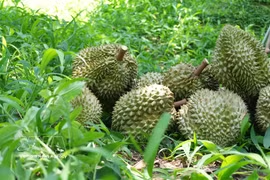
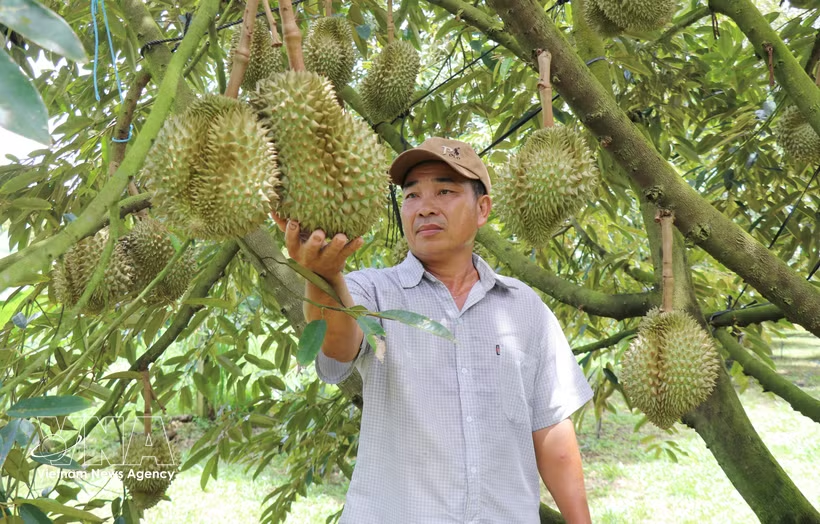
At a durian farm in Lam Dong province. (Photo: VNA)

Hanoi (VNA) - Vietnam's durian industry is poised for another year of record-breaking export earnings as stronger institutional reforms, improved market access and streamlined export procedures boost confidence that the country's "king of fruits" could generate 4.5 billion USD in export revenue this year.

Just four years ago, few imagined that a single fruit could become one of Vietnam's billion-dollar export earners. Since fresh durian exports to China officially began in 2022, the industry has set a new export record almost every year and is now emerging as one of the country's fastest-growing agricultural sectors.

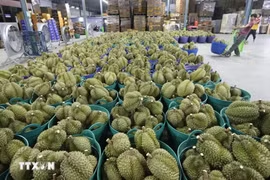
Durian exports reached nearly 1.1 billion USD in the first six months of 2026, up 32% year-on-year. The industry's strongest export season, however, is still ahead. The Central Highlands harvest, which accounts for a large share of annual production, begins in August and lasts through October. During the same period last year, the country's monthly export turnover approached 1 billion USD.

With exports maintaining strong momentum, industry insiders believed annual revenue could exceed 4 billion USD and potentially reach 4.5 billion USD, bringing Vietnam closer to Thailand in supplying China's lucrative durian market.

Recent policy developments have strengthened those prospects. The General Administration of Customs of China (GACC) officially recognised 18 additional Vietnamese testing laboratories on July 31, raising the total number of approved laboratories to 50.

The move comes after exporters faced disruptions earlier this year when several laboratories temporarily suspended operations, slowing customs clearance for shipments.

At the same time, authorities have accelerated the issuance of planting area codes, with processing time reduced from ten days to three days through a fully digital system.

The Government has also intensified efforts to clean up the industry. Authorities have prosecuted and detained several officials for allegedly receving bribery and abuse of power in the management of planting area codes and export procedures, aiming to eliminate unnecessary administrative barriers and restore fair competition.

Industry experts said fraudulent trading of planting area codes had undermined the sector for years. The ongoing crackdown is expected to improve transparency and strengthen confidence among overseas buyers.

Vietnam is also expanding beyond its heavy reliance on China by opening new markets.

India has recently opened its market to Vietnamese durian, offering another promising destination as production continues to increase.

Dang Phuc Nguyen, General Secretary of the Vietnam Fruit and Vegetables Association (VINAFRUIT), estimated that exports to India could generate 50-100 million USD annually in the initial years as consumers gradually become familiar with the fruit.

Vietnam's durian exports officially began four years ago after Vietnam and China signed a protocol on fresh durian exports in July 2022. Export turnover reached 400 million USD in the final months of that year before surging to 2.2 billion USD in 2023.

Last year, exports climbed to 3.8 billion USD, placing durian alongside Vietnam's traditional export staples such as rice, shrimp, rubber and cashew nuts.

Unlike several major agricultural exports that rely partly on imported raw materials, durian's value is created almost entirely within Vietnam, generating higher returns for domestic growers.

Despite its rapid rise, the industry remains heavily dependent on China, which accounts for around 90% of exports. Experts therefore stressed the need to diversify markets while investing more in processed durian products, which are easier to transport, have a longer shelf life and appeal to a broader range of international consumers./.

VNA
See more

A display area for Mid-Autumn Festival cakes at a supermarket (Photo: VNA)

Mid-Autumn Festival cake market heats up at affordable end

Industry insiders say competition is no longer just about the cake itself. Product quality, packaging, brand reputation, delivery services and personalisation are increasingly shaping consumer choices in a market crowded with both domestic and foreign players.

Minister of Foreign Affairs Le Hoai Trung (Photo published by VNA)

Vietnam, India set 25 billion USD trade goal

Vietnam and India agreed to make better use of complementary strengths, ease market access difficulties and facilitate business activities toward achieving the 25 billion USD bilateral trade target.

Delegates at the meeting between Vietnamese businesses operating in Cambodia and the Council for the Development of Cambodia (CDC) on September 14. (Photo: VNA)

Vietnamese businesses seek to expand investment in Cambodia

Vietnam currently has 223 investment projects in Cambodia with total registered capital of nearly 3.4 billion USD. Vietnamese companies operate in agriculture, particularly large-scale farming, finance and banking, telecommunications, aviation, processing, trade and services.

Children visit President Ho Chi Minh's hometown and learn about his childhood. (Photo: VNA)

Vietnam's tourism sector faces labour shortage

A 2026 survey by Hoteljob.vn found that nearly 90% of tourism businesses planned to recruit. In Ho Chi Minh City alone, 89.7% of businesses were hiring, while 71.8% said recruitment was difficult or very difficult. The biggest shortages were among frontline workers, particularly in housekeeping, engineering, food service, front-office operations, and kitchens.

Octopus processing for export at Huy Nam Company in An Giang province. (Photo: VNA)

New opportunities for Vietnam’s seafood exports

The Vietnam-EFTA Free Trade Agreement brings together two groups of highly complementary economies. EFTA members Switzerland, Norway, Iceland and Liechtenstein have strengths in technology, innovation, finance, clean energy and sustainable development, while Vietnam is one of Asia’s most dynamic economies and is emerging as a major regional manufacturing, trade and investment hub.

The saponin content of Lai Chau ginseng can reach as high as 23.85% in its natural state, a remarkably high level compared to many other ginseng species. (Photo: baolaichau.vn)

Lai Chau ginseng development gains momentum

Blessed with rare and distinctive ecological values, the northern mountainous province of Lai Chau is stepping up efforts to conserve and develop its native ginseng, with the medicinal plant expected to play a growing role in the forest-based economy and local livelihoods.

The Vietnamese delegation poses for a group photo at the third meeting of the Vietnam-Canada Joint Economic Committee (Photo: VNA)

Vietnam, Canada broaden economic cooperation beyond trade

Vietnam is currently Canada’s largest trading partner in ASEAN. Building on the Comprehensive and Progressive Agreement for Trans-Pacific Partnership (CPTPP), the two countries are expanding bilateral economic ties into higher value-added areas such as clean energy, critical minerals, advanced technology, manufacturing and value-chain linkages.

The Index of Industrial Production (IIP) rises 14.4% in August and 11.9% in the first eight months compared to a year earlier. (Photo: VNA)

More momentum needed for economic growth in year-end race

To build momentum for the year-end race, one of the top priorities is to accelerate public investment disbursement, ensuring 100% of the allocated plan is disbursed without allowing funds to be concentrated in the final months of the year.

Vietnamese enterprises showcase products at the Vietnam Pavilion during the Foodist Istanbul 2026 fair. (Photo: Vietrade)

Vietnamese goods gain export opportunities in Türkiye, Spain

Vietrade said the programme helped businesses gain practical market information, identify potential products and partners, and better understand requirements on quality, pricing and distribution. Such direct connections are expected to help companies adapt their products and develop more effective export strategies.