Hanoi builds attractive investment ecosystem for FDI enterprises

By translating Resolution No. 10-NQ/TW into concrete programmes and actions, Hanoi is laying a solid foundation to attract high-quality FDI, turning foreign investment not only into an economic resource but also a catalyst for innovation, productivity growth and faster, greener and more sustainable development.

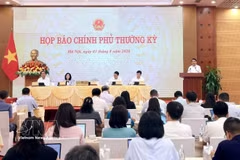
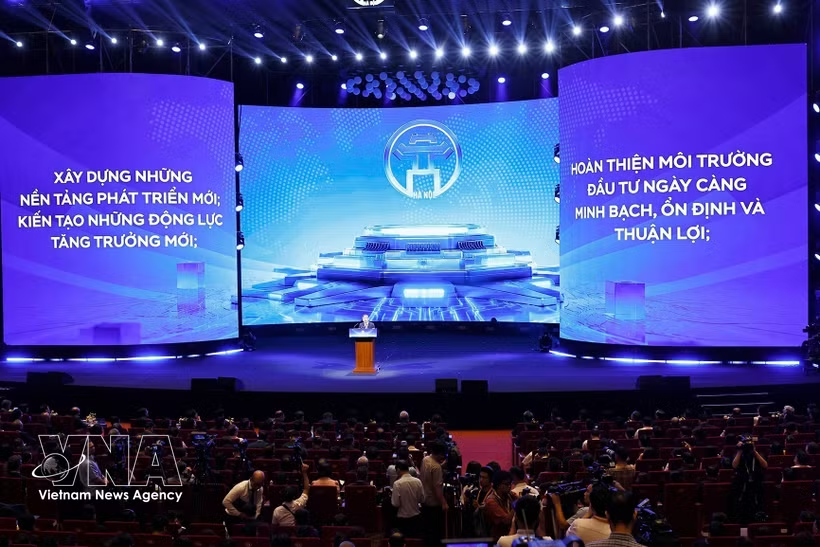
Chairman of the municipal People’s Committee Vu Dai Thang speaks at an event to announce Hanoi's 100-year master plan. (Photo: VNA)

Hanoi (VNA) – As Hanoi accelerates development, foreign-invested industrial parks are expanding, research and innovation centres are emerging, and strategic infrastructure projects are being rolled out.

These developments reflect the capital’s efforts to translate Politburo Resolution No. 10-NQ/TW on developing the foreign-invested economic sector into concrete actions, from improving the investment climate and infrastructure to administrative reform and building a transparent, modern and globally competitive investment ecosystem.

A key focus is administrative reform. At the Hanoi Public Administration Service Centre, most business applications are now processed digitally, with procedures made public and progress available for online monitoring. For foreign investors, time is a cost, so simplifying procedures and shortening processing times can strengthen confidence in the capital’s investment environment.

Following the issuance of Resolution No. 10-NQ/TW, Hanoi has stepped up digital transformation in public administration, expanded online public services and strengthened dialogue with businesses to promptly address bottlenecks related to investment, land, construction, planning and infrastructure.

At a recent conference announcing Hanoi’s 100-year master plan and promoting investment, foreign investors praised the city’s determination to improve the business environment, particularly its approach of listening to enterprises and resolving their concerns. Manabu Hamamoto, General Manager at Sumitomo Corporation’s Global Urban Development Strategic Business Unit, said foreign businesses look not only for incentives but also a clear development vision, a stable investment environment, open dialogue and transparent governance.

According to Vice Chairman of the municipal People’s Committee Do Anh Tuan, 117 countries and territories are currently investing in the capital city. FDI attraction reached 4.29 billion USD in 2025, placing Hanoi among the country’s leading localities. Cumulative FDI attracted so far this year has reached nearly 3.39 billion USD, or 75.3% of the annual target.

Amid global supply chain restructuring, Hanoi is seeking to attract a new generation of investment, shifting from investment incentives at all costs towards projects with high added value and strong spillover effects.

Priority areas include strategic transport infrastructure, transit-oriented development (TOD), high technology, semiconductors, artificial intelligence, data centres, new-generation industrial parks, smart logistics, clean energy, the circular economy, cultural industries, tourism, and high-quality health care and education.

Chairman of the municipal People’s Committee Vu Dai Thang affirmed that the city is committed to development based on quality, efficiency, innovation and sustainability. It will not sacrifice the environment, cultural values or quality of life for short-term growth, but prioritise projects with high added value and strong scientific, technological and innovation content.

The city also aims to attract investors with long-term vision, modern governance and social responsibility, while continuing to build a transparent, stable and predictable investment environment. It pledges to proactively make decisions and resolve issues within its authority, ensuring businesses do not face delays in implementation, he added.

According to Nguyen Van Toan, Vice Chairman of the Vietnam's Association of Foreign Invested Enterprises (VAFIE), Hanoi has demonstrated a significant shift in its development mindset and is now well positioned in terms of capacity and conditions to receive high-quality investment and establish strategic partnerships with leading global corporations.

Alongside “hard infrastructure” such as ring roads, routes connecting industrial parks, logistics networks, digital infrastructure and high-tech parks, Hanoi is also strengthening “soft infrastructure”, including skilled human resources, universities, research institutions, innovation ecosystems and a modern living environment for international experts and workers.

By translating Resolution No. 10-NQ/TW into concrete programmes and actions, Hanoi is laying a solid foundation to attract high-quality FDI, turning foreign investment not only into an economic resource but also a catalyst for innovation, productivity growth and faster, greener and more sustainable development./.

VNA
See more

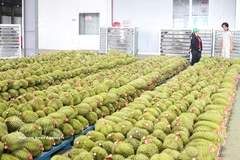
Illustrative image (Photo: VNA)

US boosts biofertiliser exports to Vietnam

According to a notice issued on August 4, FAS invites US universities, agricultural trade associations, and non-profit organisations to apply for this technical assistance funding to evaluate crop yields and reductions in nitrogen leaching in the US and Vietnam using US manufactured biofertilsers such as liquid fish fertiliser.

Vietnamese Ambassador to Cuba Le Quang Long (second from left) witnesses the handover ceremony for the first batch of rice produced by TBAgri to the Cuban side. (Photo: Embassy of Vietnam in Cuba)

Vietnam hands over Cuba-grown rice to partner

More than 470 tonnes of rice grown in Cuba from Vietnam's OM5451 variety were handed over to Cuban partner GRANMAX at a ceremony in Havana on August 4, marking the first harvest delivered by Vietnamese agricultural company TBAgri under a joint Vietnam–Cuba rice production project.

Illustrative image (Photo: nhandan.vn)

Four-pronged plan mapped out to unlock next-gen FDI

Vietnam must pivot hard from tax breaks to cost-based support. Incentives will target infrastructure, workforce training, research and development, and innovation, which directly lower investment costs and lift operational efficiency, a formula already being copied by countries competing for quality FDI.

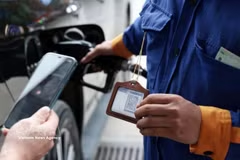
A buyer is making cashless payment at a petrol station. (Photo: VNA)

SBV moves to close dormant bank accounts to curb financial fraud

The SBV has proposed amendments to Decree 52/2024/ND-CP on cashless payment, allowing banks to close accounts that have remained inactive for at least three years since their last transaction unless otherwise agreed between the banks and the customers.

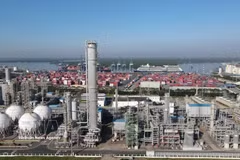
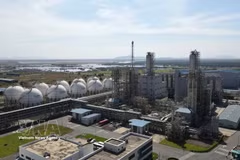
A view of the Hyosung chemical plant, a Korean-invested project in Tan Phuoc ward, Ho Chi Minh City (Photo: VNA)

Resolution 10-NQ/TW changes "measure" of FDI success: HSBC

Success will increasingly be measured by whether foreign investment brings technology, develops local talent, establishes research and development (R&D) capability, and integrates Vietnamese enterprises more deeply into global value chains, according to HSBC.

Garment is one of the key contributors to Vietnam's export growth. (Photo: VNA)

Resolution on renewing development model expected to unlock new growth drivers for Vietnam

The resolution on renewing Vietnam’s development model goes beyond the goal of rapid and sustainable economic growth. It establishes a comprehensive development model designed to unlock new growth space, mobilise resources more effectively, strengthen national competitiveness, and help Vietnam achieve its goal of becoming a developed, high-income country by 2045.

Production activities at FDI enterprises in Tay Ninh province help boost exports, create jobs, and enhance the locality's role in the regional supply chain. (Photo: VNA)

Seven-month economy stays on growth track, eyes double-digit expansion

According to the National Statistics Office (NSO) under the Ministry of Finance, inflation remained under control, with the consumer price index (CPI) edging down 0.1% in July from the previous month. Average CPI in the January–July period rose an estimated 4.39% year-on-year, staying within the yearly target.

A view of Hyosung chemical plant, a RoK-invested project in Tan Phuoc ward, Ho Chi Minh City. (Photo:: VNA)

Ho Chi Minh City gears up for next-generation FDI inflows

Ho Chi Minh City is calling for investment in around 250 projects across nine priority sectors, mainly focusing on developing the International Financial Centre, digital finance, smart banking and supporting data infrastructure, large-scale logistics and port developments, transport infrastructure supporting trade, import-export activities, industry and smart logistics, green industries, clean energy and next-generation industrial parks.