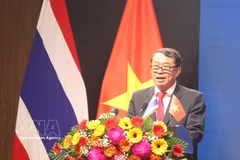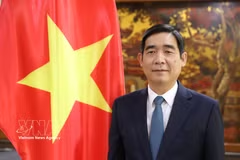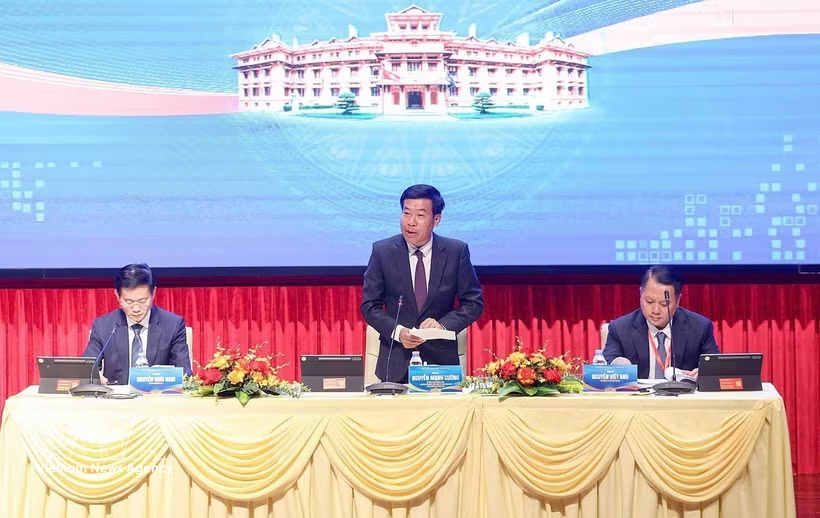
Hanoi (VNA) – Party diplomacy helps strengthen political trust and create favourable conditions for deeper and more practical cooperation between Vietnam and other countries, Deputy Minister of Foreign Affairs Nguyen Manh Cuong has said.
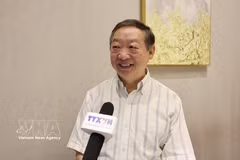
Speaking to the media on the occasion of the 33rd Diplomatic Conference, Cuong, who is a member of the Party Central Committee and Deputy Secretary of the Ministry of Foreign Affairs' Party Committee, said relations between countries may begin with shared interests, but long-term and sustainable cooperation requires a strong political foundation.
"Building that political foundation is the regular task of Party diplomacy," he said, noting that the channel has supported Vietnam throughout its struggle for national independence and reunification, as well as in the Fatherland development and defence.
Party diplomacy, together with State diplomacy and people-to-people diplomacy, form the three closely connected pillars of Vietnam's comprehensive diplomacy.
According to the deputy minister, Party diplomacy plays a central role in implementing the Communist Party of Vietnam (CPV)'s foreign policy, developing ties with political parties around the world and strengthening political foundation, thereby creating favourable conditions for Vietnam's relations with other countries and partners.
The 14th National Party Congress called for making greater use of the combined strength of Vietnam's foreign affairs. Under this direction, Party diplomacy should do more to turn strong political ties into concrete cooperation while remaining an important channel for exchanges on Party building, national governance and cadre training. Such exchanges also help Vietnam learn from international experience to improve the Party's leadership, governance capacity and combative strength, he added.
Reviewing recent achievements, Cuong said Party diplomacy has been carried out in a proactive and coordinated manner despite rapid and complex changes in the regional and global landscape.
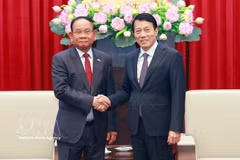
Relations between the CPV and political parties in neighbouring countries, socialist nations and traditional friends have continued to strengthen, contributing to greater political trust and the stable, long-term development of bilateral ties.
High-level cooperation mechanisms with Laos, Cambodia and China, as well as the trilateral mechanism among the ruling parties of Vietnam, Laos and Cambodia, have continued to play an important role in setting strategic directions for bilateral and regional cooperation, he said.
The Party has also expanded its network beyond communist and workers' parties to include ruling parties, parties participating in government and other influential political parties, helping create a broader political foundation for Vietnam's international relations. One notable development has been the establishment of a Strategic Dialogue mechanism with Singapore's People's Action Party, according to the deputy minister.
On the multilateral front, the CPV has actively participated in regional and international political party forums. In June this year, Hanoi hosted the first Southeast Asian Political Parties Dialogue, an initiative proposed by Vietnam. Cooperation between Party organisations in Vietnamese localities sharing borders with neighbouring countries has also been maintained.
Cuong said Party diplomacy is becoming increasingly practical, focusing on issues such as Party building, personnel work, national governance, science and technology, and digital transformation. The channel not only introduces Vietnam's experience to international partners but also helps bring useful international knowledge into the Party's policymaking process, he said.
He also highlighted progress in research and strategic policy advice through Party channels.
According to Cuong, the distinctive value of Party external relations lies in the important role political parties play in shaping national development strategies and foreign policy priorities.
Political trust, he explained, means confidence that a partner will maintain consistency in its fundamental policies even when leadership or circumstances change. Such trust makes policies more predictable and allows differences to be addressed early before they become obstacles.
"These are conditions that other diplomatic channels cannot easily create," he said.
As the ruling party leading the State and society, the CPV has a special role in promoting strategic dialogue with political parties around the world, discussing long-term issues and helping narrow differences through greater mutual understanding.
Looking ahead, Cuong said Party diplomacy will continue to follow the directions set by the 14th National Party Congress, Politburo Resolution No. 06 and Conclusion No. 49, keep strongly innovating in terms of thinking, content, and implementation methods to further contribute to national construction and development.
Priority will be given to strengthening relations with political parties in neighbouring countries, socialist countries and traditional partners, while expanding ties with ruling and influential political parties.
The Party will also seek to align external activities more closely with Vietnam's strategic development goals by promoting cooperation in science and technology, digital transformation, green transition and human resources development.
Vietnam will continue to enhance its role in multilateral political party forums, further develop the Southeast Asian Political Parties Dialogue and prepare to host the International Conference of Asian Political Parties (ICAPP) in 2028.
Cuong stressed that greater attention would also be paid to turning common perceptions and agreements into practical results, while making better use of Vietnamese representative missions abroad to strengthen links with political parties in host countries.
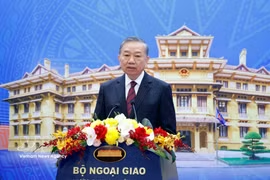
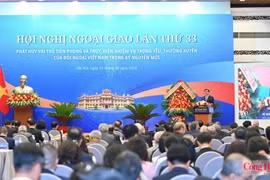
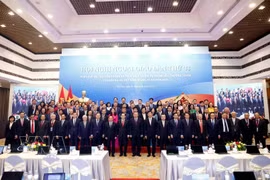
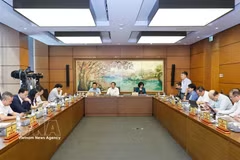
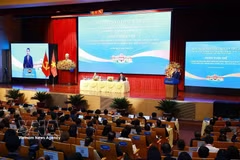
He said the ongoing 33rd Diplomatic Conference provides an opportunity for the foreign affairs sector to put the new thinking of the 14th National Party Congress, Resolution No. 06 and Conclusion No. 49 into practice.
"For Party diplomacy, the goal is to provide more proactive policy advice, build higher political trust, deepen relations, make cooperation more practical and ensure stronger implementation, with concrete contributions to national development as the highest measure of success," he said./.