16th NA’s first extraordinary session targets defence law upgrade, deeper international integration

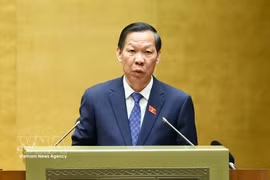
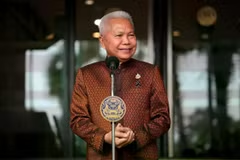
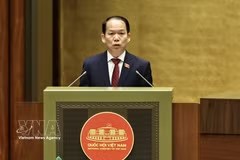
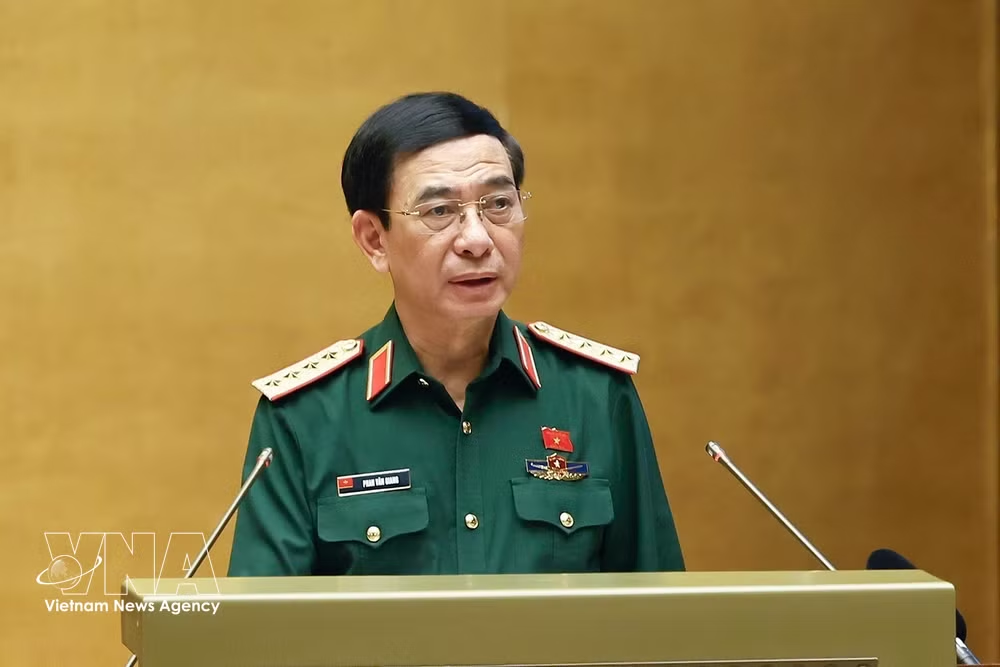
Deputy Prime Minister and Minister of National Defence Gen. Phan Van Giang, presenting the WMD non-proliferation bill, said the draft aims to swiftly and fully translate the Party and State’s policies and guidelines on safeguarding the Fatherland early and from afar, as well as on deeper international integration, into legislation, including the policy of joining multilateral nonproliferation mechanisms.

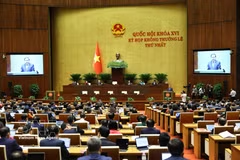
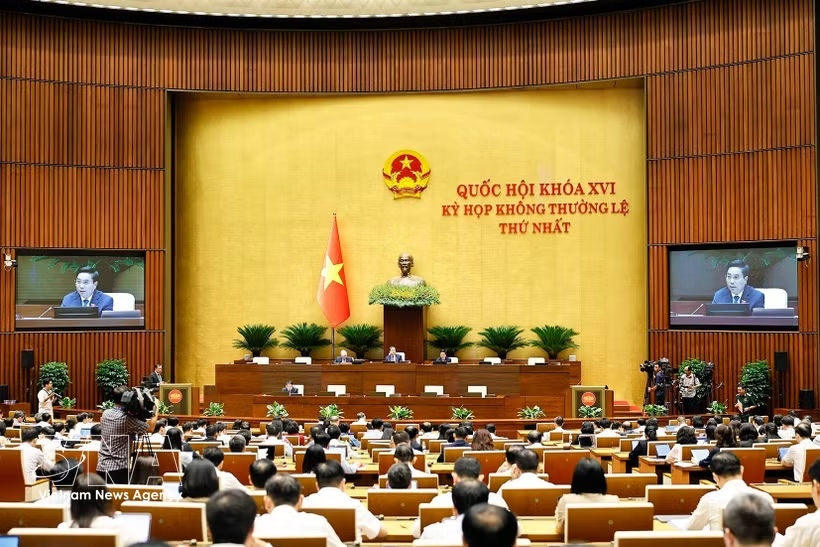
A plenary sitting of the 16th NA's first extraordinary session (Photo: VNA)

Hanoi (VNA) – Continuing the first extraordinary session, the 16th National Assembly (NA) on August 4 looked into submissions and verification reports on the draft Law on Prevention and Control of the Proliferation of Weapons of Mass Destruction (WMD) and the draft law amending and supplementing a number of articles of nine laws on military and national defence affairs.

Building on existing national defence – security rules

Deputy Prime Minister and Minister of National Defence Gen. Phan Van Giang, presenting the WMD non-proliferation bill, said the draft aims to swiftly and fully translate the Party and State’s policies and guidelines on safeguarding the Fatherland early and from afar, as well as on deeper international integration, into legislation, including the policy of joining multilateral nonproliferation mechanisms.

It will complete Vietnam’s domestic legal framework at the statutory level, enabling the country to fully and effectively meet its international commitments and national obligations. It is also designed to create a more welcoming international environment for Vietnamese agencies, organisations and businesses to broaden investment, trade and technology cooperation with partners worldwide, most notably major economies and key markets such as the US. and the EU, he said.
vnanet-c.jpg
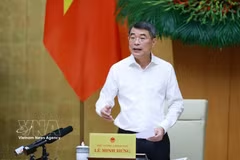
Deputy Prime Minister and Minister of National Defence Gen. Phan Van Giang presents the WMD non-proliferation bill on August 4. (Photo: VNA)

According to him, the bill is built around administrative reform, stronger post-approval inspection mechanisms, and the adoption of digital technologies, connectivity and electronic data sharing. It seeks to embed these requirements into existing sector-specific procedures, databases and management systems as much as possible, while avoiding duplicative licensing, declaration, reporting, inspection or supervision where current legislation already provides adequate regulation and no specific risk indicators exist.

Turning to the bill amending nine military and national defence laws, Giang said it is expected to quickly and fully translate the Party’s push to reorganise the political system and adopt a two-tier local administration model into legislation.

The amendments also aim to maximise decentralisation and delegation of authority while cutting and simplifying administrative procedures to meet pressing practical demands.

Reviewing national risk assessment mechanism

Le Tan Toi, Chairman of the NA Committee for National Defence, Security and Foreign Affairs, said the committee broadly backs the scope of amendments and supplements in both bills.

Toi proposed the Government to keep reviewing the issues flagged in the verification reports, revise and finalise the two drafts, ensuring the legislation better captures the drive to renew legal thinking and remains consistent and coherent with the broader legal framework.

He also called for deeper scrutiny of the national risk assessment mechanism and measures to choke off financing for WMD proliferation, balancing defence and security imperatives with the need to facilitate socio-economic development./.​

VNA

See more

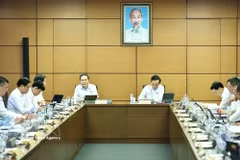
NA deputies at the discussions (Photo: VNA)

NA deputies review legal reforms on military, defence

Lawmakers later held group discussions on the draft Law on the Prevention of the Proliferation of Weapons of Mass Destruction, the draft law revising nine military and defence laws, and the revised Law on Law Dissemination and Education.

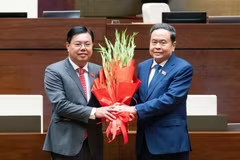
National Assembly Chairman Tran Thanh Man (R) presents flowers to congratulate new Minister of Home Affairs Nguyen Tien Hai. (Photo published by VNA)

National Assembly approves Nguyen Tien Hai as Minister of Home Affairs

The NA held a secret ballot on the appointment and later adopted a resolution approving Nguyen Tien Hai as Minister of Home Affairs. The resolution was passed with 483 votes in favour out of 484 deputies participating in the electronic vote, accounting for 96.60% of those present.

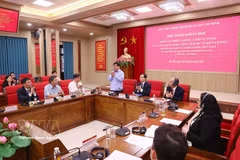
The scientific seminar is held by the Ho Chi Minh National Academy of Politics in Hanoi on August 3. (Photo: VNA)

Seminar honours Fidel Castro's legacy, enduring Vietnam–Cuba solidarity

A Vietnamese official said Fidel Castro's revolutionary ideals transcended national borders, making him a steadfast internationalist, an outstanding theorist and practitioner of the international communist and workers' movement, and an enduring symbol of national liberation and socialism.

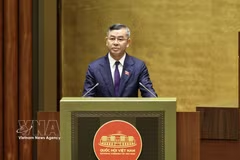
Minister of Finance Ngo Van Tuan presents the draft Law amending and supplementing several articles of the Law on Customs at the 16th National Assembly's first extraordinary session in Hanoi on August 3. (Photo: VNA)

Lawmakers discuss customs reform linked to digital transformation, risk management

Continuing the agenda of its ongoing first extraordinary session, the 16th National Assembly (NA) on August 3 heard proposals and verification reports on two bills, including the Law amending and supplementing several articles of the Law on Customs, and the Law revising Article 6 and Appendix IV on the list of conditional business lines under the Law on Investment.

A view of the Central Technology Platform No. 2 of the Bach Ho (White Tiger) oil rig under the Vietsovpetro joint venture between Vietnam and Russia (Photo: VNA)

Institutional reform key to unlocking new development model: experts

Resolution No. 19-NQ/TW, adopted at the third plenum of the 14th Party Central Committee, identifies breakthroughs in institutions and reforms as the starting point for renewing Vietnam’s development model, alongside reforms in national governance, organisation and operations to build new development capacity.

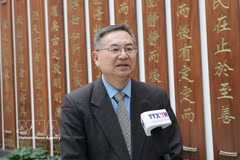
Professor Qu Qiang from Minzu University of China, in an interview granted to the Vietnam News Agency. (Photo: VNA)

Four orientations demonstrate shift in Vietnam’s development thinking: Chinese scholar

The most notable change is Vietnam’s transition from “organisational restructuring” to “improving governance effectiveness.” Previously, reforms focused on streamlining the apparatus and reducing intermediary levels. With organisational reforms largely completed, the more important task is now to ensure the new system operates more effectively, according to Professor Qu Qiang from Minzu University of China.

A view of the opening ceremony of the 16th NA's first extraordinary session (Photo: VNA)

First extraordinary session of 16th National Assembly opens

The first extraordinary session of the 16th National Assembly (NA) kicked off in Hanoi on August 3, with lawmakers set to consider and decide on a series of items, including 15 draft laws, four draft normative resolutions and a range of major issues concerning national development.

Deputy Prime Minister Le Tien Chau chairs several meetings to hear reports on the progress of the comprehensive review. (Photo: Ministry of Justice)

Over 43,000 legal normative documents reviewed

As of July 30, ministries, agencies and localities had conducted a preliminary review of more than 43,000 legal normative documents nationwide, identifying provisions that need to be amended, supplemented, replaced or annulled.

National Assembly Chairman Tran Thanh Man addresses the meeting (Photo: VNA)

Legislation must pave the way for development: NA leader

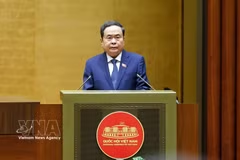
For the NA, he said, success should not be measured simply by completing the legislative agenda, but by improving the quality of every law and resolution so that each legal instrument effectively addresses institutional obstacles and generates momentum for growth.