Hanoi (VNA) – With traditional growth engines running out of room, Vietnam has pinned its hopes on science – technology, innovation and digital transformation to lift productivity, unlock new momentum and chase double-digit economic expansion.
The strategic pivot is enshrined in the Politburo’s Resolution 57-NQ/TW, a blueprint to smash bottlenecks with breakthroughs in science – technology development, innovation and national digitalisation and light the way to fast, lasting growth.
According to the Ministry of Finance’s National Statistics Office (NSO), gross domestic product (GDP) must rocket 11.7% in the second half to hit a double-digit pace for the year. That demands an 11.16% jump in the third quarter, pushing the nine-month expansion to 9.19%, before accelerating to 12.09% in the final three months.
The target is exceptionally steep, requiring growth engines to be fired strongly at once and deliver more tangible results in the second half. Yet, traditional drivers such as investment, exports, cheap labour and natural resources are approaching their limits.
NSO Director Nguyen Thi Huong said alongside foreign investment and the green economy, science – technology, innovation, the digital economy and digital transformation are the new drivers that can can pack a serious second-half punch.
Leaning harder into digital technology, artificial intelligence (AI), big data, cloud computing, the Internet of Things and automation production, trade and management will boost labour productivity, slash costs, optimise supply chains and fundamentally retool growth models, she added.
Assoc. Prof. Dr Nguyen Truc Le, Rector of the University of Economics and Business under Vietnam National University, Hanoi, noted that the world’s biggest success stories over the past half-century all put science, technology and innovation right at the heart of their playbooks.
The lesson from abroad is clear: science – technology can help a country bust through the limits of resources, workforce and market size. When productivity and innovation capacity climb, the same old pool of capital, workers and raw materials can generate a whole lot more value, he said.
Dr Nguyen Duc Hien, Vice Chairman of the Party Central Committee’s Commission for Policies and Strategies, warned that the 2026 double-digit growth target piles on massive pressure. Against that backdrop, shifting to a growth model powered by science, technology, innovation and digital transformation is an imperative.
Pham Anh Tuan, Deputy Director of the Institute of Vietnam and World Economy, said after more than a year of turning Resolution 57-NQ/TW into action, enterprises have a much sharper sense of just how much science, technology and innovation matter.
That lightbulb moment is a crucial first step because companies are the ones who actually take research breakthroughs and technology solutions from the lab to the factory floor and the marketplace. But a gap still yawns between what people now understand and what’s actually happening on the ground, especially among small and medium-sized enterprises, he added.
The NSO reported that technology adoption at many firms is still stuck in low gear while spending on R&D, digital infrastructure and top-tier talent remains too inadequate. So in the second half, the payoff from science and technology will mostly show up by fine-tuning what the economy already does rather than igniting an immediate growth spurt.
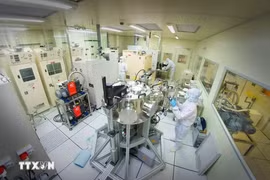
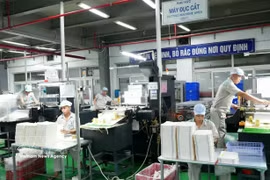
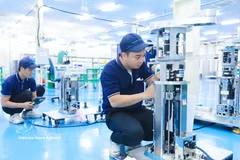
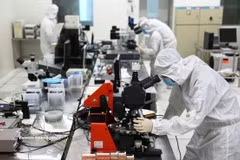
To stay on a double-digit track, Vietnam must shift from a capital- and labour-intensive model to one driven by productivity, science, technology, digital transformation and corporate innovation. That requires science and technology to move beyond paper and research labs. They have to seep onto factory floors, into corporate boardrooms and through public services. Research findings only pay off when they turn into highly practical products, processes or business models.
Harnessing AI, big data, cloud computing, IoT and automation can help companies shorten processes, cut costs, improve product quality, optimise supply chains and reach new markets. Technology can also support analysis of customer demand, inventory management and quality control, enabling faster and sharper decisions.
That’s why Tuan insisted that science, technology, innovation and digital transformation must be deeply woven into day-to-day business operations to improve efficiency, create new products, and slowly but surely lift Vietnam’s place in the market./.