Bac Ninh targets world's top 50 smart cities by 2030

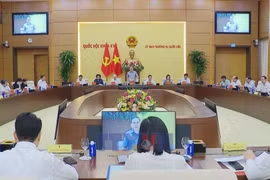
According to Chairman of the provincial People's Committee Pham Hoang Son, the province will pursue a people-centred smart city model driven by science, technology, innovation and digital transformation to improve public services, urban management and competitiveness.

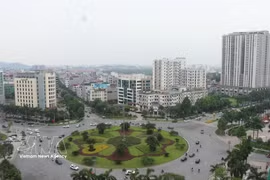
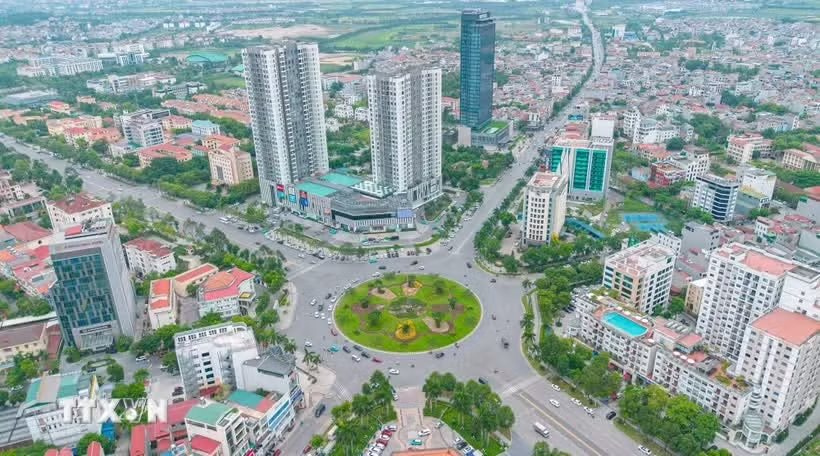
A view of Kinh Bac Ward in Bac Ninh Province. (Photo: VNA)

Bac Ninh (VNA) – The northern province of Bac Ninh aims to rank among the world's top 50 smart cities by 2030, using data and digital transformation as the foundation for sustainable urban development, contributing to its effort to become a centrally governed city.

According to Chairman of the provincial People's Committee Pham Hoang Son, the province will pursue a people-centred smart city model driven by science, technology, innovation and digital transformation to improve public services, urban management and competitiveness.

By 2030, Bac Ninh plans to establish a data-driven smart governance model, operate an integrated smart city operations centre (IOC), and incorporate City Information Modelling (CIM) into urban planning, with the long-term goal of developing a digital twin of the province.

The province will prioritise digital infrastructure and smart services in healthcare, environmental management, water supply and wastewater treatment, waste management, transport and other essential sectors, while ensuring interoperability, open APIs and cybersecurity by design.

To achieve its target, Bac Ninh will establish a provincial smart city coordination council, introduce a regulatory sandbox for innovative technologies, and accelerate investment in digital infrastructure, including 5G, cloud computing, the Internet of Things (IoT) and artificial intelligence (AI).

The province also plans to expand smart applications in transport, energy, public lighting, water management, healthcare, education, agriculture, tourism and smart industrial parks.

Bac Ninh is already among Vietnam's leading localities in smart city development. It has established an integrated smart operations centre, deployed smart urban management solutions in key urban areas, and achieved 100% mobile coverage, with 5G services reaching more than 92% of the population. The province has also launched pilot IOC scenarios for real-time governance across sectors including public administration, healthcare, education, transport and socio-economic management./.
VNA

See more

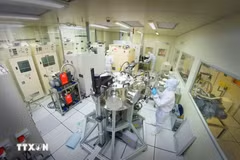
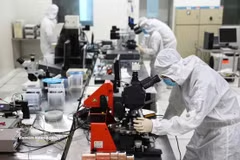
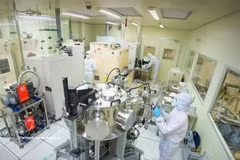
Research lab of the Vietnam National University Ho Chi Minh City. (Illustrative photo published by VNA)

Drastic measures taken to turn Resolution 57 into action

A recent meeting of the Central Steering Committee on science, technology, innovation and digital transformation, chaired by Party General Secretary and State President To Lam, marked a new phase in implementing Resolution 57 following the committee’s restructuring.

Illustrative photo: VNA

Vietnam expected to fast-track mastery, rollout of 6G technology

Vietnam has so far deployed more than 40,000 5G base transceiver stations (BTSs), providing coverage for about 92% of the population, making it one of the world's fastest countries in this regard. By comparison, many advanced economies typically take two to three years to extend 5G coverage to more than 80% of their populations.

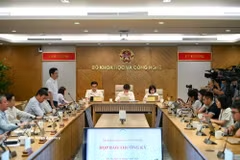
Deputy Prime Minister Ho Quoc Dung chairs the meeting in Hanoi on July 31 to discuss the establishment of a high-tech park in the northern province of Hung Yen. (Photo: VNA)

Deputy PM chairs meeting on establishment of Hung Yen High-Tech Park

Chairman of the Hung Yen provincial People’s Committee Nguyen Manh Quyen said the proposed high-tech park will cover about 496.1 hectares in Hoan Long and Viet Yen communes. The location is expected to attract high-quality talent and innovation resources from Hanoi while strengthening production and logistics links across the Northern Key Economic Region, including Bac Ninh, Hai Phong, Quang Ninh, Phu Tho and Ninh Binh.

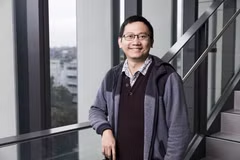
Dr Nguyen Minh Triet, Chair of Academic Council at the Vietnam Australia Innovation Network (NIC AU) and a research engineer at Archer Materials in Australia (Photo published by VNA)

Investing in core capabilities key to elevating Vietnam's semiconductor industry: expert

Vietnam's ultimate goal should not simply be to establish a presence in the semiconductor industry, but to gradually master high-value, knowledge-intensive segments of the value chain and become a key link in the global semiconductor supply chain. This would provide a launch pad for strengthening the country's competitiveness in artificial intelligence, electronics and the digital economy.

Building a digital ecosystem for foreigners in Vietnam

Building a digital ecosystem for foreigners in Vietnam

Registering residence, applying for an electronic visa (e-Visa), obtaining an electronic identity account or completing administrative procedures online can now all be done conveniently in the digital environment. For many foreigners, these changes have made it easier to enter, live and work in Vietnam while also reflecting the initial results of implementing the Politburo's Resolution No. 57.

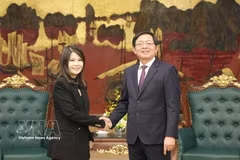
Deputy Prime Minister Ho Quoc Dung (right) receives Linda Tan, President of the Southeast Asia Semiconductor Association. (Photo: VNA)

Vietnam, Southeast Asia Semiconductor Association deepen semiconductor cooperation

Welcoming the SEMI Southeast Asia delegation, Deputy Prime Minister Ho Quoc Dung commended the association and its members for supporting Vietnamese ministries and agencies in advancing cooperation in science, technology, innovation and digital transformation, which he described as key drivers of the country's next phase of economic growth.

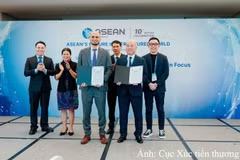
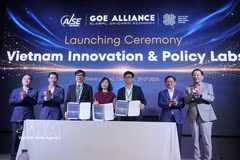
Representatives of participating organisations sign an agreement and officially launch the Vietnam Innovation & Policy Labs, an independent policy research and advisory organisation, at the Vietnam Global Innovation Connect (VGIC) 2026 in Ho Chi Minh City on July 29. (Photo: VNA)

Technology, talent to drive Vietnam’s digital leap forward: forum

The Vietnam Global Innovation Connect (VGIC) 2026 serves as a platform for dialogue among policymakers, enterprises, startups, investors and the global Vietnamese expert community to transform knowledge, technology and resources into practical initiatives and projects that contribute to the country's development.

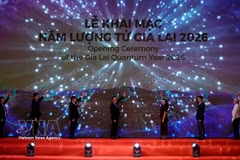
Delegates mark the launch of Gia Lai Quantum Year 2026. (Photo: VNA)

Gia Lai launches Quantum Year 2026

Held under the theme "Quantum Connectivity – Mastering Technology – Breakthrough Development", Quantum Year 2026 centres on four pillars: science, technology, education and training, and innovation ecosystem development.

AI offers both opportunities, challenges for Vietnam’s growth

AI offers both opportunities, challenges for Vietnam’s growth

Dr. Ho Duc Thang, a full-time member of the National Assembly’s Committee for Cultural and Educational, said productivity is the key to sustaining double-digit economic growth, and AI has greater potential to improve productivity than any previous technology.

Attracting sci-tech talent plays a critical role. (Photo: VNA)

Sci-tech seen as lever for Vietnam’s new growth phase

Raising the level of scientific and technological development is the only way to break out of the middle-income trap. Without it, Vietnam will remain stuck in low-value segments, said Dr. Le Xuan Sang, Deputy Director of the Institute of Vietnam and World Economy.

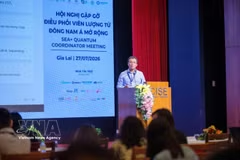
A speaker addresses the SEA+ Quantum Coordinator Meeting held in Gia Lai province on July 27. (Photo: VNA)

Regional conference strengthens Southeast Asia’s quantum technology ecosystem

Stronger networks linking government agencies, research institutes, universities, businesses and scientific organisations will provide a solid foundation for faster and more effective development of quantum technology, contributing to the sustainable development of each country and the region as a whole, said a Gia Lai official.

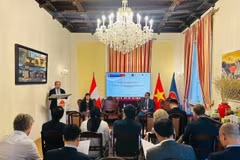
VAST Vice President Prof. Dr. Tran Tuan Anh speaks at an event in Vienna. (Photo published by VNA)

VAST expands global partnerships through science and people-to-people diplomacy

During a working visit to Austria from July 19-23, a VAST delegation led by Vice President Prof. Dr. Tran Tuan Anh held a series of meetings with leading research institutions and international organisations, including the International Institute for Applied Systems Analysis (IIASA), the Austrian Academy of Sciences, the Vienna University of Technology (TU Wien), and the International Atomic Energy Agency.