Vietnam to roll out 8.4 billion USD preferential loan scheme

The programme will be funded by state-owned commercial banks, which have pledged to provide concessional loans to help SMEs gain better access to capital to expand production and business activities, and support economic growth.

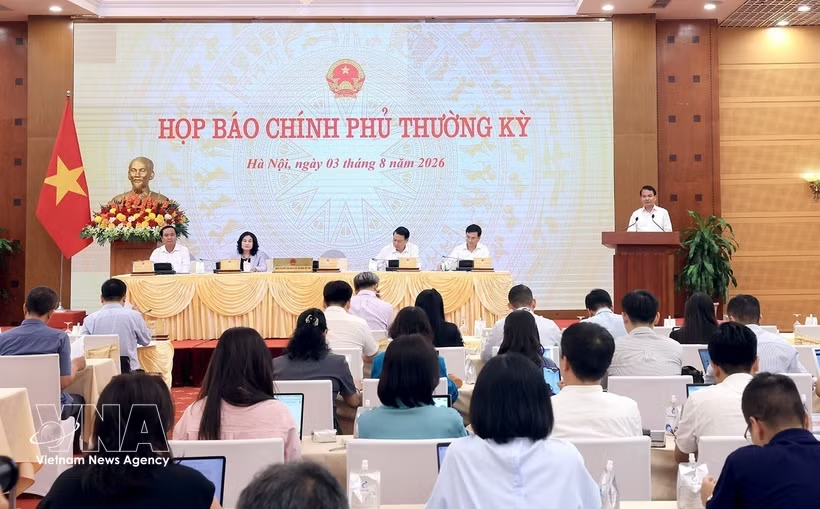
Delegates at the Government's regular press conference on August 3. (Photo: VNA)

Hanoi (VNA) – The State Bank of Vietnam (SBV) is finalising guidelines to launch a preferential credit programme worth around 220 trillion VND (nearly 8.4 billion USD) for small and medium-sized enterprises (SMEs) operating in priority sectors, Deputy Governor Pham Thanh Ha said at the Government's regular press conference on August 3.

The programme will be funded by state-owned commercial banks, which have pledged to provide concessional loans to help SMEs gain better access to capital to expand production and business activities, and support economic growth.

​According to Ha, the central bank has instructed and encouraged commercial banks, particularly state-owned lenders, to take the lead in allocating low-interest credit for eligible businesses. Following consultations with participating banks, the SBV is now completing implementation guidelines to ensure the programme can begin as soon as possible.

The credit package forms part of the SBV's broader efforts to stimulate growth amid persistent global uncertainties stemming from geopolitical conflicts and trade tensions.

Despite external headwinds, Vietnam's economy has posted encouraging results. Gross domestic product (GDP) expanded 8.18% in the first half of 2026 while inflation during the first seven months stood at 4.39%, with core inflation at 4.19%. However, growth remains below the Government's first-half target of 9.7%, underscoring the need for continued policy support.

To facilitate credit expansion, the SBV has maintained an accommodative monetary policy, keeping key policy interest rates unchanged while flexibly managing open market operations to support banking system liquidity. It has also adjusted exchange rates in line with market developments and introduced measures to improve capital availability.

A notable policy took effect on August 1 under Decision No. 1743/QD-NHNN, allowing banks to deduct 50% of fixed-term deposits held by the State Treasury when calculating their loan-to-deposit ratio. The SBV said the move would strengthen banks' funding capacity, improve liquidity management and create greater room for credit expansion.

At the same time, the central bank has instructed commercial banks to provide financing for 18 key infrastructure projects. It also raised the maximum ratio of short-term funds permitted for medium- and long-term lending to 40% from July 1, 2026, while allowing 25 credit institutions to exclude additional lending for social housing, industrial parks and export processing zones from their real estate credit growth limits.

As a result of these measures, outstanding credit across the banking system exceeded 20.15 quadrillion VND as of July 29, up 8.38% from the end of 2025. Credit has continued to be channelled into production, business activities, priority sectors and key growth drivers identified by the Government.

Ha said the SBV will continue pursuing a proactive and flexible monetary policy in the remaining months of the year, coordinating it closely with fiscal and other macroeconomic policies to contain inflation, maintain macroeconomic stability, ensure adequate credit supply and support sustainable economic growth./.


VNA

See more

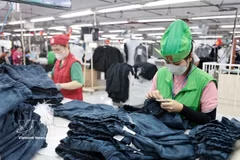
Garment is one of the key contributors to Vietnam's export growth. (Photo: VNA)

Resolution on renewing development model expected to unlock new growth drivers for Vietnam

The resolution on renewing Vietnam’s development model goes beyond the goal of rapid and sustainable economic growth. It establishes a comprehensive development model designed to unlock new growth space, mobilise resources more effectively, strengthen national competitiveness, and help Vietnam achieve its goal of becoming a developed, high-income country by 2045.

Production activities at FDI enterprises in Tay Ninh province help boost exports, create jobs, and enhance the locality's role in the regional supply chain. (Photo: VNA)

Seven-month economy stays on growth track, eyes double-digit expansion

According to the National Statistics Office (NSO) under the Ministry of Finance, inflation remained under control, with the consumer price index (CPI) edging down 0.1% in July from the previous month. Average CPI in the January–July period rose an estimated 4.39% year-on-year, staying within the yearly target.

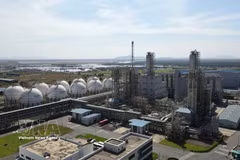
A view of Hyosung chemical plant, a RoK-invested project in Tan Phuoc ward, Ho Chi Minh City. (Photo:: VNA)

Ho Chi Minh City gears up for next-generation FDI inflows

Ho Chi Minh City is calling for investment in around 250 projects across nine priority sectors, mainly focusing on developing the International Financial Centre, digital finance, smart banking and supporting data infrastructure, large-scale logistics and port developments, transport infrastructure supporting trade, import-export activities, industry and smart logistics, green industries, clean energy and next-generation industrial parks.

The construction site of the APEC Conference Centre in Phu Quoc special zone, An Giang province. (Photo: VNA)

Government proposes special mechanisms to unblock APEC 2027 projects in Phu Quoc

The projects in Phu Quoc have been implemented under tight deadlines. Since May 2025, the Prime Minister has directed preparations for APEC 2027, including accelerated infrastructure development on the special zone. An Giang province and investors have subsequently launched a number of major projects involving complex technical requirements and demanding construction schedules.

An overview of the smart Youyi Guan-Huu Nghi border gate pair (Photo published by VNA)

Law expected to facilitate cross-border trade

Deputy Director of the Department of Customs Nguyen Thanh Hung said the draft law establishes a legal framework to convert fragmented customs documents into standardised digital data, enabling AI to process and analyse information for automated customs clearance.

Using drones in agricultural production in Lai Chau province. (Photo: nhandan.vn)

New growth drivers offer Vietnam's agriculture chance to accelerate

According to Deputy Minister of Agriculture and Environment Dang Ngoc Diep, agricultural, forestry and fishery exports fetched an estimated 35.88 billion USD in the first six months of 2026, up 6% year-on-year. The sector's GDP expanded by more than 3.8%, exceeding the government's 3.7% target. The results were underpinned by stable production, particularly in key industries.