Hanoi (VNA) – The effective use of new-generation free trade agreements (FTAs) has enabled Vietnamese businesses to expand into new markets, strengthen their competitiveness and integrate more deeply into global value chains.
According to the Ministry of Industry and Trade, as of July this year, more than 1.2 million certificates of origin (C/Os) had been issued under various FTAs, covering exports worth nearly 100 billion USD, equivalent to 28% of Vietnam's total export value.
The utilisation rate of FTA tariff preferences remains high, with some agreements, such as the EU-Vietnam Free Trade Agreement (EVFTA), the ASEAN-India FTA, and the ASEAN-Australia-New Zealand FTA, recording rates of 30-50%.
More than 383 billion USD generated in six years
Statistics from the Ministry of Finance show that total two-way trade between Vietnam and the EU from January 1995 to June 2026 surpassed 900 billion USD.
Notably, 383.8 billion USD, or 42.6% of the total, was generated during just the first six years of implementing the EVFTA from 2020 to 2026.
In the first half of this year alone, bilateral trade reached 41.4 billion USD, with Vietnam exporting 31.8 billion USD to the bloc. The country posted a record trade surplus of 22 billion USD in the period, exceeding the 21.7 billion USD surplus recorded for the whole of 2019, before the EVFTA came into force.
According to a recent survey by the European Chamber of Commerce in Vietnam (EuroCham), 50% of EU businesses operating in Vietnam reported benefiting directly from EVFTA tariff preferences, while 66% said they had reduced costs by 5-30%. Some European companies noted that more than 80% of Vietnam-EU trade now qualifies for preferential tariffs, lowering product costs by 5-15% and improving market competitiveness.
Beyond the EVFTA, many Vietnamese companies are also optimising other new-generation FTAs, including the Comprehensive and Progressive Agreement for Trans-Pacific Partnership (CPTPP), the Regional Comprehensive Economic Partnership (RCEP) and the Vietnam-Korea Free Trade Agreement (VKFTA), to diversify markets and deepen participation in global supply chains.
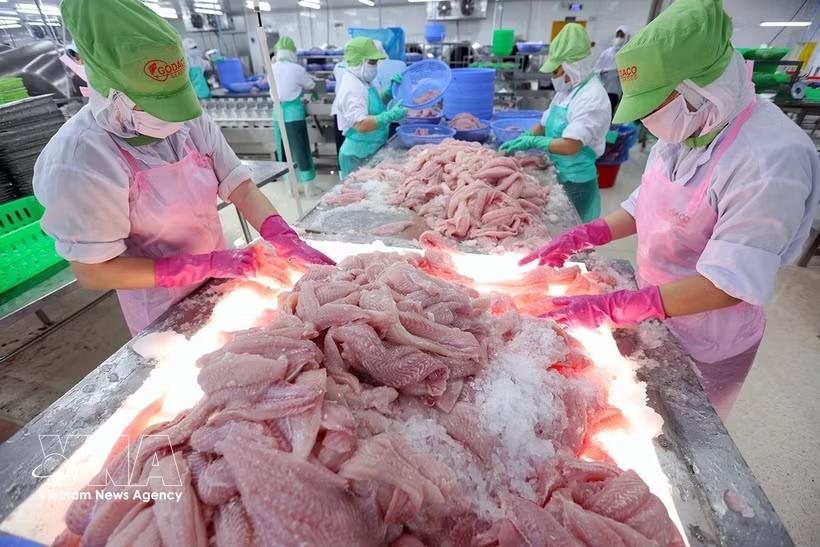
Huynh Minh Tuong, deputy general director of Ba Ria - Vung Tau Seafood Processing And Import-Export JSC (BASEAFOOD), said that before the Vietnam-Japan FTA took effect, part of local seafood exports was shipped to China for processing before being re-exported to Japan. With preferential tariffs now available, Vietnamese companies can process products domestically and export them directly to Japan, significantly enhancing competitiveness. As a result, BASEAFOOD's exports to Japan have increased by 30-40%.
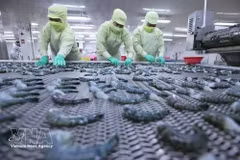
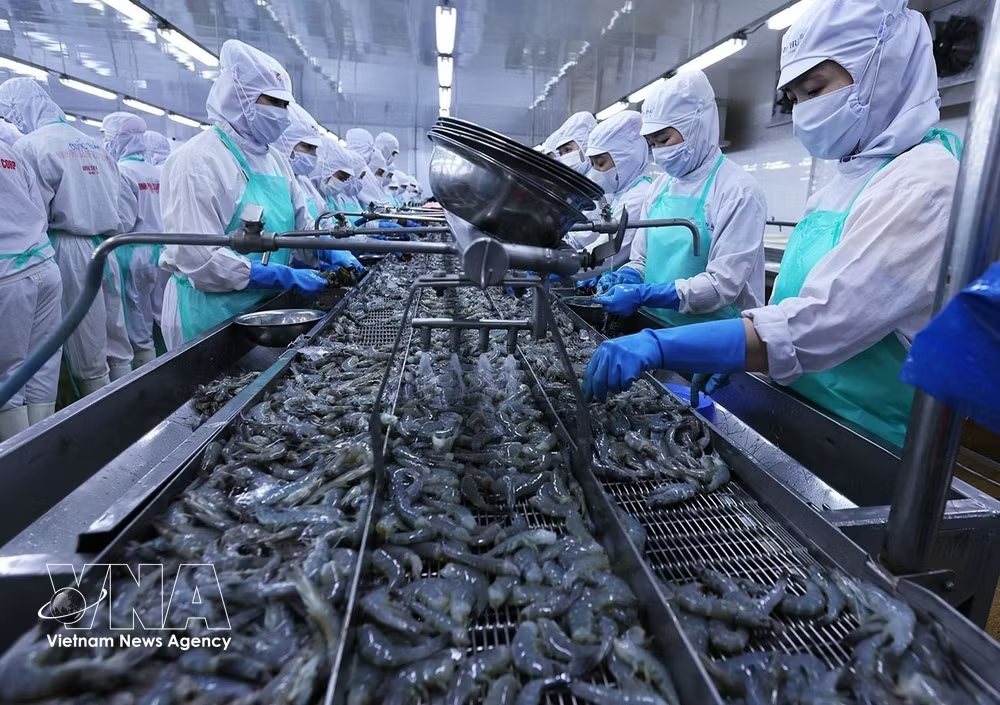
Similarly, Minh Phu Seafood Corporation has used the CPTPP to expand shrimp exports to Canada, Japan and Australia, while Vinh Hoan Corporation has increased its Tra fish market share in Canada and other CPTPP members.
Loc Troi Group has expanded rice exports to Asian markets, particularly China and ASEAN countries, by taking advantage of the CPTPP's flexible rules of origin and streamlined procedures. Vinamilk has utilised the VKFTA and ASEAN FTAs to boost dairy exports to the Republic of Korea, the Philippines, Singapore and other regional markets. Hoa Phat Group has increased steel exports across the Asia-Pacific while using regional raw materials to satisfy RCEP rules of origin. Meanwhile, Vinatex has secured more orders from Canada, Australia and New Zealand under the CPTPP and invested in an integrated fibre-weaving-dyeing supply chain to comply with origin requirements.
Considerable untapped potential remains
Assessing Vietnam's FTA performance, Nguyen Ly Truong An, a trade expert at Long An University of Economics and Industry, said businesses' ability to utilise FTAs remains uneven.
Large enterprises with stronger management capacity, advanced technology and well-developed supply chains generally benefit more, while many small- and medium-sized ones continue to face difficulties accessing information, mobilising resources and meeting the stringent standards of export markets.
"The effectiveness of FTA utilisation depends heavily on business leaders' awareness and strategic vision," An said. "Some companies have achieved remarkable growth by proactively taking advantage of these agreements, while others have missed valuable opportunities despite having similar resources.”
FTAs are not simply about tariff reductions; they are a catalyst for them to restructure production, enhance competitiveness, and integrate more deeply into global value chains, he noted.
From a broader perspective, Associate Professor Nguyen Thuong Lang from the National Economics University’s institute of trade and international economics, said FTAs are not only a powerful driver of exports but also an important catalyst for restructuring Vietnam's economy.
According to the expert, if Vietnam fully capitalises on its FTA commitments, it will expand its development opportunities, attract higher-quality investment and become more appealing to international investors. At the same time, it will strengthen domestic production capacity and enhance the global standing of Vietnamese products.
“This is the key to creating new growth momentum at a time of intensifying international trade competition," he said./.