Rice exports: Leveraging FTAs to overcome global challenges

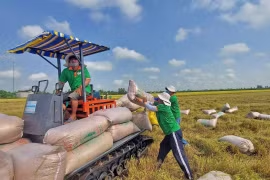
According to data from Vietnam Customs, Vietnam exported more than 7.53 million tonnes of rice worth over 3.85 billion USD in the first 11 months of 2025.

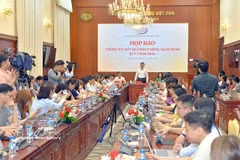
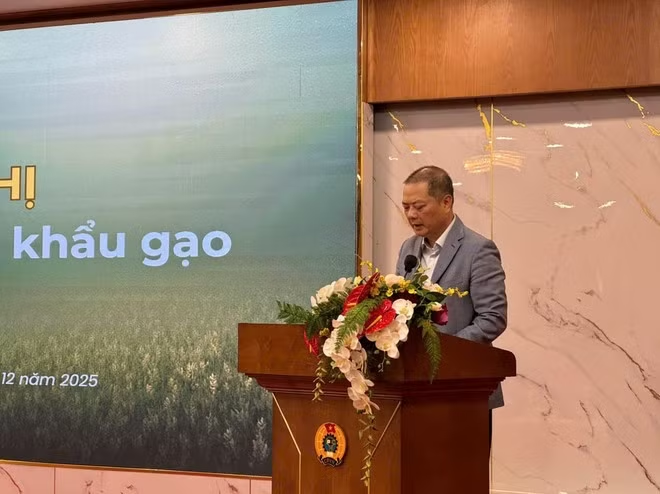
Nguyen Anh Son, Director General of the Agency of Foreign Trade under the Ministry of Industry and Trade, speaks at the conference. (Photo: Ministry of Industry and Trade)

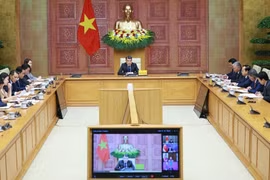
HCM City (VNA) – Solutions to capitalise on incentives from free trade agreements (FTAs), expand into high-value markets and build strong, high-quality rice brands were highlighted as strategic directions for the sector at an export rice business conference on December 10.

Nguyen Anh Son, Director General of the Agency of Foreign Trade under the Ministry of Industry and Trade (MoIT), noted a series of difficulties facing the rice sector, including escalating geopolitical instability, persistently high inflation, and slow global trade and investment recovery. Tight monetary policies in major economies continue to exert pressure on financial and currency markets in developing countries.

Meanwhile, global consumer demand and economic activity remain subdued.

He added that protectionist measures are re-emerging in various forms, while developed economies are increasingly prioritising consumer safety, sustainability and climate action, resulting in new standards and regulations for imported goods.

According to data from Vietnam Customs, Vietnam exported more than 7.53 million tonnes of rice worth over 3.85 billion USD in the first 11 months of 2025. The average export price stood at more than 511 USD per tonne, down 10.9% in volume and 27.4% in value year-on-year. Significant declines were recorded in several markets, including Indonesia (down over 96%) and Malaysia (down 32.5%).

Conversely, exports reported strong growth in other markets: Ghana up 52.64%, China up more than 165%, Senegal up roughly 73 times, and Bangladesh up a remarkable 238 times. These increases helped offset sharp falls in Indonesia, Cuba, and Malaysia. Vietnam’s rice exports currently consist mainly of high-quality white rice and fragrant varieties, which account for 69% of total shipments.

The Philippines, Vietnam’s largest rice market in recent years, is expected to resume imports from January 2026, albeit with adjustments to tariff levels. Demand from traditional markets such as China, Bangladesh and African countries is also rising. Vietnam has additionally secured new rice trade agreements, creating opportunities to penetrate emerging markets. Domestically, the quality of Vietnamese rice continues to improve, strengthening its competitiveness globally.

Representatives from the Plant Protection and Crop Production Department under the Ministry of Agriculture and Environment forecast that rice cultivation areas will fall by around 0.2 million ha in 2026 due to seasonal adjustments, with output estimated at about 43 million tonnes. They urged localities to focus on restoring production after natural disasters and ensuring stable cultivation areas, seed structures and schedules for the 2025–2026 winter-spring crop.

The Mekong Delta will continue rolling out the project to develop one million ha of sustainable, high-quality, low-emission rice linked to green growth by 2030, while fostering consumption and export of this product line.

Le Thanh Tung, Standing Vice Chairman and General Secretary of the Vietnam Rice Industry Association, proposed that rice be considered a special commodity requiring close monitoring to ensure domestic consumption and food security alongside effective export performance.

He called for strengthening linkages to establish stable material zones that meet food safety, traceability and quality standards, and to build strong branding for Vietnamese rice. Businesses and farmers, he stressed, must produce in line with import market requirements to balance supply and demand and maintain price stability.

Ngo Chung Khanh, Deputy Director General of the MoIT’s Multilateral Trade Policy Department, recommended developing plans and strategies to maximise the benefits of FTAs for the rice sector. This includes clear task allocation among agencies and enterprises, accelerating brand-building efforts, and enhancing coordination between state bodies and industry associations.

Commercial counsellors from Vietnam’s trade offices in Australia, Nigeria, Singapore, Malaysia, the Philippines, Egypt, Algeria, China and other markets provided updates on rice import policies in their host countries. They urged Vietnamese exporters to pay close attention to quality standards, quarantine procedures, packaging and labelling, while carefully assessing the profiles and payment practices of foreign partners to ensure safe and effective exports./.
VNA

See more

Hoa Phat Wharf inside the Dung Quat Economic Zone (Photo: VNA)

Dung Quat EZ, Quang Ngai IPs draw nearly 19.4 bln USD

The Dung Quat Economic Zone and Quang Ngai industrial parks have so far attracted 441 projects worth around 19.4 billion USD, according to the Dung Quat Economic Zone and Quang Ngai Industrial Parks Authority (DEZA).

The Kim Long Motor Hue factory (Photo: VNA)

Hue courts capital to turn industrial zones into growth engine

The economic and industrial zones in Hue city host more than 200 active investment projects worth over 152 trillion VND (5.84 billion USD), with 139 already operational. Since the start of 2026, they have generated about 32 trillion VND, contributed 4.2 trillion VND to the state budget and brought in 730 million USD in exports, while employing more than 46,000 workers.

Processing cashew nuts for export at Nguyen Thong Co., Ltd. in Dak Lak province. (Photo: VNA)

Vietnam’s exports to New Zealand post strong growth

According to the Customs Department, two-way trade reached 844 million USD in the first half of 2026, of which Vietnam’s exports to New Zealand totaled 399.7 million USD, up 18.8% year-on-year, while imports stood at 444 million USD.

Starting from September 2026, agricultural products from the Mekong Delta are expected to be transported directly from Cai Cui Port to Guangxi, China. (Photo: VNA)

Investing in logistics to boost agricultural production and exports

Logistics is increasingly becoming a major bottleneck for exports as transport costs rise and requirements for data management, low emissions and supply chain transparency become more stringent, requiring coordinated investment in logistics infrastructure, data infrastructure and transport capacity.

Harvesting rice in the Mekong Delta (Photo: VNA)

Vietnam seen as gateway for Canadian farm produce to ASEAN

As Canada steps up trade diversification and seeks to reduce its dependence on the North American market, Vietnam could serve both as a market for Canadian goods and a base for Canadian businesses to build production capacity and expand operations in the region.

Illustrative image (Photo: VNA)

Turkish cooperatives open sourcing channel for Vietnamese businesses

The Vietnam Trade Office recommended that Vietnamese businesses in agriculture and food actively study cooperative networks in different localities in Türkiye and consider them an additional channel for accessing raw materials, processing partners, and distribution networks.

Delegates at the signing ceremony (Photo: VNA)

VPI, Beicip-Franlab Asia deepen oil, gas cooperation

Under the MoU, VPI and Beicip-Franlab Asia will undertake advanced studies in geology, geophysics, and reservoir engineering to support exploration, field development, and oil and gas resource assessment.

A visitor explores Vietnamese coffee at the expo. (Photo: VNA)

Vietnam pushes coffee, farm produce at Hong Kong food expo

After nearly 200 years, especially since the Doi Moi (renewal) began in 1986, Vietnamese coffee is now exported to more than 100 countries and territories and supports about 2.6 million jobs. Vietnam remains the world’s second largest coffee exporter, holding roughly 19-21% of the global market, and is the top producer of Robusta coffee.

Delegates at the event (Photo: VNA)

Da Nang hosts 2026 International Logistics Forum

Co-hosted by the Ministry of Industry and Trade and the Da Nang People’s Committee, the forum put modern logistics, strategic infrastructure, digital transformation, green growth and international connectivity at the centre of discussions.

Prime Minister Le Minh Hung speaks at the working session. (Photo: VNA)

Monetary policy must ensure macro stability, support growth: PM

The SBV was required to keep policy interest rates steady and add liquidity so lenders can access cheaper funding. It must manage the exchange rate in line with market developments, coordinate monetary tools, and intervene to stabilise the foreign exchange market, while maintaining close oversight of gold. Lenders must continue cutting costs, stabilising lending rates, and delivering substantive reductions.

People buy petrol at a station in Hanoi (Photo: VNA)

Petrol prices cut from 15:00 on August 13

The price of E5 RON92 petrol is capped at 21,235 VND (0.81 USD) per litre, down 493 VND, while E10 RON95-III is priced at no more than 22,119 VND per litre, down 205 VND.

Domestic and foreign businesses engage in trade networking at the event series held at Ho Chi Minh's Saigon Exhibition and Convention Centre (SECC) on August 13, 2026. (Photo: VNA)

Int'l sports exhibitions, export trade fair open in Ho Chi Minh City

A series of events opened at the Saigon Exhibition and Convention Centre (SECC) in Ho Chi Minh City on August 13, including the Vietnam Sport Show 2026, Vietnam Cycle Expo 2026 and the 14th Zhejiang Export (Vietnam) Fair 2026. They feature 520 booths operated by 400 businesses from 15 countries and territories.

Production at Bumjim Electronics Vina Co., Ltd invested by the Republic of Korea in Quang Ninh province (Photo: VNA)

Resolution No. 19-NQ/TW sets new growth drivers for Vietnam

Science and technology, innovation, digital transformation and AI must be translated into higher productivity rather than pursued as ends in themselves. At the same time, people should be placed at the centre of development, not merely viewed as a resource but as the ultimate objective of development policies.