Tay Ninh strengthens cooperation in human resource training with Japan’s Okayama

Tay Ninh province is currently home to over 2,000 foreign direct investment (FDI) projects with a total registered capital of nearly 25 billion USD. Japan ranks fourth among the foreign investors, with 176 projects worth more than 1.26 billion USD.

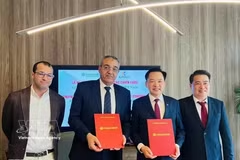
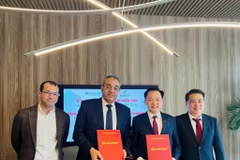
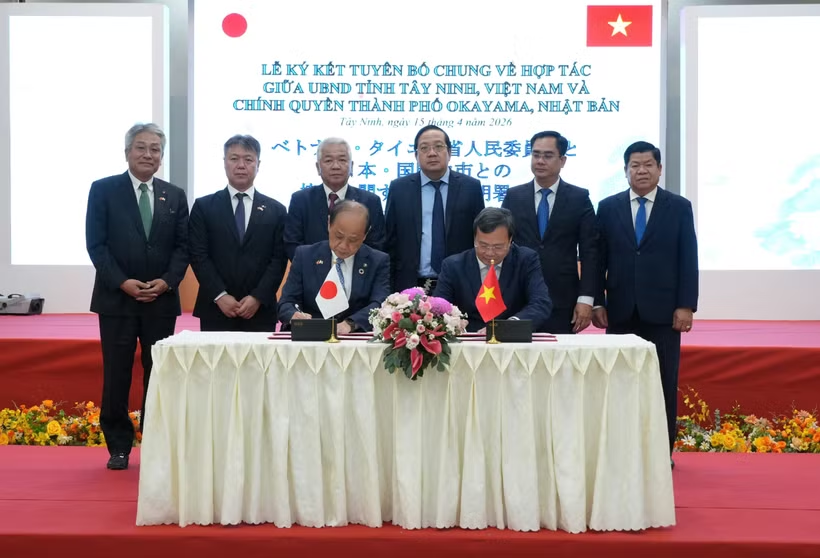
Chairman of the Tay Ninh provincial People's Committee Le Van Han and Mayor of Okayama city Masao Omori sign a joint declaration on cooperation between the two localities. (Photo: VNA)

Tay Ninh (VNA) – A delegation from Japan’s Okayama City, led by Mayor Masao Omori, paid a working visit to the southern province of Tay Ninh on April 15, aiming to enhance exchanges and promote bilateral cooperation between the two localities.

The delegation was received by Chairman of the Tay Ninh People’s Committee Le Van Han, along with representatives from provincial departments and agencies.

At the meeting, both sides shared updates on their socio-economic development, reviewed past cooperation outcomes, and discussed future orientations. Key areas included high-tech industries, supporting industries, human resource training, internship programmes, and cultural and tourism exchanges.

Han highlighted the visit as an important opportunity to deepen mutual understanding and foster more substantive and effective cooperation.

He noted that Tay Ninh has recorded encouraging socio-economic achievements in recent years. In 2025, the province’s GRDP expanded by 9.52%, placing it among the country’s high-growth localities. Its economic structure has continued to shift towards industrialisation, with industry and construction driving growth. Total import-export turnover exceeded 31 billion USD, with Japan remaining a key trade partner, accounting for nearly 1.5 billion USD.

Tay Ninh province is currently home to over 2,000 foreign direct investment (FDI) projects with a total registered capital of nearly 25 billion USD. Japan ranks fourth among the foreign investors, with 176 projects worth more than 1.26 billion USD. Japanese enterprises operating in Tay Ninh are mainly engaged in manufacturing, mechanical engineering, electronics, and agro-forestry-fishery processing.

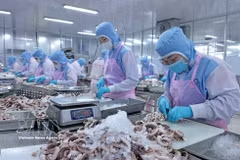
Looking ahead, Tay Ninh aims to attract further investment in high-tech industries, supporting industries, digital transformation, artificial intelligence, semiconductor production, high-tech agriculture, and renewable energy. The province also proposed expanding cooperation in human resource training and sending Vietnamese workers to Japan, particularly in precision engineering, automotive technology, nursing, and elderly care. Strengthening links between training institutions and businesses was also highlighted as key to improving workforce quality.

Both sides discussed expanding cooperation in culture and education, including developing a display space at the Vietnam–Japan Friendship Cultural Village in Tay Ninh, and creating tourism products incorporating Japanese cultural elements.

For his part, Omori praised the strong ties between Vietnam and Japan, as well as between Tay Ninh and Okayama. Amid deepening international integration, businesses from Okayama are increasingly expanding overseas, with Vietnam considered a strategic destination. He expressed his hope that Vietnamese localities, including Tay Ninh, would continue to facilitate Japanese enterprises in exploring investment and business opportunities.

Omori also noted that Okayama is facing labour shortages in sectors such as construction, nursing, elderly care, driving, and commerce. He expressed his desire to strengthen cooperation with Tay Ninh in training and recruiting qualified workers to meet local development needs, while creating more job opportunities and improving incomes for Vietnamese labourers.

At the meeting, the two sides agreed to consolidate and expand cooperation based on existing agreements, while considering updates to align with new conditions. A joint statement on cooperation between Tay Ninh and Okayama was signed, laying the groundwork for deeper, more practical and sustainable ties in the future./.

VNA

See more

The meeting between General Secretary of the Communist Party of Vietnam Central Committee and State President To Lam and Chairman and Chief Executive Officer of Hayleys PLC Mohan Pandithage in Colombo on May 8 (Photo: VNA)

Vietnamese leader hopes for stronger ties with Sri Lanka's Hayleys PLC

General Secretary and President To Lam said that given the complementarity of the two economies and their substantial room for growth, Vietnam wishes to enhance cooperation with major Sri Lankan enterprises, especially those with regional market networks and connectivity capabilities such as Hayleys.

The export of 1.1 million doses of vaccine lumpy skin disease (LSD) to the Republic of Korea marks an important milestone for Vietnam’s veterinary vaccine industry. (Photo: nongnghiepmoitruong.vn)

Vietnamese-made LSD vaccine enters demanding RoK market

The successful research and commercialisation of the LSD vaccine, which has been widely used in the domestic market and is gradually expanding internationally, helps affirm the position of Vietnamese veterinary vaccines globally.

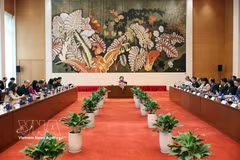
General Secretary of the Communist Party of Vietnam (CPV) Central Committee and State President To Lam addresses the Vietnam – Sri Lanka Trade-Investment-Tourism Cooperation Forum in Colombo on May 8. (Photo: VNA)

Top leader urges stronger Vietnam-Sri Lanka economic connectivity

Vietnam – Sri Lanka cooperation should be viewed within the broader context of the Indian Ocean, South Asia and emerging global supply chains, and the key issue now is not potential, but swift, decisive and effective action, said Vietnam's top leader To Lam.

The meeting between Vietnamese Minister of Industry and Trade Le Manh Hung and representatives from Essar Group (Photo: VNA)

Vietnam, India step up cooperation in energy, biofuels

Vietnam encourages capable investors to participate in oil and gas, energy and energy infrastructure projects in line with the national energy development strategy, while ensuring investment efficiency and compliance with Vietnamese law.

In the first four months of 2026, total FDI inflows into Vietnam reaches 18.24 billion USD, up 32% year-on-year. (Illustrative photo: VNA)

Vietnam draws stronger foreign investment inflows despite global headwinds

In the first four months of 2026, total FDI inflows into Vietnam reached 18.24 billion USD, up 32% year-on-year. Disbursed capital was estimated at more than 7.4 billion USD, an increase of 9.8% and the highest four-month disbursement level recorded in the past five years, reflecting effective implementation of many registered projects.

A Boeing 787 aircraft of Vietnam’s national flag carrier, Vietnam Airlines, lands on its first flight at Long Thanh International Airport. (Photo: VNA)

Deputy PM stresses strategic, synchronous planning for airport system

The national airport system planning was approved by the Prime Minister under Decision No. 648/QD-TTg dated June 7, 2023. Under the planning, 30 airports (14 international and 16 domestic) are to be developed during the 2021–2030 period, with a vision to 2050 expanding the network to 33 airports (14 international and 19 domestic).

Modern machinery improves labour productivity. (Photo: VNA)

Upskilling becomes key lever for Vietnamese workforce in digital era

As the economy is pivoting to a growth model fueled by knowledge, technology and innovation, the working class, or the backbone of production, demands better professional qualifications, vocational skills, industrial discipline and work habits. Timely adaptation is the only shield against being undercut by accelerating automation, artificial intelligence and increasingly fiercer global competition.

A circular organic farming model in Khanh Hoa is delivering initial economic efficiency. (Photo: VNA)

New growth potential unlocked for Vietnamese economy

Prime Minister Le Minh Hung once stressed that cutting administrative procedures and business conditions remains one of the fastest and most effective ways to stimulate growth and strengthen confidence among citizens and enterprises. He underscored that the reform process must remain continuous and responsive to practical requirements.