Seven-month economy stays on growth track, eyes double-digit expansion

According to the National Statistics Office (NSO) under the Ministry of Finance, inflation remained under control, with the consumer price index (CPI) edging down 0.1% in July from the previous month. Average CPI in the January–July period rose an estimated 4.39% year-on-year, staying within the yearly target.

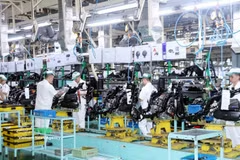
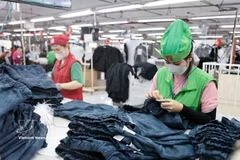
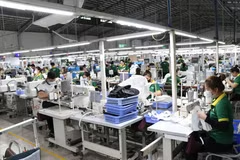
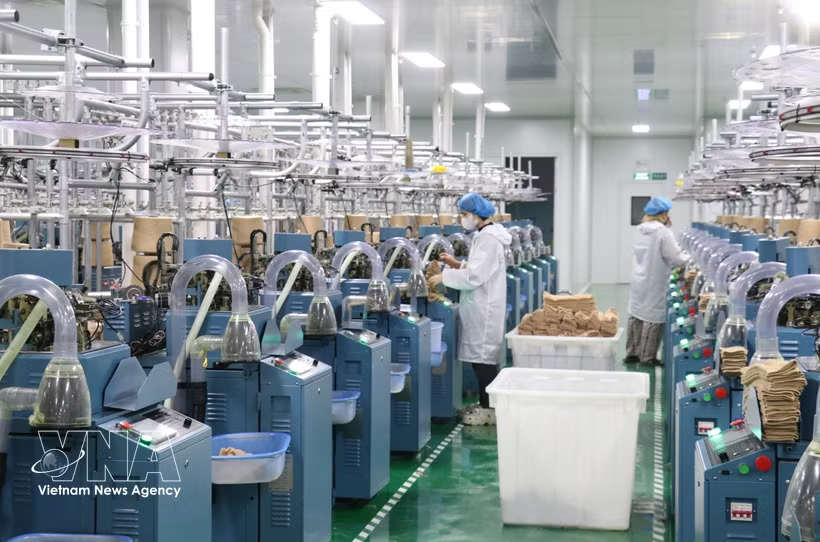
Production activities at FDI enterprises in Tay Ninh province help boost exports, create jobs, and enhance the locality's role in the regional supply chain. (Photo: VNA)

Hanoi (VNA) – Vietnam's economy maintained solid momentum in the first seven months of 2026, supported by resilient trade, robust foreign investment, stronger public investment disbursement and a recovery in manufacturing, although significant challenges remain in achieving the Government's double-digit GDP growth target this year.

According to the National Statistics Office (NSO) under the Ministry of Finance, inflation remained under control, with the consumer price index (CPI) edging down 0.1% in July from the previous month. Average CPI in the January–July period rose an estimated 4.39% year-on-year, staying within the yearly target.

State budget revenue reached an estimated 1.83 quadrillion VND, equivalent to 72.5% of the annual target, up 16% from a year earlier. During the period, tax and fee reductions amounted to about 131.6 trillion VND, while around 42 trillion VND in taxes and fees were deferred to support businesses and people.

Foreign direct investment (FDI) remained a bright spot in the reviewed period. Total registered FDI, including direct and indirect investment, exceeded 38 billion USD in the last seven months, up 58% year-on-year. Disbursed FDI was estimated at more than 15 billion USD, nearly 12% higher than a year earlier – the highest level recorded in the past five years.

Manufacturing and processing attracted nearly 13 billion USD, accounting for almost 83% of total disbursed FDI, followed by real estate with 1.1 billion USD, and production and distribution of electricity, gas, hot water and air conditioning with 549 million USD.

Public investment disbursement also improved, reaching 425.3 trillion VND as of July 31, equivalent to 41.9% of the plan assigned by the Prime Minister.

Nguyen Thi Mai Hanh, head of the National Accounts Department at the NSO, said public investment is expected to become a stronger growth driver in the second half as major infrastructure projects gather pace.

Business activity showed further recovery, with more than 187,000 newly established and resumed enterprises in the January–July period, up nearly 8% year-on-year. Meanwhile, over 155,000 firms exited the market, also up nearly 8%.

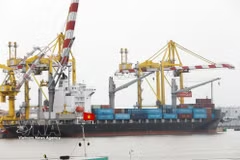
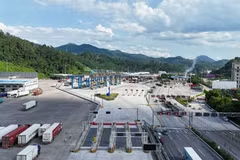
Trade remained a key pillar of growth. Total import-export turnover approached 660 billion USD, up more than 28% year-on-year. Exports reached nearly 320 billion USD, rising almost 22%, while imports climbed nearly 35% to about 340 billion USD.

Deputy Minister of Industry and Trade Nguyen Sinh Nhat Tan said the country's total trade value may surpass 1 trillion USD in 2026, driven by more effective use of new-generation free trade agreements (FTAs).

Meanwhile, S&P Global's July Purchasing Managers' Index (PMI) showed manufacturing recovery gaining strength, with faster growth in output, new orders and exports, rising employment and purchasing activity, and easing inflationary pressures.

Despite the positive picture, the Ministry of Finance warned of mounting challenges, including labour shortages in some projects, rising labour and material costs, slow disbursement progress in key national projects, limited room for inflation management amid volatile global oil prices.

Deputy Minister of Finance Nguyen Duc Chi said the Government has updated its growth scenarios under Resolution No. 168/NQ-CP and adopted flexible policy responses through Resolution No. 180/NQ-CP to support the goal of achieving at least 10% growth while maintaining macroeconomic stability.

Key measures include continuing fiscal support through tax and fee policies, maintaining stable monetary and foreign exchange markets, keeping lending rates in check, ensuring energy security and stable fuel supplies, reducing administrative and logistics costs, accelerating strategic infrastructure projects, expanding export markets and making full use of signed FTAs.

Prime Minister Le Minh Hung has also instructed ministries and localities to regularly review and update their progress toward growth targets so that timely and effective measures can be taken to sustain economic momentum; speed up public investment disbursement, particularly in lagging ministries and provinces; and ensure the full disbursement of the 2026 public investment plan without returning unused central budget funds before evaluating their impact on growth objectives./.
VNA

See more

New Zealand apples on sale at a supermarket in Vietnam (Photo: VNA)

Vietnamese consumers develop taste for Australian, New Zealand fruit

According to statistics from the Department of Customs, in the first six months of 2026, Vietnam imported 102.8 million USD worth of fruit, vegetables and flowers from Australia, up 55.7% from the same period last year. Australia's share of total imports rose from 5.5% to 6.51%, highlighting the growing position of the market as a supplier. Imports from New Zealand reached 78.04 million USD, up 20.4% year-on-year.

Semiconductor products, chips and components displayed at a ceremony to launch a national centre for semiconductor chip pilot production support in Hanoi on June 26. (Photo: VNA)

US semiconductor push offers Vietnam opportunities, policy challenges

The Vietnam-US semiconductor partnership is therefore not simply a “golden opportunity” arising from geopolitical shifts, but also a long-term test of Vietnam’s institutional reform and implementation capacity. If domestic capacity cannot keep pace, adjusting targets toward quality and execution, rather than simply expanding the number of projects, will be essential.

Workers process fruit for export at the Chanh Thu factory in Cho Lach commune, Vinh Long province. (Photo: VNA)

Vietnam works to maintain edge in key agricultural market

According to Le Hang, Deputy Secretary-General of the Vietnam Association of Seafood Exporters and Producers (VASEP), China and Hong Kong (China) remained bright spots for Vietnam’s aquatic exports in July, with revenue exceeding 267 million USD, up 24.7% year-on-year.

An estimated 6,300 workers are needed by the semiconductor industry in Bac Giang province during the 2025-2030 period. (Photo: VNA)

India's semiconductor strategy complementary to Vietnam's chip sector: expert

Sudhanshu Mittal, Director of Engineering Solutions at the National Association of Software and Service Companies (Nasscom) of India, noted that during the state visit to India by General Secretary of the Communist Party of Vietnam Central Committee and President To Lam in May, the two countries signed a number of cooperation agreements, with semiconductors identified as a priority area alongside artificial intelligence (AI), cybersecurity, and advanced technologies.

At the working session between Vietnamese Minister of Finance Ngo Van Tuan (right) and RMIT University’s Vice-Chancellor and President Professor Alec Cameron in Sydney on August 10 (Photo: tapchikinhtetaichinh.vn)

Vietnam, Australia seek to expand investment in rice value chain

During General Secretary of the Communist Party of Vietnam Central Committee and President To Lam’s state visit to Australia from August 9-12, Vietnamese Minister of Finance Ngo Van Tuan, authorised by the General Secretary and President, held working sessions with SunRice Group CEO Paul Serra and RMIT University’s Vice-Chancellor and President Professor Alec Cameron in Sydney on August 10.

Students practice microcontroller programming at the Vietnam-Korea College of Technology in Bac Ninh province (Photo: VNA)

Vietnam – one of most attractive destinations for leading US semiconductor companies: expert

Vietnam has built a solid semiconductor and electronics industry before joining ITSI, attracting major US semiconductor companies. Intel Products Vietnam is one of Intel's largest assembly and testing facilities worldwide, while chip design companies such as Synopsys, Cadence, Marvell and Qualcomm have established engineering and research centres in the Southeast Asian country.

Lawmakers on August 9 discuss a draft law amending and supplementing a number of articles of the Law on the State Bank of Vietnam, the Law on Anti-Money Laundering and the Law on Credit Institutions. (Photo: VNA)

Lawmakers discuss measures to ensure banking system safety, support digital economy

The draft law sets out provisions to control conflicts of interest when commercial banks act as agents managing collateral for corporate bonds. In this regard, Deputy Le Van The of Ninh Binh province said he supported the move, noting that it could provide a more professional approach to collateral management and help strengthen investor confidence if properly regulated.

A company in Da Nang operates a customer relationship management system supported by AI chatbots. (Photo: VNA)

AI drives rise of sleepless enterprises in Vietnam

The concept of a sleepless enterprise does not necessarily mean making employees stay on the job all the time. Instead, it's about building intelligent systems that can respond to customers, process transactions, monitor operations, analyse data and flag risks continuously.

Head of the Vietnam Trade Office in Australia Tran Thi Thanh My (Photo: VNA)

Vietnam, Australia eye 20 bln USD trade target

The head of the Vietnam Trade Office in Australia hoped that the visit by Party General Secretary and State President To Lam will mark a new milestone, opening the door for firms on both sides to forge stronger links and launch concrete cooperation agendas, helping hit that 20 billion USD trade goal sooner rather than later.