Ho Chi Minh City gears up for next-generation FDI inflows

Ho Chi Minh City is calling for investment in around 250 projects across nine priority sectors, mainly focusing on developing the International Financial Centre, digital finance, smart banking and supporting data infrastructure, large-scale logistics and port developments, transport infrastructure supporting trade, import-export activities, industry and smart logistics, green industries, clean energy and next-generation industrial parks.

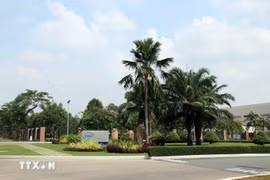
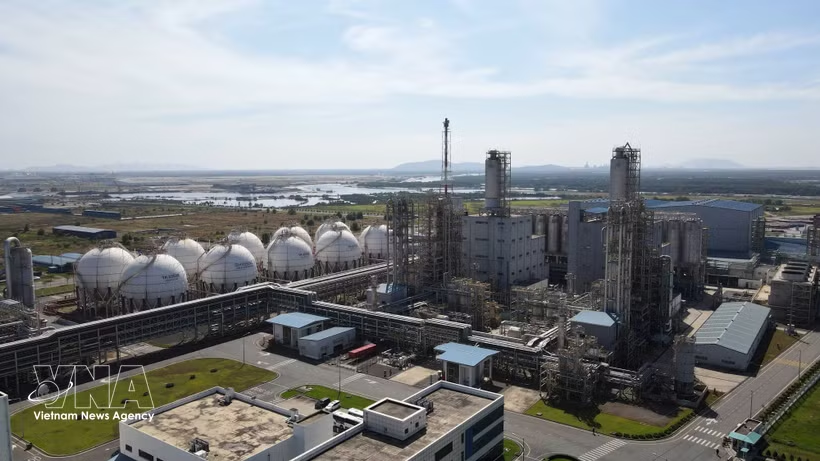
A view of Hyosung chemical plant, a RoK-invested project in Tan Phuoc ward, Ho Chi Minh City. (Photo:: VNA)

Hanoi (VNA) - Ho Chi Minh City is positioning itself as a destination for next-generation foreign direct investment (FDI) after its administrative merger with Binh Duong and Ba Ria-Vung Tau provinces, leveraging the combined strengths of finance, manufacturing, logistics, innovation and high-quality services to drive sustainable growth.

Beyond market access, global investors are increasingly seeking destinations with well-connected infrastructure, skilled human resources, vibrant innovation ecosystems and business-friendly governance. According to local officials, the expanded city is well positioned to meet those requirements.

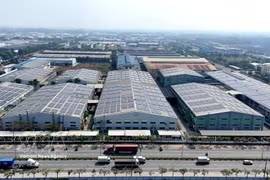
The city now has 67 export processing and industrial parks covering more than 27,000 ha. Under its master plan to 2050, the number will rise to 105, spanning over 49,000 ha. As of June 2026, the city was home to more than 21,350 FDI projects with nearly 147 billion USD in registered capital.

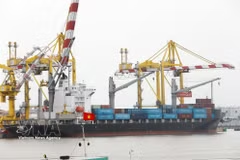
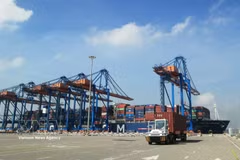
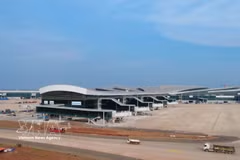
Pham Quang Nhat, Director of the Ho Chi Minh City Investment and Trade Promotion Centre (ITPC), said the merger has significantly strengthened the city's competitive advantages by integrating key transport, logistics and industrial infrastructure, including Cat Lai Port, the Cai Mep-Thi Vai port complex, Tan Son Nhat International Airport and inland container depots (ICDs).

The former Ho Chi Minh City continues to serve as the country's finance, high-end services, science and technology, education, healthcare and innovation hub, while the former Binh Duong area contributes strong manufacturing capabilities, modern industrial parks and extensive experience in attracting high-quality industrial investment.

Meanwhile, the former Ba Ria-Vung Tau enhances the city's strengths in deep-water ports, logistics, energy and the marine economy, while Con Dao special zone is envisioned as an eco-heritage tourism destination, with a focus on preserving its ecosystems and cultural identity while promoting sustainable development.

The city also boasts one of the world's top 100 startup ecosystems, with nearly 30,000 technology firms accounting for around 40% of Vietnam's total. Its dynamic business ecosystem provides an ideal environment for testing, refining, and scaling up business models.

By 2030, Ho Chi Minh City aims for the digital economy to contribute 30-40% of its Gross Regional Domestic Product (GRDP), with strategic priorities including artificial intelligence (AI), semiconductors, biotechnology, big data, fin-tech, data centres, smart logistics, clean energy and research and development (R&D).

Nhat said that investment incentives alone are no longer sufficient to attract global investors. Instead, they are looking for a comprehensive ecosystem featuring a large market, skilled workforce, well-connected infrastructure, a supportive government and an open environment where new technologies, business models and innovative solutions can be tested and deployed.

Nguyen Viet Long, deputy head of the Saigon Hi-Tech Park (SHTP) Management Board, said the park hosted 166 projects worth 13.73 billion USD as of May 2026. By 2026, SHTP had generated cumulative exports of 185 billion USD and created nearly 53,700 high-quality labourers.

The city is also developing dedicated development spaces to help investors integrate into global technology supply chains. These include a 52-ha strategic technology centre now open for investment and a nearly 195-ha science park scheduled to launch in the fourth quarter of 2027, both expected to attract projects in semiconductors, AI, data centres and biotechnology.

The southern metropolis is currently calling for investment in around 250 projects across nine priority sectors, mainly focusing on developing the International Financial Centre, digital finance, smart banking and supporting data infrastructure, large-scale logistics and port developments, transport infrastructure supporting trade, import-export activities, industry and smart logistics, green industries, clean energy and next-generation industrial parks./.

VNA
See more

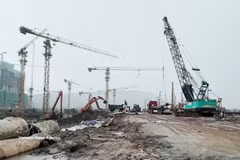
The construction site of the APEC Conference Centre in Phu Quoc special zone, An Giang province. (Photo: VNA)

Government proposes special mechanisms to unblock APEC 2027 projects in Phu Quoc

The projects in Phu Quoc have been implemented under tight deadlines. Since May 2025, the Prime Minister has directed preparations for APEC 2027, including accelerated infrastructure development on the special zone. An Giang province and investors have subsequently launched a number of major projects involving complex technical requirements and demanding construction schedules.

An overview of the smart Youyi Guan-Huu Nghi border gate pair (Photo published by VNA)

Law expected to facilitate cross-border trade

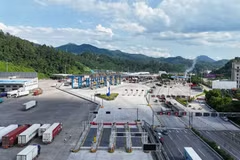
Deputy Director of the Department of Customs Nguyen Thanh Hung said the draft law establishes a legal framework to convert fragmented customs documents into standardised digital data, enabling AI to process and analyse information for automated customs clearance.

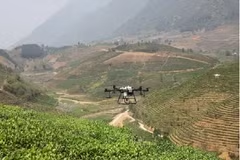
Using drones in agricultural production in Lai Chau province. (Photo: nhandan.vn)

New growth drivers offer Vietnam's agriculture chance to accelerate

According to Deputy Minister of Agriculture and Environment Dang Ngoc Diep, agricultural, forestry and fishery exports fetched an estimated 35.88 billion USD in the first six months of 2026, up 6% year-on-year. The sector's GDP expanded by more than 3.8%, exceeding the government's 3.7% target. The results were underpinned by stable production, particularly in key industries.

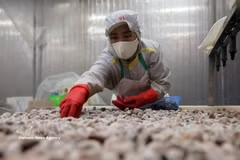
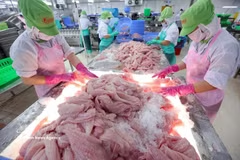
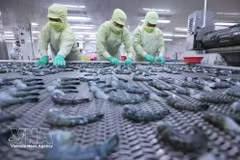
Freezing black tiger shrimp for export at a processing plant of the Minh Phu Seafood Corporation. (Illustrative photo: VNA)

EVFTA deliver tangible gains for Vietnam-EU trade after six years

Reflecting on the agreement's sixth anniversary, EuroCham Chairman Bruno Jaspaert said that nearly half of all EU-Vietnam trade over the past three decades has taken place under the EVFTA, underscoring the rapid acceleration of economic integration once market access barriers were removed.

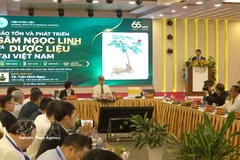
Delegates attend the international scientific conference, "Ngoc Linh Ginseng – From National Product to Global Brand," in Da Nang on August 2. (Photo: VNA)

Ngoc Linh ginseng sets sights on global brand recognition

Dr. Tran Minh Ngoc, Director of the National Institute of Medicinal Materials under the Ministry of Health, said Ngoc Linh ginseng (Panax vietnamensis) is an endemic species found only in Vietnam's Ngoc Linh mountain range at elevations of 1,500–2,100 metres.

The canal in front of Long Son Big House has become cleaner thanks in part to environmental clean-up efforts by Long Son Petrochemicals Co., Ltd. (Photo: VNA)

FDI firm spreads sustainable value through community commitment

A subsidiary of Thailand’s SCG Chemicals, LSP manages one of Vietnam’s largest foreign direct investment (FDI) projects, with an initial investment of more than 5 billion USD. The company is also investing an additional USD 500 million to integrate ethane into its feedstock portfolio.

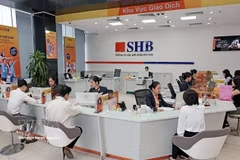
Transactions at a branch of SHB in Hanoi. (Photo: VNA)

Deeper reforms needed to achieve target of 2 million firms

If Vietnam can create the institutions, funding channels and support systems that allow businesses to develop at different stages, the target of 2 million active enterprises by 2030 could mark not just a numerical milestone, but the emergence of a more resilient engine of growth.