Institutional reform helps accelerate national target programme

By the end of 2026, the province aims to have four communes recognised under the new-style rural area development standards while reducing its household poverty rate to 2% from 2.68% at the end of 2025.

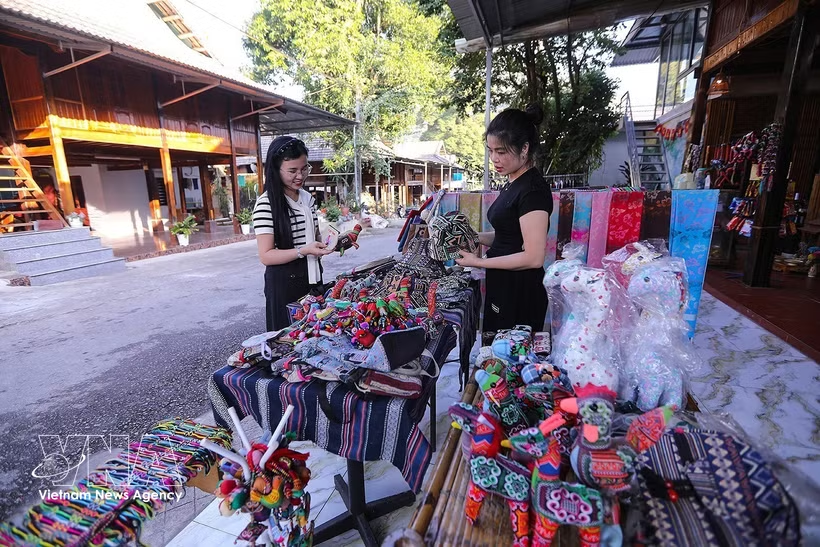
Products of ethnic minorities are sold at a tourism site in Phu Tho province. (Photo: VNA)

Phu Tho (VNA) – After completing an overhaul of its implementation apparatus and issuing key guiding documents, the northern province of Phu Tho is shifting its national target programme on new-style rural area development, sustainable poverty reduction, and socio-economic development in ethnic minority and mountainous areas for 2026–2030 from preparation to full-scale implementation.

However, funding shortages, slow disbursement and limited implementation capacity at the grassroots level remain key bottlenecks that must be addressed to meet first-year targets.

Institutional reform lays the groundwork

With 2026 kicking off the new programme cycle, the province is focusing on building a solid institutional framework, clear organisational structure, and strong coordination to ensure smooth and consistent implementation from the provincial level down to the communes.

By the end of June, Phu Tho had established a steering committee for the national target programme and restructured its coordinating office into a more specialised body. Communes and wards also completed the reorganisation of their steering boards with clearly assigned responsibilities.

The province simultaneously issued implementation guidelines, including task assignments for agencies and new-style rural area development criteria for 2026–2030. It also organised 29 training workshops for more than 1,940 participants while expanding communications through media and digital platforms.

Phu Tho carried over 814 billion VND (31.2 million USD) in central funding into 2026. More than 89.1 billion VND was allocated to new-style rural area development, with 6.8% disbursed. Sustainable poverty reduction activities received over 130 billion VND, with 11.14% disbursed, while nearly 595 billion VND was allocated to ethnic minority and mountainous area development, with 6.98% disbursed.

Nguyen Nam Cuong, Deputy Chief of the provincial National Target Programme Coordinating Office, said implementation is beginning to produce tangible results.

In Lai Dong commune, where more than 93% of residents belong to ethnic minority groups, many targets from the previous phase have already been achieved or exceeded. By June 30, all households had access to electricity and hygienic water while average annual income among ethnic minority residents reached 37.5 million VND.

Dinh Thi Tuyet Mai, Secretary of the Lai Dong Party Committee, said the commune has integrated funding sources to invest in essential infrastructure, improve social welfare and create sustainable livelihoods. It is implementing 11 infrastructure projects, including schools, flood-resilient rural roads, farm access roads and technology-related facilities.

Similar progress in Lai Dong, Tam Nong, Xuan Dai and other localities shows the programme is gradually improving rural infrastructure, incomes, living conditions and access to essential public services.

Tackling bottlenecks


Despite early progress, implementation continues to face challenges.

Authorities noted that following the introduction of the two-tier local administration model, communes and wards now oversee larger administrative areas while many civil servants still lack experience in planning, monitoring and programme management. Reporting in some localities has also been delayed or inadequate.

Ensuring sustainable poverty reduction remains another challenge. Implementation has slowed because of unstable livelihoods in some communities, modest capacity, limited awareness raising communications, dependence on state support, and delays in central budget allocations for the new programme phase.

Vice Chairman of the Phu Tho People's Committee Dinh Cong Su said by the end of 2026, the province will finalise policies and mechanisms, issue new-style countryside development criteria and strengthen the accountability of local authorities, particularly agency heads. It will also expand training, inspections and public communications while preparing funding allocation plans immediately after central budget approval.

It will review poor and near-poor households in 2026, monitor poverty reduction efforts and redesign communication campaigns to encourage greater self-reliance, he went on.

Phu Tho has proposed the Government to allocate the full five-year funding package in the first year and grant local authorities greater flexibility in planning investment and recurrent spending. It also called on ministries to streamline and ensure consistent implementation guidelines.

By the end of 2026, the province aims to have four communes recognised under the new-style rural area development standards while reducing its household poverty rate to 2% from 2.68% at the end of 2025. It will enhance efforts to boost incomes and improve access to basic public services, paving the way for greener and more sustainable rural development, especially in ethnic minority and mountainous regions./.

VNA
See more

The opening of the 2026 Asian Science Camp in Hong Kong (China) (Photo: VNA)

Vietnam sends top students to 2026 Asian Science Camp

Dr Nguyen Bich Huyen, a lecturer at the Hanoi University of Science and Technology’s School of Electrical and Electronic Engineering who leads the delegation, said the team is attending with a mandate to share ideas and knowledge with international peers through a bridge built by the Vietnam Physical Society.

The People's Court of Hanoi on August 3 held a first-instance public trial in absentia for Doan Bao Chau, who was charged with "producing, storing, disseminating or propagandising information, documents and items aimed at opposing the Socialist Republic of Vietnam". (Photo: cand.vn)

Doan Bao Chau sentenced to seven years in prison for anti-State propaganda

According to the indictment issued by the Hanoi People's Procuracy, on May 2, 2024, the Investigation Security Agency under the Hanoi Department of Public Security received reports that Doan Bao Chau (born in 1968, residing in Giang Vo ward, Hanoi), appeared in livestreams on the BBC Vietnamese YouTube channel and his personal Facebook account, "Chau Doan", delivering content distorting and defaming the people's administration, fabricating information that caused public anxiety, and conducting psychological warfare.

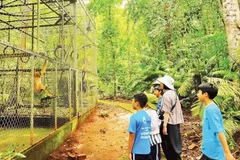
Young volunteers help care for rescued wildlife at Bu Gia Map National Park. (Photo: Nhan Dan)

Journey to return rescued wildlife to the wild

Beyond wildlife rehabilitation, Bu Gia Map National Park has become an important centre for environmental education, helping raise public awareness of biodiversity conservation through guided visits, rescue-centre experiences, school outreach programmes and digital communication campaigns.

Representatives from various consulates, the Vietnam Association of Victims of Agent Orange/dioxin, and a large number of people from Ho Chi Minh City participated in the solidarity walk "For Victims of Agent Orange" (Photo: VNA)

More than 5,000 join walk in support of AO victims

Speaking at the event, Major General, Associate Professor, Dr Nguyen Hong Son, Chairman of the VAVA chapter in Ho Chi Minh City, said the programme is not only a commemorative event but also an opportunity to call on agencies at all levels, businesses, organisations and individuals to continue supporting AO victims in overcoming hardship and building their better lives.

Students in Ho Chi Minh City take the 2025 National High School Graduation Examination. (Illustrative photo: VNA)

Ho Chi Minh City lays groundwork for English as second language in schools

Ho Chi Minh City is building on nearly three decades of experience in English-language education as it prepares to gradually make English a second language in schools, with a focus on improving teaching quality, investing in educational infrastructure and creating an English-speaking learning environment.

A view of the national ceremony commemorating the 300th birth anniversary of cultural luminary Le Quy Don (1726–2026) at the memorial site dedicated to the renowned scholar in the northern province of Hung Yen on the evening of July 31, 2026. (Photo: VNA)

National ceremony marks 300th birth anniversary of cultural luminary Le Quy Don

In recognition of Le Quy Don's exceptional contributions, UNESCO adopted a resolution to jointly commemorate the 300th anniversary of his birth, acknowledging that his intellectual legacy, commitment to practical learning and humanistic values transcend national borders and form part of humanity's shared cultural heritage.

Inspecting the electrical switching system before maintenance at the 110kV WHA Industrial Park substation, Trung Loc commune, Nghe An province. (Photo: VNA)

Powering growth: Ensuring reliable energy supply to keep investment flowing

Across Ha Tinh and Nghe An, maintenance teams conduct inspections day and night, using thermal cameras and drones to detect potential faults without interrupting electricity supply. Their work helps ensure stable power supply for businesses as the region accelerates development in line with the Government's economic growth targets.

Deputy head of the Ho Chi Minh City’s National Assembly (NA) deputies delegation Vo Hoang Ngan speaks at the conference (Photo: VNA)

Land Law revision: A step toward more effective governance

Experts and regulators are pushing to fine-tune rules on land acquisition, compensation, valuation, decentralisation and the capture of land-generated added value, aiming for a harmonious balance of interests among stakeholders.

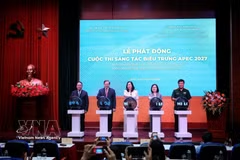
Delegates launch a nationwide competition to design the official logo and visual identity for APEC Vietnam 2027 on July 31 (Photo: VNA)

Contest launched to design APEC 2027 logo, visual identity

Speaking at the launch ceremony, Deputy Minister of Foreign Affairs Le Thi Thu Hang, head of the Communications and Culture Subcommittee under the National Committee for APEC 2027, described the contest as one of the first key preparations for APEC 2027, marking the start of efforts to build the event’s branding and communications for one of the largest and most significant multilateral diplomatic events Vietnam will host in the coming years.

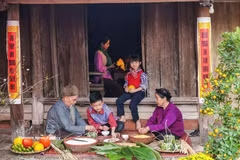
Family members gather to make banh chung – an indispensable part of the Lunar New Year (Tet) celebration. (Photo: VNA)

National value system needs unified implementation to drive development: official

The national value system sets the country's development goals and aspirations; the cultural value system fosters an environment in which these values are embraced, practised and promoted; the family value system serves as the primary foundation for character formation; while the standards of the Vietnamese people serve both as the driving force behind these values and as the ultimate goal of development.