NA Chairman urges ‘revolution’ in legal information access

NA Chairman Tran Thanh Man said the requirement that “every citizen live and work in accordance with the Constitution and the law” remains hollow unless people can fully access, understand, and actually use the rules that govern their lives.

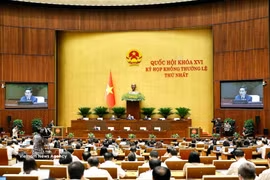
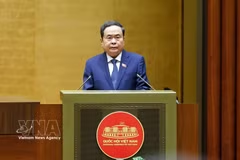
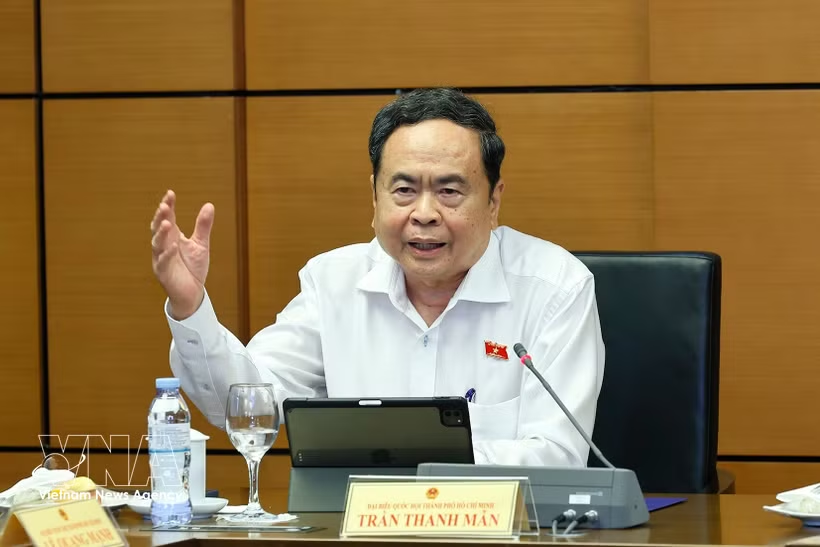
NA Chairman Tran Thanh Man speaks at the group debate on August 4. (Photo: VNA)

Hanoi (VNA) – National Assembly (NA) Chairman Tran Thanh Man has demanded a “revolution” in how citizens access legal information, calling for a radical shift from a management mindset of simply supplying documents to a service model that equips people to protect themselves using the law.

Building a national digital ecosystem for legal outreach

Speaking in a group debate on the draft revised Law on Legal Dissemination and Education in Hanoi on August 4, Chairman Man said the requirement that “every citizen live and work in accordance with the Constitution and the law” remains hollow unless people can fully access, understand, and actually use the rules that govern their lives.

He called for an aggressive digital transformation push, urging lawmakers to embed a national digital ecosystem for legal education and outreach directly into the bill. The draft must force every issuing agency to hand over open data so AI tools and round-the-clock chatbots can chew through complex regulations and deliver plain answers instantly.

The bill, he said, should mandate feedback loops, gauge citizens’ legal literacy, and track their “legal access health” within the digital space, so authorities can recalibrate outreach in real time. It must also introduce quantitative criteria to slice target groups by location, age, and livelihood.

On community-based education, the top legislator pressed for firm institutionalisation of the role of grassroots cultural bodies and influential local figures, including village elders, clan heads, and respected individuals, alongside self-governance models. The approach should shift from “comprehensive” dissemination in favour of “practical” access, prioritising laws that directly hit citizens’ rights and interests based on their occupations and places of residence.

A chronic funding squeeze at the commune level and a workforce of mostly part-timers are choking progress, he said, demanding firm staffing targets and dedicated support for those on the front lines.

He pushed for tax breaks, preferential land access, and easier credit to be written directly into the law for businesses and organisations. As for lawyers, the draft must set mandatory annual hours of pro bono legal education and tie that record to performance reviews and professional license renewals.

Commune-level coordination councils for legal dissemination

Deputy Leo Thi Lich from Bac Ninh province warned that a rule restricting legal information access “only through verified accounts” needs its scope sharply defined to avoid trampling on citizens’ constitutional right to obtain and share legal information.

She proposed that the draft law immediately enshrine content quality principles, post-publication review mechanisms, and clear liability for tackling false information, especially when generated or manipulated by AI.

Lich insisted on channels that gauge what users truly grasp and measure whether digital access is actually working, cautioning that “mechanical digitalisation” firing out one-way information is a dead end.

Deputy Tran Thi Hoa Ry from Ca Mau province proposed scrapping a requirement for commune-level councils. Instead, a chairperson of the commune-level People’s Committee should simply assign a specialised unit to handle legal education, or create a council only where it’s genuinely needed under Government rules./.​

VNA

See more

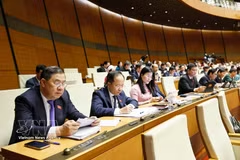
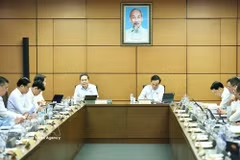
NA deputies at the discussions (Photo: VNA)

NA deputies review legal reforms on military, defence

Lawmakers later held group discussions on the draft Law on the Prevention of the Proliferation of Weapons of Mass Destruction, the draft law revising nine military and defence laws, and the revised Law on Law Dissemination and Education.

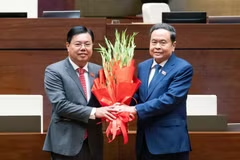
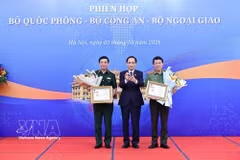
National Assembly Chairman Tran Thanh Man (R) presents flowers to congratulate new Minister of Home Affairs Nguyen Tien Hai. (Photo published by VNA)

National Assembly approves Nguyen Tien Hai as Minister of Home Affairs

The NA held a secret ballot on the appointment and later adopted a resolution approving Nguyen Tien Hai as Minister of Home Affairs. The resolution was passed with 483 votes in favour out of 484 deputies participating in the electronic vote, accounting for 96.60% of those present.

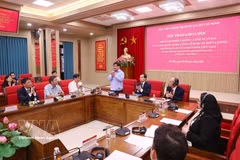
The scientific seminar is held by the Ho Chi Minh National Academy of Politics in Hanoi on August 3. (Photo: VNA)

Seminar honours Fidel Castro's legacy, enduring Vietnam–Cuba solidarity

A Vietnamese official said Fidel Castro's revolutionary ideals transcended national borders, making him a steadfast internationalist, an outstanding theorist and practitioner of the international communist and workers' movement, and an enduring symbol of national liberation and socialism.

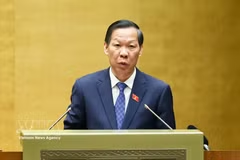
Phan Van Mai, Chairman of the NA’s Committee for Economic and Financial Affairs, speaks at the NA session on August 3. (Photo: VNA)

16th NA’s first extraordinary session stresses efficient resource use, national sovereignty

Presenting the Government’s proposal, Minister of Public Security Luong Tam Quang said the proposed resolution on special mechanisms for handling legal violations related to the State and private sectors and the application of science, technology, innovation and digital transformation aims to institutionalise Party policies and provide a legal basis to protect dynamic and innovative officials who dare to think and act for the common good, without corruption, wastefulness or wrongdoing.

Minister of Finance Ngo Van Tuan presents the draft Law amending and supplementing several articles of the Law on Customs at the 16th National Assembly's first extraordinary session in Hanoi on August 3. (Photo: VNA)

Lawmakers discuss customs reform linked to digital transformation, risk management

Continuing the agenda of its ongoing first extraordinary session, the 16th National Assembly (NA) on August 3 heard proposals and verification reports on two bills, including the Law amending and supplementing several articles of the Law on Customs, and the Law revising Article 6 and Appendix IV on the list of conditional business lines under the Law on Investment.

A view of the Central Technology Platform No. 2 of the Bach Ho (White Tiger) oil rig under the Vietsovpetro joint venture between Vietnam and Russia (Photo: VNA)

Institutional reform key to unlocking new development model: experts

Resolution No. 19-NQ/TW, adopted at the third plenum of the 14th Party Central Committee, identifies breakthroughs in institutions and reforms as the starting point for renewing Vietnam’s development model, alongside reforms in national governance, organisation and operations to build new development capacity.

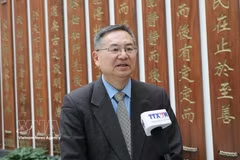
Professor Qu Qiang from Minzu University of China, in an interview granted to the Vietnam News Agency. (Photo: VNA)

Four orientations demonstrate shift in Vietnam’s development thinking: Chinese scholar

The most notable change is Vietnam’s transition from “organisational restructuring” to “improving governance effectiveness.” Previously, reforms focused on streamlining the apparatus and reducing intermediary levels. With organisational reforms largely completed, the more important task is now to ensure the new system operates more effectively, according to Professor Qu Qiang from Minzu University of China.

A view of the opening ceremony of the 16th NA's first extraordinary session (Photo: VNA)

First extraordinary session of 16th National Assembly opens

The first extraordinary session of the 16th National Assembly (NA) kicked off in Hanoi on August 3, with lawmakers set to consider and decide on a series of items, including 15 draft laws, four draft normative resolutions and a range of major issues concerning national development.

Deputy Prime Minister Le Tien Chau chairs several meetings to hear reports on the progress of the comprehensive review. (Photo: Ministry of Justice)

Over 43,000 legal normative documents reviewed

As of July 30, ministries, agencies and localities had conducted a preliminary review of more than 43,000 legal normative documents nationwide, identifying provisions that need to be amended, supplemented, replaced or annulled.