Hanoi (VNA) – Electronic visas (e-visas) have become an increasingly popular option for foreigners travelling to Vietnam thanks to their convenience and speed. However, as demand continues to grow, a rising number of websites offering online visa services have appeared, leaving many travellers unsure about their legitimacy.
Tang Zhen Zhong, a Chinese tourist who chose to apply for an e-visa to visit Vietnam, said finding the correct website for the application was one of his biggest concerns before travelling.
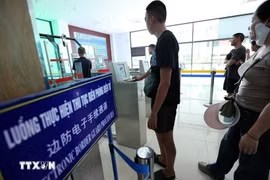
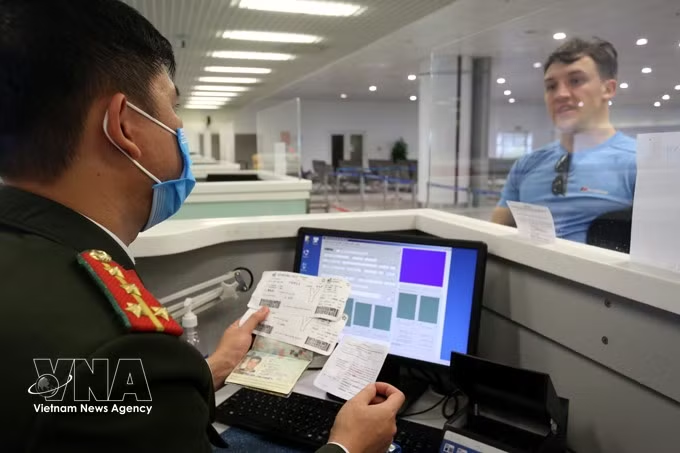
During last Christmas, he spent nearly two hours completing immigration procedures at Ho Chi Minh City's Tan Son Nhat International Airport. He said although the wait was long, he said he had prepared all the required documents in advance and encountered no problems during the process.

To make travel easier for foreigners, Vietnam currently grants e-visas to citizens of all countries and territories. The entire process, from submitting applications and paying fees to receiving visa approvals, is completed online. E-visa holders can also enter and leave Vietnam through 83 international border gates nationwide, according to Pham Dang Khoa, Director of the Immigration Department.
The convenience of the system has attracted a growing number of users. Vietnam issued more than four million e-visas to foreigners in 2025, up over 30% from the previous year. In the first six months of 2026 alone, nearly 2.5 million e-visas were approved, an increase of almost 30% year-on-year.
Supported by more open visa policies, Vietnam welcomed more than 22.8 million international visitors in 2025, the highest figure on record. However, the surge in online visa applications has also led to the spread of fake websites, raising the risks of fraud and identity theft. Authorities therefore advise foreigners to use only the Vietnamese Government's official online portals when applying for visas.
The traps behind "express visa" services
A simple search for "Vietnam e-visa" produces numerous websites and social media pages advertising "express visas", "same-day approval" or "guaranteed visas". However, not every website appearing in search results is an official government portal.
Before the Ministry of Public Security launched the official e-visa system on the domains evisa.gov.vn and thithucdientu.gov.vn, the Immigration Department had recorded many fake websites ranking prominently on search engines, causing confusion for users.
 |
Nguyen Tien Nam, an officer from Division 5 under the Department of Cybersecurity and High-Tech Crime Prevention (A05), said fraudsters often create websites that closely resemble official portals, register misleading domain names or pay for online advertisements to attract users. Many also promote services such as "instant visas", "urgent processing" or "guaranteed approval" to gain people's trust.
According to the Ministry of Public Security, losses caused by online scams in Vietnam exceeded 8 trillion VND (about 304 million USD) in 2025. Fake websites and social media pages related to online administrative procedures were among the most common forms of fraud.
Cybersecurity experts warn that users visiting fake websites may have their passport details, personal information or payment data stolen. With the help of artificial intelligence, fraudulent websites have become increasingly sophisticated, making them much harder to distinguish from genuine ones.
Strengthening protection for e-visa applicants
As visa-related online scams become more common, authorities are stepping up efforts to detect and remove fake websites and fraudulent links. Public awareness campaigns are also being expanded to help both Vietnamese citizens and foreigners recognise online threats.
Users are advised to access only official websites with the ".gov.vn" domain and remain cautious when providing personal information or making online payments. Anyone detecting signs of fraud should immediately report the case to the police for timely assistance, Nam said.
Tang, the Chinese tourist, said he always checks website domain names before completing online procedures.
"If the website ends with '.gov.vn', I feel much more confident. Even so, it is not easy to tell genuine websites from fake ones, so I often ask my travel company for assistance," he said.
Alongside efforts to improve cybersecurity, the Immigration Department is accelerating digital transformation in the management of foreigners. Pilot programmes to collect passenger information before arrival and expand the use of biometric data are expected to shorten immigration processing times while improving management efficiency, Khoa said.

However, as cybercrime becomes increasingly cross-border in nature, no country can tackle the problem alone. Combating international cybercrime networks requires close cooperation among law enforcement agencies around the world.
International cooperation delivers results against cybercrime
International cooperation mechanisms promoted under the Hanoi Convention - the world's first global convention on combating cybercrime - are already producing tangible results in tackling crimes committed in cyberspace.
Vietnamese authorities have recently dismantled several large transnational cybercrime networks. Among the most notable were 28 joint operations with Cambodia that led to the arrest of more than 500 suspects; the dismantling of an overseas high-tech criminal organisation that defrauded more than 1,000 victims and stole around 120 billion VND; and coordinated operations with Chinese law enforcement agencies targeting investment fraud, scams impersonating government agencies and cross-border money laundering networks.
Authorities have also uncovered and dismantled criminal groups involved in fake online job offers, fraudulent investment schemes on digital platforms and cybercrime operations based overseas but targeting Vietnamese citizens. These cases demonstrate the growing effectiveness of international cooperation against cybercrime in line with the spirit of the Hanoi Convention.
Digital transformation has made travelling, studying, working and international exchanges easier than ever before. Yet these opportunities also bring new risks in cyberspace. Alongside technological solutions and stronger international cooperation, improving public awareness remains one of the most effective safeguards against increasingly sophisticated online scams./.