Vietnam positioned to harness AI wave, World Bank report says

The WB report identifies Vietnam as one of the few economies outside the European Union (EU) to have adopted a comprehensive AI regulatory framework as early as 2025. Vietnam applies a risk-tiered approach similar to that of the EU AI Act, imposing different obligations depending on whether an AI system poses “unacceptable,” “high,” “low” or “minimal” risks. The approach is viewed as a strategic step towards ensuring safe and transparent AI governance.

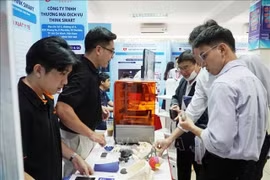
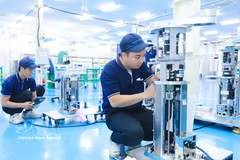
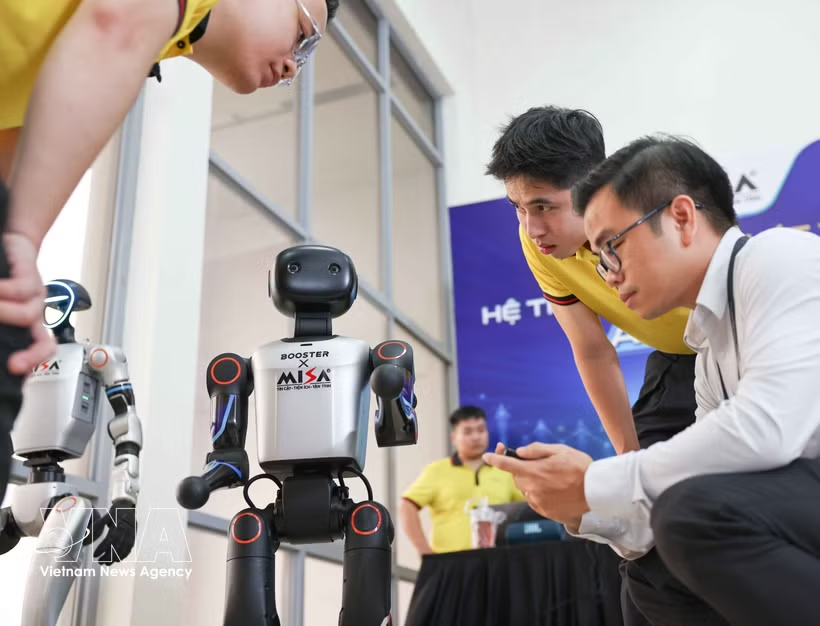
AI Day 2026 product showcase area. (Photo: VNA)

Hanoi (VNA) – The World Bank Group’s World Development Report 2026: The Promise of Artificial Intelligence, released on August 4, highlights Vietnam’s role in global technology supply chains, as it is listed among the top five developing countries with the highest value of exports of AI-enabling products in 2025, alongside China, Mexico, Malaysia and Thailand.

These economies have benefited from growing investment in semiconductors, electronic components and data-centre equipment.

The report identifies Vietnam as one of the few economies outside the European Union (EU) to have adopted a comprehensive AI regulatory framework as early as 2025. Vietnam applies a risk-tiered approach similar to that of the EU AI Act, imposing different obligations depending on whether an AI system poses “unacceptable,” “high,” “low” or “minimal” risks. The approach is viewed as a strategic step towards ensuring safe and transparent AI governance.

The report, however, offers an important caution through a case study from Vietnam: AI cannot simply be “imported”. An AI model developed by the University of Oxford to classify patients suspected of having COVID-19, which performed well in the UK, saw its performance decline sharply when tested at two hospitals in Vietnam. Differences in demographic and epidemiological characteristics between the populations were a key factor. The example underscores the need for Vietnam to invest in local data and strengthen its capacity to fine-tune AI systems to domestic conditions so that the technology can better serve its people.

In the labour market, the report notes that while wealthy economies are concerned about AI-related job displacement, the risk is lower in Vietnam due to the large share of workers engaged in agriculture and labour-intensive manufacturing. In the garment sector, for instance, automated cutting and sewing technologies have existed for decades, but remain relatively uncommon in Vietnam because local labour costs are still more competitive than investment in AI and robotics.

This is an economically rational response, but also a reminder of the need to upgrade workers’ skills as technology becomes increasingly affordable.

AI offers Vietnam an opportunity to accelerate its development and strengthen its position on the global technology map. With proactive policymaking, the country is moving in the right direction. However, Gaurav Nayyar, Director of the World Development team in charge of the 2026 report, said Vietnam and developing countries in general need to build the foundations now – including energy infrastructure, connectivity, skills and institutions – to be ready to adopt and adapt AI for the benefit of their people./.

VNA
See more

Thai Binh Seed Group JSC is one of Vietnam’s leading crop seed producers, holding rights for 30 varieties and operating three globally certified plants. (Photo: VNA)

Politburo’s Resolution 57-NQ/TW powers new growth momentum

NSO Director Nguyen Thi Huong said alongside foreign investment and the green economy, science – technology, innovation, the digital economy and digital transformation are the new drivers that can can pack a serious second-half punch.

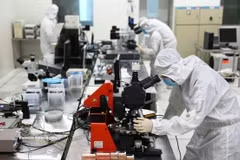
Research lab of the Vietnam National University Ho Chi Minh City. (Illustrative photo published by VNA)

Drastic measures taken to turn Resolution 57 into action

A recent meeting of the Central Steering Committee on science, technology, innovation and digital transformation, chaired by Party General Secretary and State President To Lam, marked a new phase in implementing Resolution 57 following the committee’s restructuring.

A view of Kinh Bac Ward in Bac Ninh Province. (Photo: VNA)

Bac Ninh targets world's top 50 smart cities by 2030

According to Chairman of the provincial People's Committee Pham Hoang Son, the province will pursue a people-centred smart city model driven by science, technology, innovation and digital transformation to improve public services, urban management and competitiveness.

Illustrative photo: VNA

Vietnam expected to fast-track mastery, rollout of 6G technology

Vietnam has so far deployed more than 40,000 5G base transceiver stations (BTSs), providing coverage for about 92% of the population, making it one of the world's fastest countries in this regard. By comparison, many advanced economies typically take two to three years to extend 5G coverage to more than 80% of their populations.

Deputy Prime Minister Ho Quoc Dung chairs the meeting in Hanoi on July 31 to discuss the establishment of a high-tech park in the northern province of Hung Yen. (Photo: VNA)

Deputy PM chairs meeting on establishment of Hung Yen High-Tech Park

Chairman of the Hung Yen provincial People’s Committee Nguyen Manh Quyen said the proposed high-tech park will cover about 496.1 hectares in Hoan Long and Viet Yen communes. The location is expected to attract high-quality talent and innovation resources from Hanoi while strengthening production and logistics links across the Northern Key Economic Region, including Bac Ninh, Hai Phong, Quang Ninh, Phu Tho and Ninh Binh.

Dr Nguyen Minh Triet, Chair of Academic Council at the Vietnam Australia Innovation Network (NIC AU) and a research engineer at Archer Materials in Australia (Photo published by VNA)

Investing in core capabilities key to elevating Vietnam's semiconductor industry: expert

Vietnam's ultimate goal should not simply be to establish a presence in the semiconductor industry, but to gradually master high-value, knowledge-intensive segments of the value chain and become a key link in the global semiconductor supply chain. This would provide a launch pad for strengthening the country's competitiveness in artificial intelligence, electronics and the digital economy.

Building a digital ecosystem for foreigners in Vietnam

Building a digital ecosystem for foreigners in Vietnam

Registering residence, applying for an electronic visa (e-Visa), obtaining an electronic identity account or completing administrative procedures online can now all be done conveniently in the digital environment. For many foreigners, these changes have made it easier to enter, live and work in Vietnam while also reflecting the initial results of implementing the Politburo's Resolution No. 57.

Deputy Prime Minister Ho Quoc Dung (right) receives Linda Tan, President of the Southeast Asia Semiconductor Association. (Photo: VNA)

Vietnam, Southeast Asia Semiconductor Association deepen semiconductor cooperation

Welcoming the SEMI Southeast Asia delegation, Deputy Prime Minister Ho Quoc Dung commended the association and its members for supporting Vietnamese ministries and agencies in advancing cooperation in science, technology, innovation and digital transformation, which he described as key drivers of the country's next phase of economic growth.

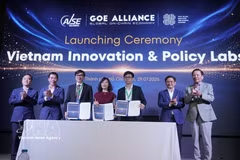
Representatives of participating organisations sign an agreement and officially launch the Vietnam Innovation & Policy Labs, an independent policy research and advisory organisation, at the Vietnam Global Innovation Connect (VGIC) 2026 in Ho Chi Minh City on July 29. (Photo: VNA)

Technology, talent to drive Vietnam’s digital leap forward: forum

The Vietnam Global Innovation Connect (VGIC) 2026 serves as a platform for dialogue among policymakers, enterprises, startups, investors and the global Vietnamese expert community to transform knowledge, technology and resources into practical initiatives and projects that contribute to the country's development.

Delegates mark the launch of Gia Lai Quantum Year 2026. (Photo: VNA)

Gia Lai launches Quantum Year 2026

Held under the theme "Quantum Connectivity – Mastering Technology – Breakthrough Development", Quantum Year 2026 centres on four pillars: science, technology, education and training, and innovation ecosystem development.

AI offers both opportunities, challenges for Vietnam’s growth

AI offers both opportunities, challenges for Vietnam’s growth

Dr. Ho Duc Thang, a full-time member of the National Assembly’s Committee for Cultural and Educational, said productivity is the key to sustaining double-digit economic growth, and AI has greater potential to improve productivity than any previous technology.

Attracting sci-tech talent plays a critical role. (Photo: VNA)

Sci-tech seen as lever for Vietnam’s new growth phase

Raising the level of scientific and technological development is the only way to break out of the middle-income trap. Without it, Vietnam will remain stuck in low-value segments, said Dr. Le Xuan Sang, Deputy Director of the Institute of Vietnam and World Economy.

A speaker addresses the SEA+ Quantum Coordinator Meeting held in Gia Lai province on July 27. (Photo: VNA)

Regional conference strengthens Southeast Asia’s quantum technology ecosystem

Stronger networks linking government agencies, research institutes, universities, businesses and scientific organisations will provide a solid foundation for faster and more effective development of quantum technology, contributing to the sustainable development of each country and the region as a whole, said a Gia Lai official.