EU consults on steel regulation scope, implications for Vietnamese exporters

The European Union’s (EU) Steel Regulation introduces a “melt and pour” traceability rule, forcing importers to declare the country where steel was originally melted and cast, not just where final processing took place.

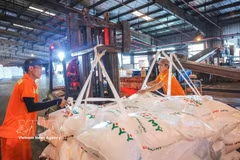
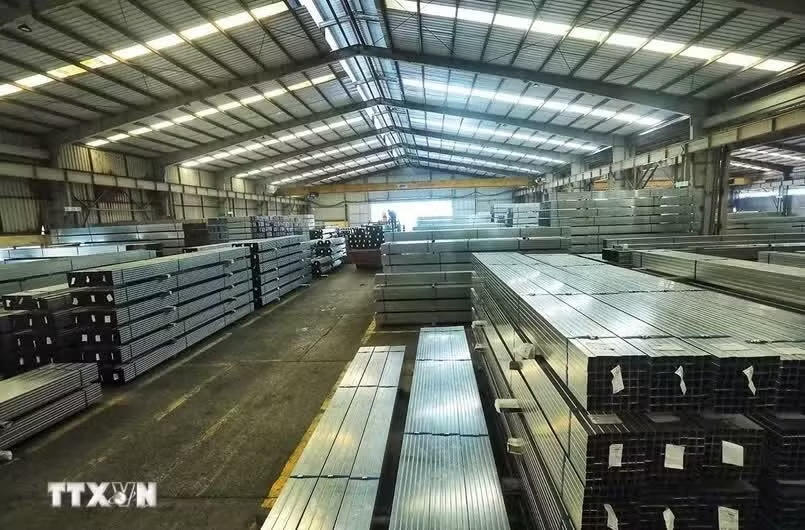
The Vietnam Steel Association forecast that Vietnam’s crude steel output could reach 27 million tonnes this year, up 10% annually, with finished steel production pegged at 33 million tonnes and exports at roughly 6 million tonnes. (Illustrative photo: VNA)

Brussels (VNA) – The European Commission (EC) has recently launched its first targeted consultation to define product scope under the European Union’s (EU) Steel Regulation, establishing a new safeguard framework that is far stricter than the previous regime and could directly affect Vietnam’s steel shipments.

The regulation slashes the duty-free import quota to 18.3 million tonnes a year, a nearly 47% cut from the 2024 levels, while doubling the out-of-quota tariff to 50%. Product coverage has also widened from 28 to 30 categories.

Critically, the regulation introduces a “melt and pour” traceability rule, forcing importers to declare the country where steel was originally melted and cast, not just where final processing took place.

The current consultation zeroes in on four product groups being evaluated for inclusion, including cast iron pipes, tubes and hollow profiles; non-alloy and other alloy steel wire; stainless steel wire, and non-alloy and other alloy forged steel bars.

The consultation stays open through September 30, with results due no later than December 31, 2026.

The Vietnam Trade Office in Belgium and the EU warned that the 2026 Steel Regulation poses two distinct but tightly linked challenges.

The first is market-driven. In the first five months of this year, Vietnam’s steel exports to the EU tumbled nearly 18.3% in volume and 23.3% in value year on year. The slide began well before the new rules, hammered by weak European demand and mounting trade protection.

The second, more structural, challenge comes straight from the “melt and pour” rule. Vietnam is acutely exposed because its domestic crude steel capacity remains limited.

Vietnamese mills that import billets or hot-rolled coil from overseas, chiefly from Asia, for further processing and re-export to the EU will see their quotas tied to the raw material’s country of origin, not Vietnam. That means steel “made in Vietnam” by processing standards could be locked out of Vietnam’s quota when it reaches the EU borders.

On the other hand, the Vietnam Steel Association (VSA) forecast that Vietnam’s crude steel output could reach 27 million tonnes this year, up 10% annually, with finished steel production pegged at 33 million tonnes and exports at roughly 6 million tonnes.

A sustained expansion of domestic crude steel capacity would, over time, put Vietnam in a stronger position to satisfy the melt-and-pour requirement.

Tran Ngoc Quan, head of the Vietnam Trade Office in Belgium, stressed that for now, Vietnamese steel exporters must track the consultation closely, particularly stainless steel wire and steel pipes, two categories under review that could directly hit some local shippers.

Pointing to Vietnam’s earlier success in working with the European leather industry and other nations to get leather commodities carved out of the EU Deforestation Regulation, the trade office urged Vietnamese steel exporters and the VSA to step up engagement with EU importers and industry associations. The aim is to submit comments reflecting Vietnam’s actual production and trade realities and, at a bare minimum, secure a transition period long enough for companies to adapt./.
VNA

See more

Illustrative image (Photo: VNA)

US boosts biofertiliser exports to Vietnam

According to a notice issued on August 4, FAS invites US universities, agricultural trade associations, and non-profit organisations to apply for this technical assistance funding to evaluate crop yields and reductions in nitrogen leaching in the US and Vietnam using US manufactured biofertilsers such as liquid fish fertiliser.

Vietnamese Ambassador to Cuba Le Quang Long (second from left) witnesses the handover ceremony for the first batch of rice produced by TBAgri to the Cuban side. (Photo: Embassy of Vietnam in Cuba)

Vietnam hands over Cuba-grown rice to partner

More than 470 tonnes of rice grown in Cuba from Vietnam's OM5451 variety were handed over to Cuban partner GRANMAX at a ceremony in Havana on August 4, marking the first harvest delivered by Vietnamese agricultural company TBAgri under a joint Vietnam–Cuba rice production project.

Illustrative image (Photo: nhandan.vn)

Four-pronged plan mapped out to unlock next-gen FDI

Vietnam must pivot hard from tax breaks to cost-based support. Incentives will target infrastructure, workforce training, research and development, and innovation, which directly lower investment costs and lift operational efficiency, a formula already being copied by countries competing for quality FDI.

A buyer is making cashless payment at a petrol station. (Photo: VNA)

SBV moves to close dormant bank accounts to curb financial fraud

The SBV has proposed amendments to Decree 52/2024/ND-CP on cashless payment, allowing banks to close accounts that have remained inactive for at least three years since their last transaction unless otherwise agreed between the banks and the customers.

A view of the Hyosung chemical plant, a Korean-invested project in Tan Phuoc ward, Ho Chi Minh City (Photo: VNA)

Resolution 10-NQ/TW changes "measure" of FDI success: HSBC

Success will increasingly be measured by whether foreign investment brings technology, develops local talent, establishes research and development (R&D) capability, and integrates Vietnamese enterprises more deeply into global value chains, according to HSBC.

Garment is one of the key contributors to Vietnam's export growth. (Photo: VNA)

Resolution on renewing development model expected to unlock new growth drivers for Vietnam

The resolution on renewing Vietnam’s development model goes beyond the goal of rapid and sustainable economic growth. It establishes a comprehensive development model designed to unlock new growth space, mobilise resources more effectively, strengthen national competitiveness, and help Vietnam achieve its goal of becoming a developed, high-income country by 2045.

Production activities at FDI enterprises in Tay Ninh province help boost exports, create jobs, and enhance the locality's role in the regional supply chain. (Photo: VNA)

Seven-month economy stays on growth track, eyes double-digit expansion

According to the National Statistics Office (NSO) under the Ministry of Finance, inflation remained under control, with the consumer price index (CPI) edging down 0.1% in July from the previous month. Average CPI in the January–July period rose an estimated 4.39% year-on-year, staying within the yearly target.

A view of Hyosung chemical plant, a RoK-invested project in Tan Phuoc ward, Ho Chi Minh City. (Photo:: VNA)

Ho Chi Minh City gears up for next-generation FDI inflows

Ho Chi Minh City is calling for investment in around 250 projects across nine priority sectors, mainly focusing on developing the International Financial Centre, digital finance, smart banking and supporting data infrastructure, large-scale logistics and port developments, transport infrastructure supporting trade, import-export activities, industry and smart logistics, green industries, clean energy and next-generation industrial parks.