“Socialist communes/wards” concretise Vietnam’s new development orientation: Chinese scholar

With a comprehensive approach combining stronger grassroots governance, socio-economic development, improved living conditions, sustainable poverty reduction and a people-centred orientation, the “socialist communes/wards” model could become a meaningful direction in Vietnam’s development process.

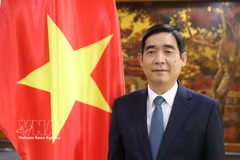
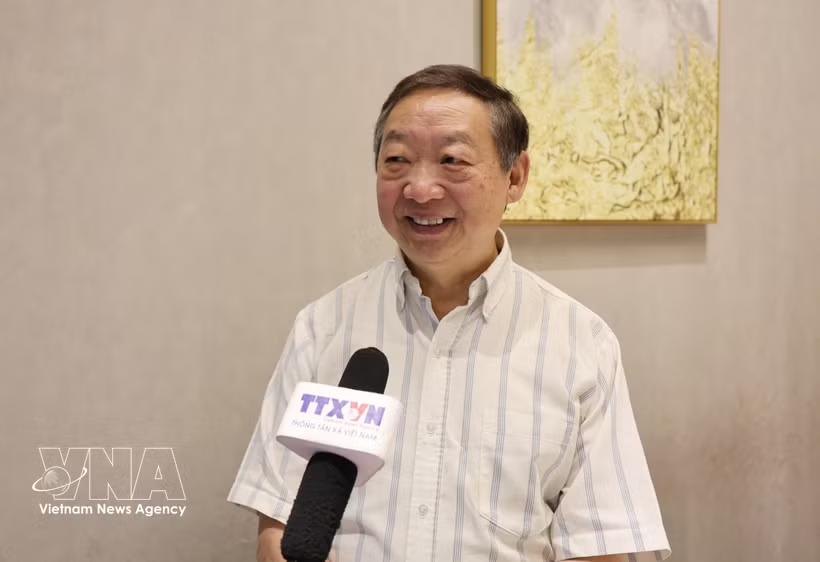
Professor Zhu Chenming, Honorary Director of the Institute of South and Southeast Asian Studies under the Yunnan Academy of Social Sciences, in an interview granted to the Vietnam News Agency. (Photo: VNA)

Beijing (VNA) – The pilot rollout of “socialist communes/wards” in Hanoi is an important step concretising the development orientations set out at the Communist Party of Vietnam’s 14th National Congress, and helping strengthen grassroots governance as Vietnam implements a two-tier local administration model, according to a Chinese scholar.

Speaking to Vietnam News Agency (VNA) correspondents in China, Professor Zhu Chenming, Honorary Director of the Institute of South and Southeast Asian Studies under the Yunnan Academy of Social Sciences, said the direct attention and direction of Party General Secretary and State President To Lam towards the pilot programme reflects the practical need to renew grassroots governance methods and provides an opportunity to draw lessons for future replication.

According to Zhu, the term “socialist communes/wards” itself reflects the comprehensive nature of the model, which goes beyond economic development, tourism or cultural activities to encompass economic, political, social and cultural development as well as people’s living standards.

He highlighted the model’s relevance to Vietnam’s two-tier local administration. With the district level no longer serving as an intermediate administrative tier, communes and wards will assume greater responsibilities, requiring stronger management capacity and better policy implementation at the grassroots level. Zhu said the pilot could therefore serve as a testing ground for appropriate grassroots governance approaches, with improving the capacity of local officials being a key factor.

The model also stresses that people must remain at the centre, with its success not be measured solely by economic growth or infrastructure development, but more importantly by improvements in people’s quality of life, satisfaction and sense of wellbeing, Zhu said, adding that development should ensure that people can see and benefit from tangible improvements in their daily lives.

He recommended that Vietnam treat the model as a comprehensive and systematic undertaking requiring coordination among different levels and sectors. In the initial phase, priority could be given to improving infrastructure, the living environment and landscapes, as visible improvements could strengthen people’s confidence and encourage their participation in development.

He also suggested that Vietnam consider piloting the model in additional localities with diverse socio-economic and geographical conditions. While Hanoi offers favourable conditions for the pilot, experience from mountainous, remote and disadvantaged areas will provide more diverse lessons for nationwide replication.

Poverty reduction, particularly sustainable poverty alleviation, should be a key priority, Zhu said, stressing that socialist-oriented development should aim for shared prosperity and ensure that development benefits are broadly distributed. No group should be left behind.

With a comprehensive approach combining stronger grassroots governance, socio-economic development, improved living conditions, sustainable poverty reduction and a people-centred orientation, the “socialist communes/wards” model could become a meaningful direction in Vietnam’s development process, the scholar concluded./.

VNA
See more

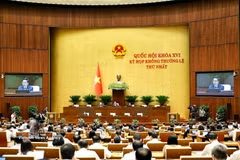
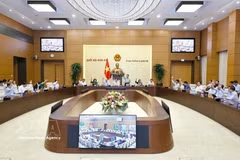
A plenary discussion during the first extraordinary session of the 16th National Assembly (Photo: VNA)

Legislators discuss bill on protection for Vietnamese overseas workers

The draft amendments to the Law on Vietnamese Guest Workers under Contract aim to strengthen the legal framework and promote decentralisation, science and technology application, digital transformation and the shift from a pre-approval to a post-approval inspection approach while addressing shortcomings in the current law.

The meeting between Minister of Public Security General Luong Tam Quang and a delegation from US-based American Kestrel Global Strategies Group and leading American defence, security, technology and energy companies in Hanoi on August 4 (Photo: bocongan.gov.vn)

Vietnam, US firms seek closer cooperation in defence, security industries

US companies are committed to strengthening dialogue and cooperation with Vietnam's Ministry of Public Security, supporting the country's development objectives while contributing to the deepening of the Vietnam–US Comprehensive Strategic Partnership for the mutual benefit of both governments, businesses and peoples.

☀️ Morning digest on August 5

☀️ Morning digest on August 5

Party General Secretary and State President To Lam's reception for ASEAN ambassadors and chargés d'affaires, Prime Minister Le Minh Hung's attendance at the 33rd Diplomatic Conference, and proposals on the establishment of Quang Ninh, Bac Ninh cities to be submitted to the legislature are among news highlights on August 5 evening.

Nguyen Van Khoi, Vice Chairman of the municipal People's Committee, speaks at the ceremony. Photo: VNA

Can Tho marks 50 Years of Vietnam–Thailand diplomatic relations

During the first six months of 2026, Can Tho exported 13.9 million USD worth of goods to Thailand, mainly rice, seafood, agricultural products, and processed foods. Its imports from this market totalled about 3.8 million USD, consisting primarily of textiles, chemicals, and production materials.

An overview of the talks between the delegations of the Ho Chi Minh National Academy of Politics and the Lao National Academy of Politics and Public Administration on August 4. (Photo: VNA)

Vietnam, Laos step up cooperation in political theory, training

The two central theory councils of Vietnam and Laos should step up joint research on strategic issues of mutual concern, closely link theoretical studies with practical reviews and policy consultation, build cooperation networks, connect young theory researchers and publish bilingual research works.

Party General Secretary and State President To Lam meets with ASEAN ambassadors and chargés d'affaires in Hanoi on August 4, 2026. (Photo: VNA)

Top leader meets ASEAN diplomats, calls for united, resilient ASEAN Community

Party General Secretary and State President To Lam highly valued the bloc’s achievements across political, security-defence, economic, socio-cultural and other areas through numerous programmes and initiatives. He voiced confidence that member states would uphold solidarity, strengthen cooperation, reinforce ASEAN's centrality, and successfully realise the ASEAN Community Vision 2045.

National Assembly Chairman Tran Thanh Man speaks at the meeting with leaders of the Ministry of Foreign Affairs, Vietnamese ambassadors and heads of representative missions abroad. (Photo: VNA)

NA Chairman urges stronger parliamentary, economic diplomacy

The National Assembly always stands alongside and supports the diplomatic sector. It will continue to proactively improve the legal framework governing foreign affairs, international treaties and agreements, as well as the operations of Vietnamese representative missions abroad, while paying attention to policies and working conditions for officials serving overseas, said NA Chairman Tran Thanh Man.

Politburo member and Minister of Public Security General Luong Tam Quang (R) welcomes Secretary of State at the Cambodian Ministry of Interior Santibindit Chan Ean in Hanoi on August 4. (Photo: VNA)

Vietnam, Cambodia strengthen security cooperation, law enforcement coordination

​ Politburo member and Minister of Public Security General Luong Tam Quang spoke highly of the annual conference of the Ministers of Public Security/Interior of Cambodia, Laos and Vietnam, describing it as an important cooperation mechanism for strengthening coordination in safeguarding national security and maintaining social order and safety, thereby contributing to a stable environment for socio-economic development.

The National Assembly Standing Committee votes and approves the submission of the proposals on the establishment of Quang Ninh and Bac Ninh cities to the 16th-tenure legislature. (Photo: VNA)

Proposals on establishment of Quang Ninh, Bac Ninh cities to be submitted to legislature

Presenting the Government’s proposals, Minister of Home Affairs Nguyen Tien Hai said the establishment of the two cities and Bac Ninh’s 12 wards has met all political and legal requirements. The proposals are also consistent with the national master plan, plans on the urban and rural system and the Red River Delta region, provincial plans, and general urban planning schemes.

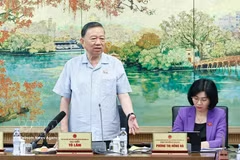
Party General Secretary and State President To Lam, a National Assembly deputy of Hanoi, speaks at the 16th National Assembly's first extraordinary session. (Photo: VNA)

Lawmakers move to tackle traditional, non-traditional security threats

To avoid squandering opportunities and falling behind, the legal and institutional systems must undergo a top-to-bottom review, with legislation brought closer to reality and, where needed, designed to “stay ahead” to create growth rather than scrambling to plug holes after a crisis hits, said top leader To Lam.

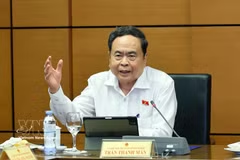
NA Chairman Tran Thanh Man speaks at the group debate on August 4. (Photo: VNA)

NA Chairman urges ‘revolution’ in legal information access

NA Chairman Tran Thanh Man said the requirement that “every citizen live and work in accordance with the Constitution and the law” remains hollow unless people can fully access, understand, and actually use the rules that govern their lives.

A plenary sitting of the 16th NA's first extraordinary session (Photo: VNA)

16th NA’s first extraordinary session targets defence law upgrade, deeper international integration

Deputy Prime Minister and Minister of National Defence Gen. Phan Van Giang, presenting the WMD non-proliferation bill, said the draft aims to swiftly and fully translate the Party and State’s policies and guidelines on safeguarding the Fatherland early and from afar, as well as on deeper international integration, into legislation, including the policy of joining multilateral nonproliferation mechanisms.

NA deputies at the discussions (Photo: VNA)

NA deputies review legal reforms on military, defence

Lawmakers later held group discussions on the draft Law on the Prevention of the Proliferation of Weapons of Mass Destruction, the draft law revising nine military and defence laws, and the revised Law on Law Dissemination and Education.