Lawmakers move to tackle traditional, non-traditional security threats

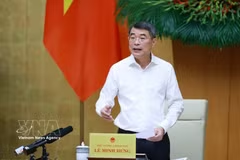
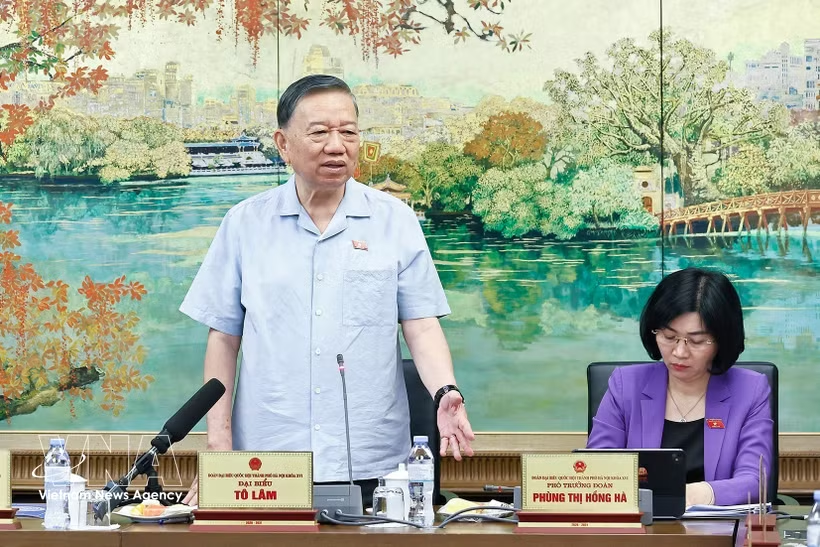
To avoid squandering opportunities and falling behind, the legal and institutional systems must undergo a top-to-bottom review, with legislation brought closer to reality and, where needed, designed to “stay ahead” to create growth rather than scrambling to plug holes after a crisis hits, said top leader To Lam.

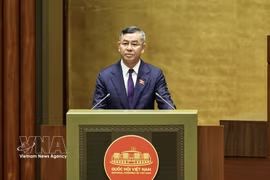
Party General Secretary and State President To Lam, a National Assembly deputy of Hanoi, speaks at the 16th National Assembly's first extraordinary session. (Photo: VNA)

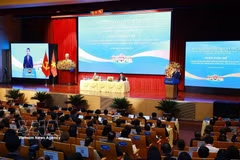
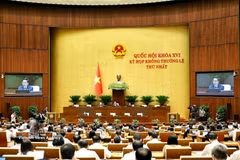
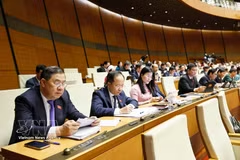
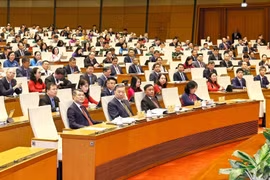
Hanoi (VNA) – The 16th National Assembly continued its first extraordinary session in Hanoi on August 4, with group debates on the draft Law on the Prevention and Control of the Proliferation of Weapons of Mass Destruction (WMD) and a bill amending and supplementing several articles of nine military and national defence laws.

​Party General Secretary and State President To Lam, who also serves as Secretary of the Central Military Commission, said the revisions are vital to navigate a rapidly changing global landscape and meeting requirements for the country's rapid development.

To avoid squandering opportunities and falling behind, the legal and institutional systems must undergo a top-to-bottom review, with legislation brought closer to reality and, where needed, designed to “stay ahead” to create growth rather than scrambling to plug holes after a crisis hits, he said.

On the military and defence law amendments, he said professionalising commanders of commune-level Military Commands is the right step so that core militia and self-defence forces receive effective guidance.

​On political commissars, he described the mechanism of absolute Party leadership over the army in every aspect as uniquely distinctive and effective. At the top, the Party General Secretary leads the Central Military Commission; at the provincial level, the provincial Party chief acts as Secretary of the provincial Military Command's Party Committee. Extending that same blueprint to the commune level, with the communal Party Committee Secretary taking the role, would pull the full weight of the political system and the whole population behind national defence and security missions, he said.

​Gen. Nguyen Tan Cuong, Chief of the General Staff of the Vietnam People’s Army and Deputy Minister of National Defence, who is also a deputy from Dong Thap province, stressed that commune-level Military Commands must be organised to match what they are actually asked to do, with the right personnel, vehicles, equipment, offices, training grounds, and exercise space all falling into place.

​Commenting on the WMD non-proliferation bill, deputy Luu Nam Tien from Hanoi expressed his support for its urgent enactment. The legislation, he said, is imperative to institutionalise the Party’s policy of safeguarding the fatherland early and from afar, complete the legal framework for international treaty obligations, and fix cracks in a regulatory regime now largely patched together by government decrees./.
VNA

See more

The National Assembly Standing Committee votes and approves the submission of the proposals on the establishment of Quang Ninh and Bac Ninh cities to the 16th-tenure legislature. (Photo: VNA)

Proposals on establishment of Quang Ninh, Bac Ninh cities to be submitted to legislature

Presenting the Government’s proposals, Minister of Home Affairs Nguyen Tien Hai said the establishment of the two cities and Bac Ninh’s 12 wards has met all political and legal requirements. The proposals are also consistent with the national master plan, plans on the urban and rural system and the Red River Delta region, provincial plans, and general urban planning schemes.

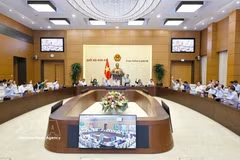
A plenary sitting of the 16th NA's first extraordinary session (Photo: VNA)

16th NA’s first extraordinary session targets defence law upgrade, deeper international integration

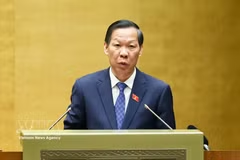
Deputy Prime Minister and Minister of National Defence Gen. Phan Van Giang, presenting the WMD non-proliferation bill, said the draft aims to swiftly and fully translate the Party and State’s policies and guidelines on safeguarding the Fatherland early and from afar, as well as on deeper international integration, into legislation, including the policy of joining multilateral nonproliferation mechanisms.

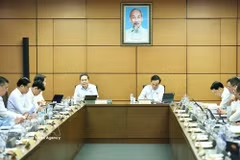
NA deputies at the discussions (Photo: VNA)

NA deputies review legal reforms on military, defence

Lawmakers later held group discussions on the draft Law on the Prevention of the Proliferation of Weapons of Mass Destruction, the draft law revising nine military and defence laws, and the revised Law on Law Dissemination and Education.

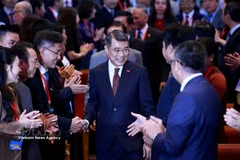
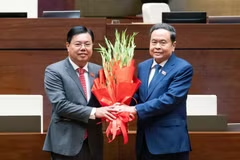
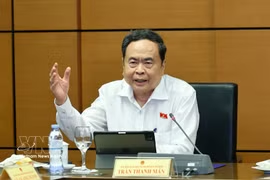
National Assembly Chairman Tran Thanh Man (R) presents flowers to congratulate new Minister of Home Affairs Nguyen Tien Hai. (Photo published by VNA)

National Assembly approves Nguyen Tien Hai as Minister of Home Affairs

The NA held a secret ballot on the appointment and later adopted a resolution approving Nguyen Tien Hai as Minister of Home Affairs. The resolution was passed with 483 votes in favour out of 484 deputies participating in the electronic vote, accounting for 96.60% of those present.

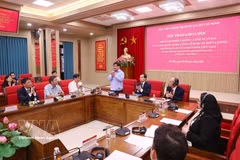
The scientific seminar is held by the Ho Chi Minh National Academy of Politics in Hanoi on August 3. (Photo: VNA)

Seminar honours Fidel Castro's legacy, enduring Vietnam–Cuba solidarity

A Vietnamese official said Fidel Castro's revolutionary ideals transcended national borders, making him a steadfast internationalist, an outstanding theorist and practitioner of the international communist and workers' movement, and an enduring symbol of national liberation and socialism.

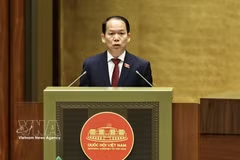
Phan Van Mai, Chairman of the NA’s Committee for Economic and Financial Affairs, speaks at the NA session on August 3. (Photo: VNA)

16th NA’s first extraordinary session stresses efficient resource use, national sovereignty

Presenting the Government’s proposal, Minister of Public Security Luong Tam Quang said the proposed resolution on special mechanisms for handling legal violations related to the State and private sectors and the application of science, technology, innovation and digital transformation aims to institutionalise Party policies and provide a legal basis to protect dynamic and innovative officials who dare to think and act for the common good, without corruption, wastefulness or wrongdoing.

A view of the Central Technology Platform No. 2 of the Bach Ho (White Tiger) oil rig under the Vietsovpetro joint venture between Vietnam and Russia (Photo: VNA)

Institutional reform key to unlocking new development model: experts

Resolution No. 19-NQ/TW, adopted at the third plenum of the 14th Party Central Committee, identifies breakthroughs in institutions and reforms as the starting point for renewing Vietnam’s development model, alongside reforms in national governance, organisation and operations to build new development capacity.

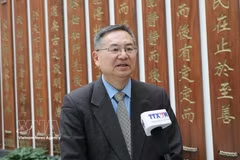
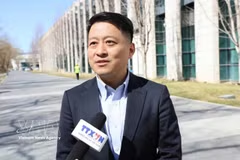
Professor Qu Qiang from Minzu University of China, in an interview granted to the Vietnam News Agency. (Photo: VNA)

Four orientations demonstrate shift in Vietnam’s development thinking: Chinese scholar

The most notable change is Vietnam’s transition from “organisational restructuring” to “improving governance effectiveness.” Previously, reforms focused on streamlining the apparatus and reducing intermediary levels. With organisational reforms largely completed, the more important task is now to ensure the new system operates more effectively, according to Professor Qu Qiang from Minzu University of China.