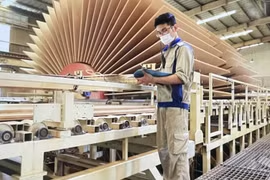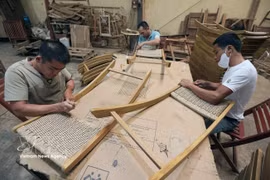
Hanoi (VNA) – Removing bottlenecks in timber supply for value-added processing is crucial for Vietnam's wood industry to increase export value and strengthen its position in the global supply chain, said insiders.
Vietnam's wood industry has grown rapidly in recent years, with exports reaching 17.2 billion USD in 2025. Wood and wood products are now shipped to more than 140 countries and territories, making Vietnam an important processing hub in the global supply chain, with key markets such as the US, Japan, China, the European Union and the Republic of Korea.
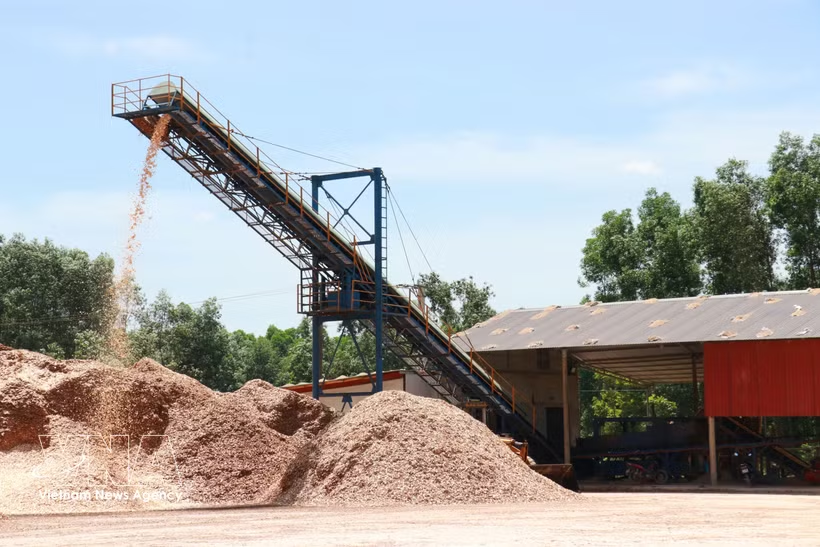
However, despite having around 4.9 million ha of planted forests, many manufacturers are struggling to secure sufficient raw materials for deep processing and value-added production. Large volumes of timber are still harvested young and exported as woodchips and pellets, limiting the supply of larger-diameter timber needed for high-value products.
Pham Thanh Long, raw material procurement director of Trieu Thai Son Co., Ltd. in Thanh Hoa province, said acacia trees are commonly harvested after just three to four years as numerous woodchip processors compete aggressively for timber, creating instability in the raw material market.
He said the current practice significantly reduces the value of forest resources. Three tonnes of fresh acacia generate only around 4 million VND (152.4 USD) when exported as woodchips or 5 million VND as pellets, compared with up to 20 million VND if used for plywood and other value-added products. As a result, many manufacturers have had to cut production or suspend operations because of raw material shortages.
According to the Vietnam Timber and Forest Product Association (Viforest), the country's four major export product groups required about 59.5 million cu.m of timber in 2025. Woodchips and pellets accounted for 46.5 million cu.m, or 78.1%, while industrial wood panels and furniture consumed just 13 million cu.m, or 21.9%, indicating that most timber is still used for low-value exports.
According to Doan Van Tinh, Chairman of the Board of Directors of MDF Mekong, woodchips continue to account for a large share of Vietnam's forestry exports despite their low added value and limited contribution to the wood industry's value chain. He attributed this to the low export tax on woodchips, at around 2%, which is fully refundable, effectively reducing the rate to nearly zero. In contrast, value-added wood products are subject to export taxes of 8–10%.
At the same time, woodchip facilities require far less investment than deep-processing plants.
The structure of Vietnam's forestry sector also poses challenges. Most plantation forests are managed by small household growers with limited financial resources, prompting many to harvest trees after only three to five years to recover capital quickly and minimise risks.
With the industry targeting 19 billion USD in exports in 2026, businesses have called on authorities to gradually curb raw material exports by raising export taxes on woodchips, introducing export quotas, stepping up inspections and tightening oversight of woodchipping facilities, collection points and unlicensed weighing stations, and taking firm action against operations that fail to meet regulatory requirements.
Viforest Secretary General Ngo Sy Hoai said Vietnam does not lack plantation forests but lacks stable supplies of large, high-quality and legally sourced timber suitable for deep processing. Addressing fragmented forest ownership, improving tree varieties and cultivation techniques, and strengthening cooperation between growers, cooperatives and processors would be key to building a sustainable timber supply chain.
He stressed the need to shift towards sustainable plantation forest management, saying that rather than treating forests as short-rotation crops for quick returns, plantations should be managed as long-term assets, with appropriate tree species selection, optimal planting density, effective pest and disease control, soil and water conservation, carbon management, and harvesting based on quality objectives.
Under this approach, forest growers would no longer sell timber solely by weight, but could also market it based on log diameter, quality, certification and processing capacity, Hoai noted.
Accoridng to Nguyen Van Dien, Deputy Director of the Forestry and Forest Protection Department under the Ministry of Agriculture and Environment, the industry must shift from pursuing export volume to creating greater value by ensuring timber is legal, fully traceable, sourced without deforestation, certified under sustainable forest management standards and produced with low carbon emissions.
He said the ministry will continue promoting large-timber plantations, expanding certified forests, developing digital traceability systems and improving policies on finance, investment and carbon markets to secure a sustainable raw material base for the industry's long-term growth./.