700 bln USD for net zero: Vietnam bets on VIFC

Assoc. Prof. Dr. Nguyen Huu Huan, Vice Chairman of the Executive Board of VIFC-HCMC, said the VIFC will focus on building market infrastructure needed to bridge the gap between big investment pledges and bankable projects.

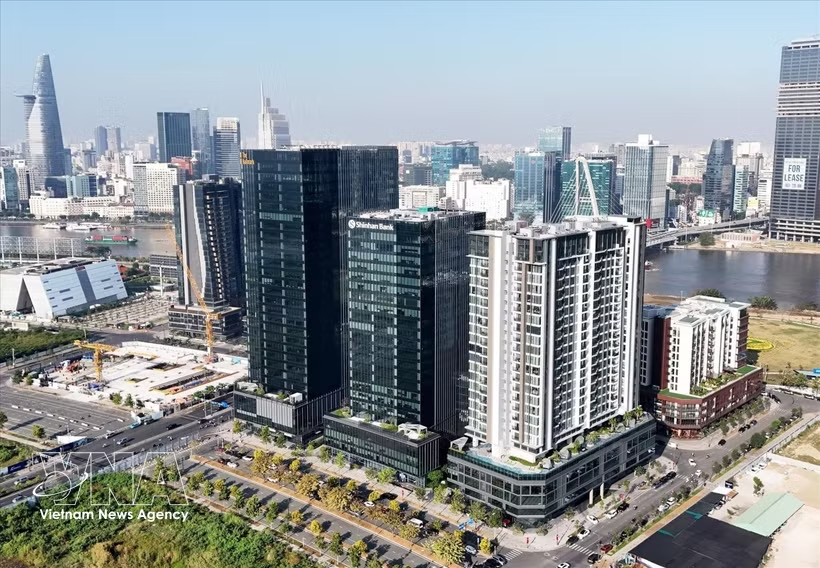
At the VIFC-HCMC (Photo: VNA)

Ho Chi Minh City (VNA) - Vietnam will require an estimated 700 billion USD to meet its green growth and net-zero targets by 2050, yet gaps in market infrastructure, transparency standards, and risk-sharing mechanisms are keeping its green projects from becoming the kind of can’t-miss opportunities global investors crave.

That warning rang out at the Vietnam Green Finance Conference 2026, built around the theme “Where Green Capital Meets Opportunities”, held in Ho Chi Minh City on August 6. The event was co-hosted by the Executive Board of the Vietnam International Financial Centre in Ho Chi Minh City (VIFC-HCMC), Nam A Bank, FiinGroup, and the Vietnam office of the Global Green Growth Institute (GGGI).

Capital demand mounts, project appeal lags

The Ministry of Finance pegs Vietnam’s long-term investment needs for green growth and sustainable development through 2050 at 670-700 billion USD. Of that, roughly 368 billion USD, or close to 30 billion USD a year, will go toward climate change adaptation alone.

That’s far too big for state budget and traditional banks to handle, making private and international cash a must if Vietnam hopes to meet its green transition goals.

Paul Xavier, from the International Finance Corporation (IFC) - a World Bank Group member, said foreign investors are still active on the hunt for green opportunities. Their biggest question isn’t which country has the largest financing hole, but which markets are ready to serve up projects attractive enough to put cash behind.

Nguyen Quang Thuan, Executive Chairman of FiinGroup and FiinRatings, said the real choke point isn’t a lack of available funds. It’s the quality of the projects themselves.

Many domestic projects simply aren’t designed or packaged to meet what foreign investors expect. Before earning the “green” label, he said, a project has to prove it makes economic sense, is financially sound and can deliver steady cash flows.

Thuan added that an investor’s own financial strength is another major screening point for international funds. Vietnam also lacks the financial tools, like infrastructure and project bonds and other long-term vehicles, to turn workable projects into assets investors can actually buy.

Green finance set to anchor VIFC’s strategy

Assoc. Prof. Dr. Nguyen Huu Huan, Vice Chairman of the Executive Board of VIFC-HCMC, said the VIFC will focus on building market infrastructure needed to bridge the gap between big investment pledges and bankable projects.

Huan said VIFC plans to open a one-stop shop dedicated to green finance projects and activities. Beyond simply matching investors with businesses, the platform will standardise the entire project development process, from setting standards and disclosure requirements to raising and allocating capital.

While plenty of global financial hubs already have full-blown green finance ecosystems, Vietnam is still missing several critical pieces, including standardised green project portfolios, mechanisms to convert projects into investable assets, adaptation finance solutions and deeper market liquidity.

That’s why a top VIFC priority is building a pipeline of globally standardised green projects with transparent cash flows, solid financial structures, appropriate public-private partnership mechanisms and full insurance coverage. At the same time, the centre will push transition finance and adaptation finance products while strengthening risk-sharing and driving down the cost of capital for firms

Another priority is market infrastructure through data, measurement, reporting and verification (MRV) systems to digital platforms and tools that help companies get projects ready to meet international standards. Notably, the VIFC Green Rulebook, a comprehensive green finance framework, is expected by the end of 2026, laying the legal foundation for Vietnam’s green and transition finance markets.

Notably, the Green Supply Chain Finance model, jointly developed by Nam A Bank, FiinGroup, IFC, and the Swiss State Secretariat for Economic Affairs (SECO), is set to be integrated into the VIFC ecosystem as a flagship green finance initiative.

According to Deputy CEO of Nam A Bank Vo Hoang Hai, the model targets small and medium-sized enterprises (SMEs), which make up some 98% of Vietnamese firms but often struggle to access credit because they lack collateral, solid data, or the documentation that international financial organisations demand.

Rather than leaning on collateral, the model taps transaction data and supply chain cash flows as the basis for lending decisions. Digitising the entire value chain also lets companies track their carbon footprint, boosts transparency and widens access to green financing.

Beyond serving Vietnam, the model is expected to scale across Southeast Asia, paving the way for a new wave of financing products, including blue finance, adaptation finance and funding for projects that make cities more resilient./.


VNA
See more

A view of the launch ceremony for the expanded Vietnam–China cross-border QR payment service. (Photo: NAPAS)

Over 1 billion Weixin Pay users can make QR code payments in Vietnam

NAPAS, Weixin Pay, and BIDV will study the rollout of the reverse payment service, enabling users of Vietnamese banking applications and e-wallets to make QR code payments in China, with the aim of completing a comprehensive cross-border payment ecosystem between the two countries.

Vietnam cuts retail fuel prices on August 6. (Photo: VNA)

Vietnam cuts retail fuel prices on August 6

The maximum retail price of E5RON92 biofuel was reduced by 1,160 VND to 21,728 VND (0.83 USD) per litre, while that of E10RON95-III fell by 1,035 VND to 22,324 VND per litre.

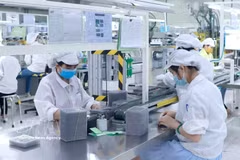
Production of electronic components at Star Engineers Vietnam Co. Ltd. in Binh Xuyen I Industrial Park in Phu Tho province. (Photo: VNA)

Vietnam targets higher-quality FDI under Resolution 10

During the first seven months of 2026, Vietnam attracted more than 38 billion USD in registered FDI, up nearly 58% year-on-year. More importantly, the increase was driven by large-scale, high-tech projects rather than a surge in the number of new investments, signalling a significant improvement in the quality of capital inflows.

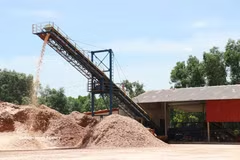
A woodchip production line at a plant in Vinh Thuy commune, Quang Tri province (Photo: VNA)

Tackling timber supply bottlenecks needed for value-added processing: experts

Vietnam's wood industry has grown rapidly in recent years, with exports reaching 17.2 billion USD in 2025. Wood and wood products are now shipped to more than 140 countries and territories, making Vietnam an important processing hub in the global supply chain, with key markets such as the US, Japan, China, the European Union and the Republic of Korea.

A Vietnam Airlines plane at Da Nang International Airport (Photo: VNA)

Da Nang International Airport to expand Terminal 1

The 12.2ha Terminal 1 of the Da Nang International Airport, which was built at a cost of 1.34 trillion VND (51 million USD), has been overloaded since its inauguration in 2011. With the new planned area, increasing demand for passenger and cargo services will be met within the next few years.

Completing the legal framework for the corporate bond market plays an important role in balancing stronger market discipline and transparency with the need to facilitate legitimate and effective fundraising activities of businesses. (Photo: vtv.vn)

Vietnam moves to facilitate corporate bond fundraising

Completing the legal framework for the corporate bond market plays an important role in balancing stronger market discipline and transparency with the need to facilitate legitimate and effective fundraising activities of businesses, according to Nguyen Hoang Duong, Vice Chairman of the State Securities Commission.

A view of Song Khoai Industrial Park in Quang Ninh (Photo: VNA)

Quang Ninh smashes FDI target with over 1 bln USD inflow

The northern province of Quang Ninh pulled in more than 1.095 billion USD in foreign direct investment (FDI) during January-July, eclipsing its full-year target and cementing its reputation as a safe, attractive and reliable destination for global capital.

Manufacturing and engineering posted the strongest recruitment growth in the first half of 2026, with hiring demand surging 70% year-on-year. (Photo: VNA)

Manufacturing, engineering drive hiring growth in H1: report

Manufacturing and engineering posted the strongest recruitment growth, with hiring demand surging 70% year-on-year, driven by production expansion, supply chain restructuring and sustained investment inflows in high-tech manufacturing.

Workers classify tra fish fillets at the factory of Go Dang Tien Giang Joint Stock Company. (Photo: VNA)

Fishery exports maintain growth momentum despite mounting headwinds

According to the Vietnam Association of Seafood Exporters and Producers (VASEP), seafood exports reached nearly 1.02 billion USD in July, up 4.8% year-on-year. The figure in the first seven months of 2026 hit nearly 6.78 billion USD, an increase of 11.5% compared to the same period last year.

Chairman of the municipal People’s Committee Vu Dai Thang speaks at an event to announce Hanoi's 100-year master plan. (Photo: VNA)

Hanoi builds attractive investment ecosystem for FDI enterprises

By translating Resolution No. 10-NQ/TW into concrete programmes and actions, Hanoi is laying a solid foundation to attract high-quality FDI, turning foreign investment not only into an economic resource but also a catalyst for innovation, productivity growth and faster, greener and more sustainable development.

Illustrative image (Photo: VNA)

US boosts biofertiliser exports to Vietnam

According to a notice issued on August 4, FAS invites US universities, agricultural trade associations, and non-profit organisations to apply for this technical assistance funding to evaluate crop yields and reductions in nitrogen leaching in the US and Vietnam using US manufactured biofertilsers such as liquid fish fertiliser.

Vietnamese Ambassador to Cuba Le Quang Long (second from left) witnesses the handover ceremony for the first batch of rice produced by TBAgri to the Cuban side. (Photo: Embassy of Vietnam in Cuba)

Vietnam hands over Cuba-grown rice to partner

More than 470 tonnes of rice grown in Cuba from Vietnam's OM5451 variety were handed over to Cuban partner GRANMAX at a ceremony in Havana on August 4, marking the first harvest delivered by Vietnamese agricultural company TBAgri under a joint Vietnam–Cuba rice production project.