Hanoi (VNA) – Vietnam needs to build an ecosystem that connects large and small businesses, strengthen their capabilities, and help them gradually move up in value chains, while linking international resources with the domestic economy to create new development capabilities.
From survival to joining value chains
Vietnamese enterprises have increasingly strengthened their global position and brands. However, small and micro enterprises, which account for 98% of the total, remain vulnerable to market fluctuations.
About 155,300 enterprises left the market in the first seven months of 2026, up 7.6% year on year. Meanwhile, nearly 187,200 new enterprises were established or resumed operations, up 7.5%. An average of about 22,200 enterprises exited the market each month, highlighting continued pressure on the business community.
Many have had to scale down or suspend operations due to limited access to capital, production facilities, technology and markets, with small and micro enterprises accounting for the majority of business closures.
Assoc. Prof. Dr. Nguyen Thuong Lang of the National Economics University said Vietnamese firms could not remain purely processing links but must gradually become strategic partners capable of participating in value-chain management and meeting sustainability requirements.
He noted that Vietnam has a major opportunity as global supply chains undergo profound restructuring. After more than two decades of international integration, the country has become an important manufacturing hub, but domestic suppliers’ contribution to global value chains remains modest.
Supply chains are increasingly complex ecosystems rather than simple buyer-seller relationships, Lang said, adding that low prices alone are no longer enough to retain partners. Enterprises need to demonstrate reliability, adaptability, consistent quality and the ability to cooperate over the long term.
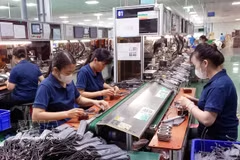
Within a value chain, large enterprises can act as a nucleus, thereby fostering a network of domestic suppliers across various tiers. As they expand production and international markets, demand for materials, components, logistics, technology and supporting services can create opportunities for smaller firms.
Building an ecosystem for domestic firms
Experts agreed that stronger linkages and an enterprise ecosystem are essential to improving competitiveness, particularly for small- and medium-sized enterprises (SMEs).
Dr. Phan Duc Hieu, Standing Member of the National Assembly’s Committee for Economic and Financial Affairs, said Vietnamese firms must build their own value chains under the leadership of large domestic enterprises.
“Domestic firms need to support one another to grow stronger together,” he said, stressing that the ultimate goal should not merely be to become suppliers to foreign-invested enterprises (FIEs), but to develop global value chains led by Vietnamese companies.
Assoc. Prof. Dr. Do Phu Tran Tinh, Director of the Institute for Policy Development under Vietnam National University-Ho Chi Minh City, said Politburo Resolution No. 10 reflects an important shift in the approach to FIEs, from “attracting capital” to “attracting investment to build capacity for the Vietnamese economy.”
The resolution calls for investment to be attracted based on industrial clusters, value chains and innovation ecosystems, while technology transfer, localisation rates, links with domestic enterprises and value added generated in Vietnam are important criteria for assessing FDI projects.
He pointed out that Vietnam has long had “two sectors running in parallel”: the FDI sector is deeply integrated into global value chains, while most domestic enterprises, especially SMEs, remain outside them.
Helping Vietnamese suppliers move up chains
Hieu suggested that Vietnam should develop a strong domestic business force capable of absorbing technology, standards, management practices and market access from major corporations. At the same time, it is necessary to issue policies that encourage FIEs to actively seek, develop and use Vietnamese suppliers.
A key solution is to establish intermediary mechanisms to connect the two sectors and build trust, he said, elabortating that business associations and local authorities should play a greater role, while specialised institutions should serve as focal points for connection, support and monitoring.
Citing Taiwan (China)’s Corporate Synergy Development Centre, Hieu said Vietnam could study international experience in establishing business-linkage centres to help domestic and foreign firms identify suitable partners and develop stable cooperation.
According to Tinh, Resolution No. 10 sets a target of raising average localisation rates in key industries to 45-50% by 2030 and having about 10,000 domestic enterprises participate in the value and supply chains of FIEs.
A supplier-development programme jointly implemented by the Ministry of Industry and Trade and Samsung helped increase the number of Vietnamese first- and second-tier suppliers in Samsung’s supply chain from 25 in 2014 to 306 at the end of 2023.
Experts said Vietnam should continue developing leading domestic enterprises as ecosystem nuclei, strengthen SMEs’ capabilities, develop industrial clusters and establish dedicated financial mechanisms for enterprises participating in supply chains./.