Vietnam’s wood industry seeks higher value

According to the Vietnam Timber and Forest Product Association (VIFORE) , about 74% of timber from planted forests is currently used to make wood chips and pellets, while 18% goes into plywood and laminated veneer lumber (LVL). Although these products consume around 80% of the raw material supply, they generate only about 3-4 billion USD of the sector’s total export turnover of 18 billion USD.

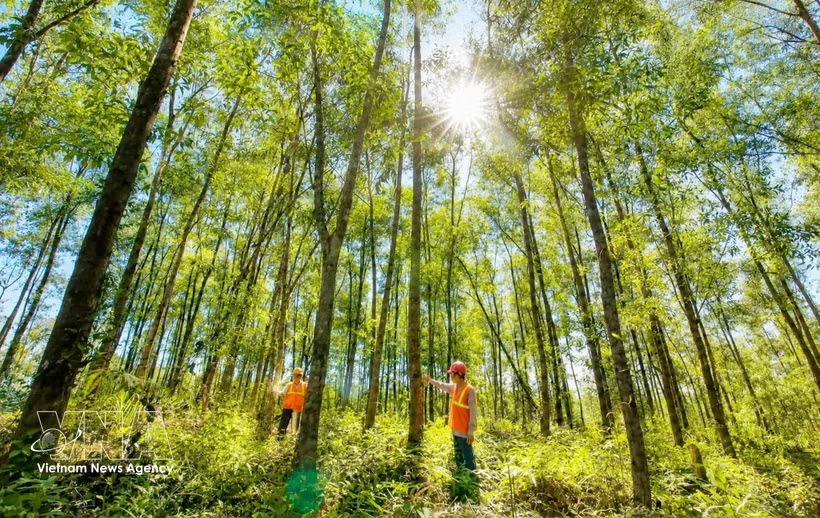
Quang Tri steps up development of large-timber forests. (Photo: VNA)

Hanoi (VNA) - Vietnam has around 4 million hectares of production forests, involving more than 1 million forest-growing households and thousands of processing and export businesses. However, weak linkages across the supply chain remain a major obstacle to increasing the value of the country’s wood industry.

According to the Vietnam Timber and Forest Product Association (VIFOREST), about 74% of timber from planted forests is currently used to make wood chips and pellets, while 18% goes into plywood and laminated veneer lumber (LVL). Although these products consume around 80% of the raw material supply, they generate only about 3-4 billion USD of the sector’s total export turnover of 18 billion USD.

By contrast, deeper processing, including indoor and outdoor furniture and laminated boards, uses just 20% of raw materials but generates 14-15 billion USD in export value.

The association said stronger links across the supply chain are essential to developing a circular and green wood industry. A key challenge, however, is raising incomes for forest growers, whose low earnings discourage them from developing larger timber plantations.

Ngo Sy Hoai, Vice Chairman and Secretary General of the association, said fragmented forest land remains a major barrier despite policies allowing forest owners to lease or transfer land and participate in investment partnerships. Difficulties in land consolidation and cooperation among households have prevented businesses from establishing concentrated raw-material areas.

Vietnam has introduced policies on large-timber forests, forest certification and carbon credits, as well as joined international mechanisms such as VPA/FLEGT and the EU Deforestation Regulation (EUDR). However, the lack of stable linkages remains the sector’s biggest bottleneck.

Without stronger connections from raw-material areas to processing and exports, businesses will struggle to meet increasingly stringent requirements on traceability, legality and sustainability in major markets.
vnanet-potal-tinh-hoa-lang-go-dong-ky-bac-ninh-8585938.jpg
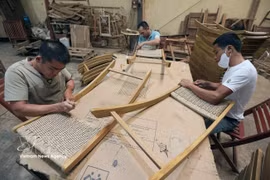
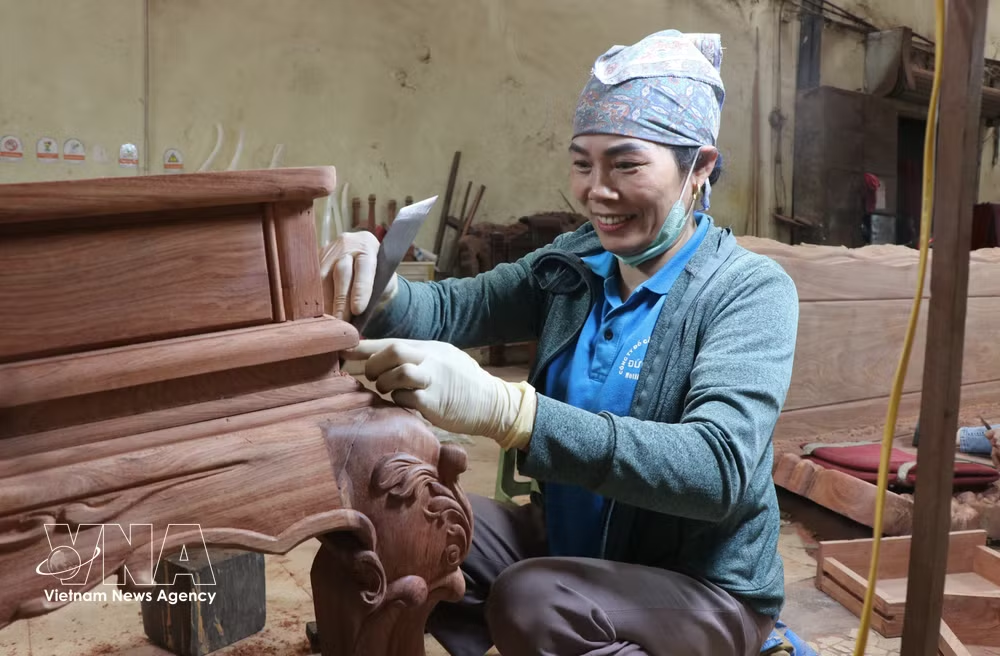
An artisan at the Dong Ky woodcraft village in Dong Nguyen ward, Bac Ninh province. (Photo: VNA)

The association said it plans to encourage members to increase the use of domestically grown, certified and legally sourced imported timber, while accelerating digital traceability systems and preparing for meeting EUDR requirements. It will also promote long-term partnerships among businesses, forest owners, cooperatives and forestry households, including contracts covering seedlings, technical support and forest certification.

Ha Cong Tuan, Chairman of the Vietnam Association of Agricultural Economics and Rural Development, said policy should shift from supporting individual tree-planting activities toward developing sustainable value-chain ecosystems.

Under this model, forest growers should become production partners rather than simply timber suppliers, while businesses should invest directly in raw-material areas and participate throughout the production cycle. Cooperatives would serve as a key link between households and businesses.

Tuan also called for long-term contracts backed by tax incentives, support for sustainable forest-management certification and forest insurance. He proposed tailored credit packages matching the forestry sector’s long production cycles, particularly for large-timber forests, as well as preferential loans for businesses investing in raw-material areas and guaranteeing product purchases.

Experts noted that very little planted forest is kept for more than five years, meaning most timber harvested is used for chips and pellets rather than higher-value products.

They therefore recommended that the Vietnam Academy of Forest Sciences work with VIFOREST and businesses to pilot longer harvesting cycles of six to 10 years, or even 12 years. Small-scale pilot plots of around two hectares could demonstrate the potential for significantly higher returns./.
VNA

See more

Ship 743 brings fisherman Truong Van Chung back to the Naval Squadron 129 port at noon on August 18, 2026. (Photo: VNA)

Ho Chi Minh City advances strategy for strong maritime nation

The resolution marks a shift from focusing primarily on the maritime economy to viewing the sea as an economic, strategic and living space, requiring close coordination between development, defence, security, foreign affairs and modern maritime governance.

Vietnamese products increasingly win popularity (Photo: VNA)

Vietnam’s home market gives local brands room to grow

Notably, the domestic market has changed a lot. Consumers no longer pick products solely on whether they are domestic or foreign. Quality, price, origin, design, safety, after-sales service and shopping experience increasingly drive purchases.

Banks dominated July's new supply, accounting for 79% or about 21 trillion VND. (Photo: VNA)

Corporate bond issuance hits five-month low in July

Despite the sharp monthly decline in issuance, Vietnam’s outstanding corporate bond market remained sizeable at nearly 1.5 quadrillion VND as of July. Private-placement bonds accounted for over 1.3 quadrillion VND, while publicly offered bonds represented 180 trillion VND.

A vessel owner completes declaration procedures at the Vam Lang Border Guard Station before heading out to sea. (Photo: VNA)

Enhancing role of local authorities in combating IUU fishing

Vice Chairman of the My Tho People's Committee Dinh Tu Khoa said lists of ineligible vessels are publicly posted at the ward People's Committee office and residential areas. Heads of residential groups are assigned to supervise vessel owners and ensure that fishing gear and equipment are not kept on ineligible vessels.

A Musinsa store in the Republic of Korea. (Photo: VNA)

Korean online fashion brand enters Vietnam

Musinsa has already signed a partnership agreement with Au Chau Fashion and Cosmetics (ACFC), a unit of Imex Pan Pacific Group (IPPG), one of Vietnam’s largest distributors.

Illustrative image (Photo: Viettel)

Viettel enters 11th international market, eyes telecom investment in Caribbean

Viettel announced on August 21 that its subsidiary, Viettel Global Investment JSC (Viettel Global), had won the right to use 240 MHz of spectrum in the 700 MHz, 2300 MHz and C-Band frequencies for 4G/5G mobile networks for 20 years, under Resolution No. 073-2026 issued by the Dominican Institute of Telecommunications (INDOTEL).

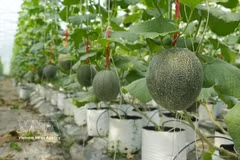
India's opening of its market to Vietnamese durian is a notable development that creats new opportunities for producers and exporters in both countries. (Photo: VNA)

Vietnam, India seek to expand agricultural trade

Economic and trade cooperation is an important pillar of Vietnam–India relations, with agricultural trade offering considerable room for expansion and diversification, said Trade Counsellor Bui Trung Thuong.

Vietnam sets a goal to raise GDP per capita to around 8,500 USD by 2030. (Photo: VNA)

Resolution 19 marks strategic shift in Vietnam’s development thinking

After 40 years of Doi Moi (Renewal), the economy has begun to show signs of shifting from a growth model heavily reliant on expanding capital and labour towards one driven by innovation, science and technology and digital transformation, with greater emphasis on improving labour productivity.

Border guards inspect fishing vessels entering and leaving La Gi fishing port. (Photo: VNA)

Lam Dong launches peak crackdown on illegal fishing

The campaign brings together the provincial Border Guard Command and relevant agencies to step up inspections, patrols and law enforcement while addressing shortcomings pointed out by the European Commission (EC).

Minister of Finance Ngo Van Tuan (R) and Guinean Minister of Planning, International Cooperation and Development Ismaël NaBé signed a Memorandum of Understanding (MOU) on cooperation between the two ministries in Hanoi on August 20. (Photo published by VNA)

Vietnam, Guinea seek to boost investment cooperation

The MOU signed between the Vietnamese Ministry of Finance and the Guinean Minister of Planning, International Cooperation and Development aims to formalise cooperation, strengthen institutional capacity and share experience in planning, development and other areas agreed upon by the two sides in writing, in line with their respective functions and responsibilities.

At a Petrolimex fuel station. (Photo: VNA)

Petrol, diesel prices increase on August 20

From 3pm on August 20, the retail price of E5RON92 petrol was capped at 21,833 VND (0.84 USD) per litre, up 598 VND per litre from the previous ceiling price. E10RON95-III petrol was priced at no more than 22,668 VND per litre, an increase of 549 VND per litre.