Vietnam startup ecosystem seeks stronger links with global innovation networks

Vietnam aims to develop an open ecosystem in which startups can actively connect with international partners, learn from global experience, access overseas markets, capital and expert networks.

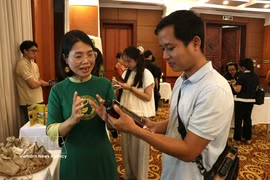
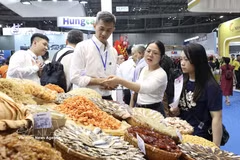
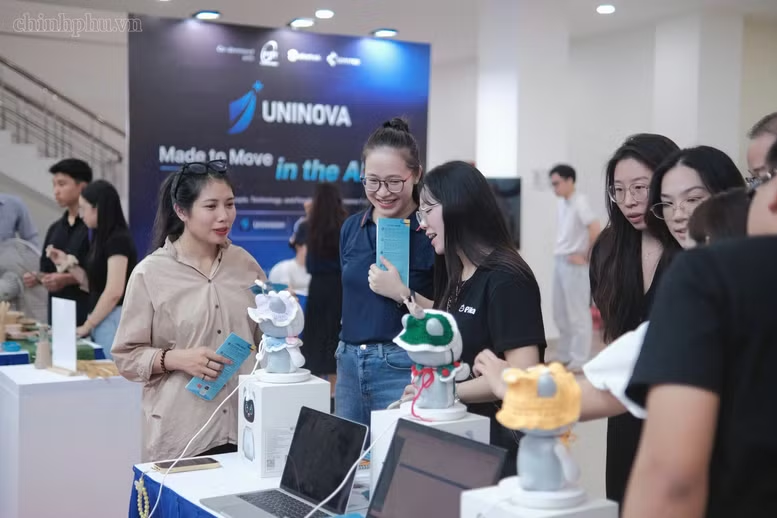
Visitors at an exhibition held within the framework of the International Conference: Startups in a Global Context. (Photo: chinhphu.vn)

Hanoi (VNA) – The International Conference: Startups in a Global Context was held at the Posts and Telecommunications Institute of Technology (PTIT) on August 21 as part of Vietnam Startup Community Day 2026.

The event brought together nearly 1,000 delegates, including speakers from China, Singapore and Canada, and featured 20 technology exhibition booths. It marked the first time Vietnam Startup Community Day included an international seminar.

In his opening remarks, Assoc. Prof. Dr. Tran Quang Anh, Vice President of PTIT, said the event, themed “Stories, Lessons and Future,” addressed an issue of particular importance to the Ministry of Science and Technology: the openness of Vietnam’s startup ecosystem and its readiness for international cooperation. Resolution No. 57-NQ/TW of the Politburo identifies science-technology, innovation and digital transformation as key drivers of national development, while the Government’s Resolution No. 86/NQ-CP sets out a national strategy for innovative startups.

Under this approach, Vietnam aims to develop an open ecosystem in which startups can actively connect with international partners, learn from global experience, access overseas markets, capital and expert networks. The country also strives to become an attractive destination for international partners, foreign investors and innovation models.

A key message of the conference was the need to move from international connections to international capabilities. Rather than simply connecting startups with foreign partners, experts and investors, the ecosystem needs to equip them with the ability to access overseas markets, build partnerships, mobilise resources and expand their business operations internationally. Universities have an important role to play in this process as they bring together young talent, research activities and new technologies.

PTIT, with its strengths in technology training and its position within the Ministry of Science and Technology’s ecosystem, aims to serve as a bridge linking policy, research, technology, businesses and markets.

The institute has developed startup support programmes covering incubation, acceleration, innovation spaces and intellectual property support, while expanding cooperation with partners in the Republic of Korea, Singapore, China, Canada and Australia.

It plans to further promote technology transfer and commercialisation of research results and create more opportunities for student startups to access international markets and global mentor networks.

Three international perspectives on going global

The conference featured practical experience from three innovation ecosystems.

Wang Fei, Deputy General Manager of TusStar, an international incubator network within Tsinghua University’s innovation ecosystem, shared experience in turning university research into innovative businesses capable of reaching global markets. TusStar has incubated more than 8,000 companies and operates in over 100 cities worldwide.

From Singapore, Marcuz Tan, CEO of Boustead APEX, Inc. and founder of AI:Xcelerator, shared insights into strategies for building businesses that create tangible value. He stressed that startups should define their ultimate goals early and align fundraising strategies with business growth and development milestones.

Zehra Khoja, an advisor on startup incubation and acceleration programmes and former advisor at the McGill Dobson Centre for Entrepreneurship in Canada, presented “A Canadian Path for Global Founders”, outlining ways for international startups to enter the North American market through Canada’s innovation ecosystem.

She highlighted Canada’s strengths in research and development, particularly in artificial intelligence, engineering, biomedical sciences and sustainable development. Innovation hubs such as the McGill Dobson Centre for Entrepreneurship, University of Toronto Entrepreneurship and British Columbia’s innovation ecosystem offer important entry points for startups seeking to enter North America.

The stories from three different ecosystems illustrate distinct approaches but point to a common conclusion: startups do not grow in isolation. Behind the development of every successful business is an ecosystem comprising universities, support organisations, businesses, investors, experts and markets./.

VNA
See more

Illustrative image (Photo: Viettel)

Viettel enters 11th international market, eyes telecom investment in Caribbean

Viettel announced on August 21 that its subsidiary, Viettel Global Investment JSC (Viettel Global), had won the right to use 240 MHz of spectrum in the 700 MHz, 2300 MHz and C-Band frequencies for 4G/5G mobile networks for 20 years, under Resolution No. 073-2026 issued by the Dominican Institute of Telecommunications (INDOTEL).

India's opening of its market to Vietnamese durian is a notable development that creats new opportunities for producers and exporters in both countries. (Photo: VNA)

Vietnam, India seek to expand agricultural trade

Economic and trade cooperation is an important pillar of Vietnam–India relations, with agricultural trade offering considerable room for expansion and diversification, said Trade Counsellor Bui Trung Thuong.

Vietnam sets a goal to raise GDP per capita to around 8,500 USD by 2030. (Photo: VNA)

Resolution 19 marks strategic shift in Vietnam’s development thinking

After 40 years of Doi Moi (Renewal), the economy has begun to show signs of shifting from a growth model heavily reliant on expanding capital and labour towards one driven by innovation, science and technology and digital transformation, with greater emphasis on improving labour productivity.

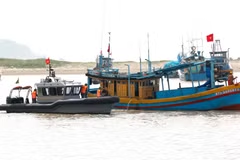
Border guards inspect fishing vessels entering and leaving La Gi fishing port. (Photo: VNA)

Lam Dong launches peak crackdown on illegal fishing

The campaign brings together the provincial Border Guard Command and relevant agencies to step up inspections, patrols and law enforcement while addressing shortcomings pointed out by the European Commission (EC).

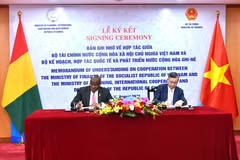
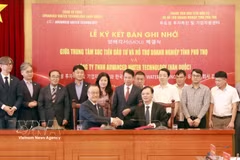
Minister of Finance Ngo Van Tuan (R) and Guinean Minister of Planning, International Cooperation and Development Ismaël NaBé signed a Memorandum of Understanding (MOU) on cooperation between the two ministries in Hanoi on August 20. (Photo published by VNA)

Vietnam, Guinea seek to boost investment cooperation

The MOU signed between the Vietnamese Ministry of Finance and the Guinean Minister of Planning, International Cooperation and Development aims to formalise cooperation, strengthen institutional capacity and share experience in planning, development and other areas agreed upon by the two sides in writing, in line with their respective functions and responsibilities.

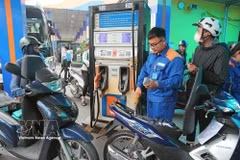
At a Petrolimex fuel station. (Photo: VNA)

Petrol, diesel prices increase on August 20

From 3pm on August 20, the retail price of E5RON92 petrol was capped at 21,833 VND (0.84 USD) per litre, up 598 VND per litre from the previous ceiling price. E10RON95-III petrol was priced at no more than 22,668 VND per litre, an increase of 549 VND per litre.

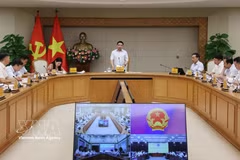
Vuong Quoc Nam, Vice Chairman of the Can Tho People’s Committee, at the meeting. (Photo: VNA)

Can Tho, World Bank join hand to boost public investment

Vuong Quoc Nam, Vice Chairman of the Can Tho People’s Committee, held a working session with a World Bank (WB) delegation on the technical assistance programme for local public financial management reform in the Mekong delta city on August 20.

An aircraft of Vietjet (Photo: VietnamPlus)

Vietjet resumes five routes to Da Lat

A Vietjet representative said the resumption of multiple routes will provide more convenient travel options for residents and tourists while restoring Lam Dong's direct air connectivity with economic and tourism centres across the country.

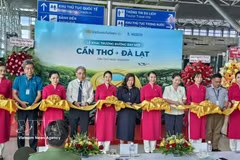
Delegates at the launch of the air route linking the Mekong Delta city of Can Tho and Da Lat in the central province of Lam Dong on August 19. (Photo: VNA)

Daily Can Tho-Da Lat flight service launched

VASCO, a member of Vietnam Airlines Group, officially launched an air route linking the Mekong Delta city of Can Tho and Da Lat in the central province of Lam Dong on August 19, expected to provide more travel options for people in the Mekong Delta while expanding tourism and trade links between the southern region and the Central Highlands.

Can Gio protective forest spans four communes — Can Gio, Binh Khanh, An Thoi Dong and Thanh An of Ho Chi Minh City - creating potential for the development of the carbon credit market. (Photo: VNA)

Ho Chi Minh City businesses eye opportunities from carbon market

Deputy Minister of Agriculture and Environment Le Cong Thanh said Vietnam is shifting from policy development and refinement to the implementation and operation of the carbon market. The domestic carbon exchange began pilot operations on June 29, 2026, providing a platform for trading greenhouse gas emission allowances and carbon credits.