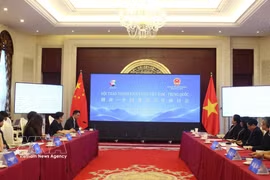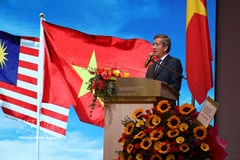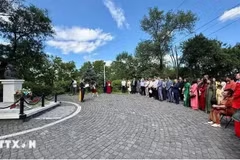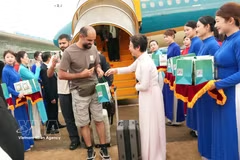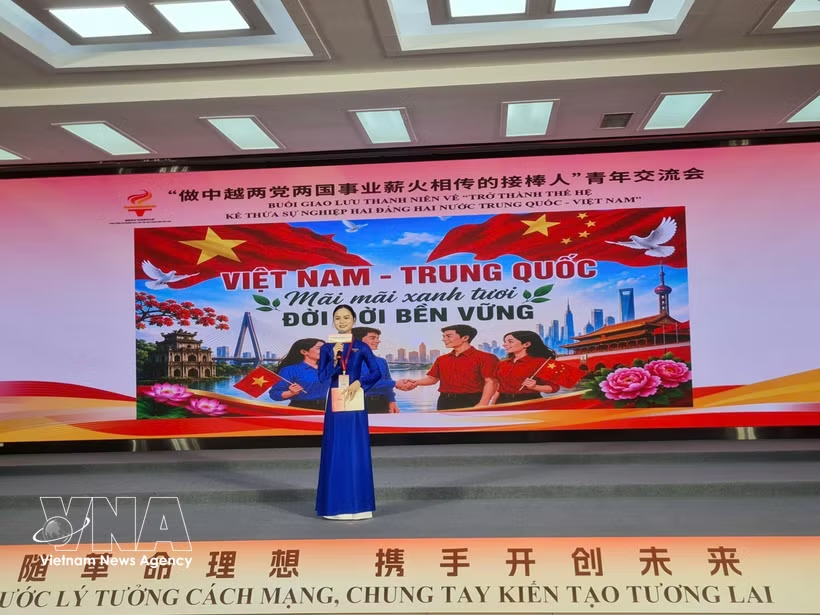
Beijing (VNA) – A youth exchange was held in Nanning, the capital of the Guangxi Zhuang Autonomous Region, on August 21 as part of the “Red Journey” programme for young Vietnamese people visiting China.
The event brought together more than 100 outstanding Vietnamese youth representatives from a range of fields. It provided an opportunity for young people from both countries to recall the revolutionary traditions, deepen mutual understanding and exchange views on issues related to study, work, innovation and development in the new era.
Addressing the event, Zheng Yuandong, Deputy Secretary-General of the People’s Government of the Guangxi Zhuang Autonomous Region, stressed that Guangxi is not only a place where President Ho Chi Minh and generations of Vietnamese revolutionary predecessors once studied, worked and fought, but also a locality that witnesses the friendship between the two Parties, States and peoples of Vietnam and China.
He expressed his hope that young people from the two countries will continue to play their role as successors to the friendship, working together in development and connectivity and helping promote bilateral ties.
On development cooperation, he said China’s modernisation process and Vietnam’s Doi Moi (Renewal) have created complementary opportunities. These provide space for young people from the two countries to learn from each other, share experience, enhance their capabilities and link their personal aspirations with the development of their respective countries.
Vietnamese Consul General in Nanning Nguyen Thi Huong affirmed that against the backdrop of positive momentum in Vietnam–China relations, with increasingly extensive cooperation across various fields, people-to-people exchanges – particularly youth exchanges – are of great importance. Young people form a dynamic and creative force and are the future owners of their respective countries; it is the younger generation that will carry forward the friendship, deepen mutual understanding and contribute to the sustainable development of bilateral relations.
She called on Vietnamese and Chinese youth to expand exchanges in emerging fields such as science – technology, innovation, digital transformation, education, culture, entrepreneurship and green development. These areas offer broad scope for young people to contribute to their respective countries’ development as well as to Vietnam–China relations.
Speaking to Vietnam News Agency correspondents in China, Zuo Xianglei, Deputy Secretary of the Guangxi Youth League Committee and President of the Guangxi Youth Federation, said that over the past year, Guangxi–Vietnam youth exchanges have made clear progress, gradually expanding from cultural and people-to-people exchanges into practical areas of cooperation. Guangxi has signed cooperation and exchange agreements with several Vietnamese localities in the field of artificial intelligence.
According to Zuo, the participants and scope of exchanges have also expanded from young people to children and teenagers on both sides. Since the launch of the “Red Journey” programme for Vietnamese youth in China, more than 1,000 Vietnamese have travelled to China to take part in activities focused on researching and learning about revolutionary history.
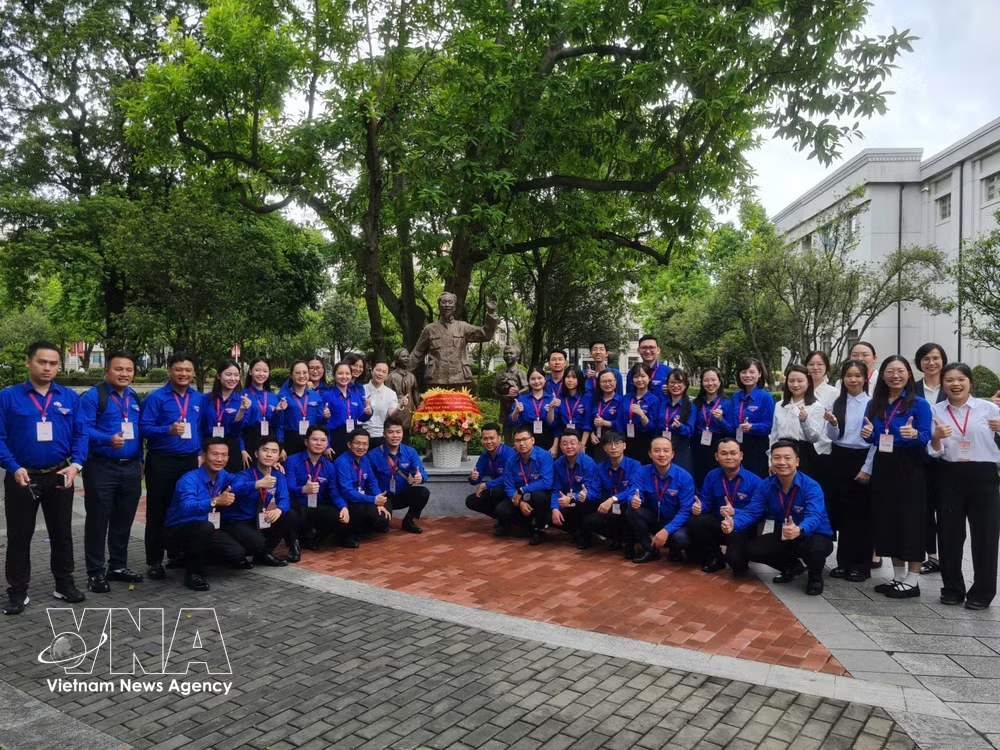
During their current stay in China as part of the programme, the Vietnamese youth delegation is set to visit a number of sites associated with revolutionary history and Vietnam–China friendship./.