Ho Chi Minh City (VNA) – The Politburo’s Resolution No. 23-NQ/TW, issued on August 2, 2026, marks a change in the mindset, approach and requirements for overseas Vietnamese (OV) affairs in the new era.
Officials overseeing OV affairs in Ho Chi Minh City are putting forward proposals to carry out the resolution, positioning the city to lead a local model for “creating resources from the OV community".
OV resource mapping
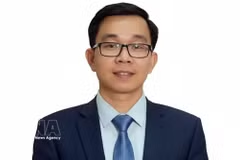
Nguyen Vu Minh Hoang, General Secretary of the Association for Liaison with OVs in Ho Chi Minh City (ALOV-HCMC), said Resolution No. 23 requires the city to move beyond care, connection and mobilisation, and create conditions where OV can contribute depending on their capabilities while generating new value together with the city. The resolution marks a far-reaching shift from “community management” to “resource governance”, he said.
Hoang proposed a breakthrough task for the 2026-2030 period – building a “Ho Chi Minh City OV resource map” with data on individuals’ expertise, capabilities and potential contributions across fields. The map would form the basis for an OV resource connection portal, integrating data on the city’s needs and cooperation opportunities.
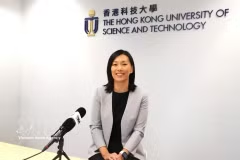
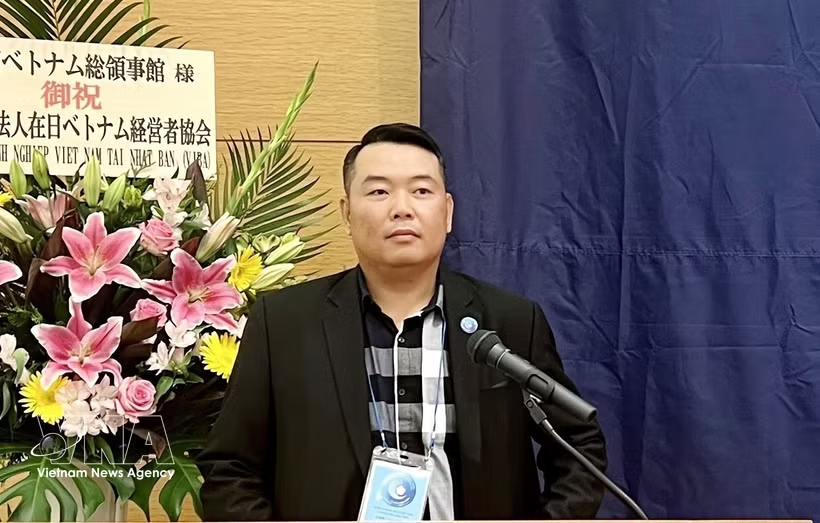
Danny Vo, ALOV-HCMC Vice President and Vice President of the Business Association of Overseas Vietnamese (BAOOV), said Ho Chi Minh City should develop an OV talent map featuring a database of experts, intellectuals and entrepreneurs connected with the city, categorised by priority areas such as AI, semiconductors, international finance, healthcare, smart urban development, the cultural industry and green economy. ALOV-HCMC is ready to collect and update the database through its global member network.
The two officials agreed that in order to embody the “mechanism creation” spirit of Resolution No. 23, Ho Chi Minh City should periodically publish a list of major issues requiring international expertise in key development areas, inviting OV experts, businesses and organisations to propose solutions, invest, transfer technology or join rollout efforts.
At the same time, the city should establish a global network of OV experts, intellectuals and entrepreneurs, built around specific projects, assignments and products serving sustainable development.
Ho Chi Minh City could connect associations, schools, Vietnamese language teacher networks, artists, entrepreneurs and younger generations of OV to develop activities such as “Vietnamese Language – Vietnamese Culture – Ho Chi Minh City – Global Connections”, showcasing the image of Vietnam and Ho Chi Minh City globally.
To ensure OV resources are secured strategically for the long term, the city should design dedicated schemes for OV younger generations, including experiential semesters and internships at Ho Chi Minh City-based companies for students of Vietnamese descent, an incubation fund for startups founded by young OVs and headquartered in the city, and volunteer and exchange summer camps.
During each overseas trip by the city's leaders, agendas should include meetings with governments, businesses, universities, international organisations and Vietnamese communities, Hoang suggested, adding that in that way, OV would become a “soft infrastructure” supporting the city’s diplomacy and global integration.
Institutional overhaul
According to Hoang, the city needs to streamline its structure and coordination mechanisms for OV affairs.
It should also redesign its approach towards a unified coordination ecosystem and study a sufficiently strong model to serve as an OV resource coordination centre. Core elements would include a single coordinating focal point, an inter-agency coordination mechanism, a shared data system and a common goal.
The city should re-establish a specialised agency in charge of OV affairs. Such an agency should have inter-agency coordination authority rather than merely serving as a point of contact; have its own budget and key performance indicators measured by the number of experts connected and projects rolled out rather than events held; and operate according to international time zones, given time differences between Vietnam and OV communities in the US, Australia and Europe.
Danny Vo stressed that ALOV-HCMC is ready to serve as an extended arm to connect the community, identify talents, lead civic initiatives and convey the authentic voices of OV.
To fulfill that role, the city should set up a clear coordination mechanism between ALOV-HCMC and a specialised agency, with defined regulations, while commissioning and funding the association to carry out tasks involving expert networking, Vietnamese language teaching, support for young OV and the hosting of overseas forums.
It was advised to establish an OV advisory council for the city's leaders, comprising OV experts and entrepreneurs with authority to provide policy feedback and propose initiatives.
Ho Chi Minh City should also create a fully bilingual, 100% online one-stop service centre to handle the issues most frequently encountered by OV, including verification of Vietnamese origin, nationality matters, investment registration, home ownership, work permits and recognition of academic qualifications, he added./.