Artificial intelligence to be included in school curriculum

The AI education content is structured around four areas corresponding to key AI competencies: human-centred thinking, AI ethics, AI techniques and applications, and AI system design.

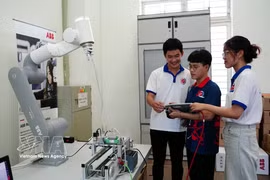
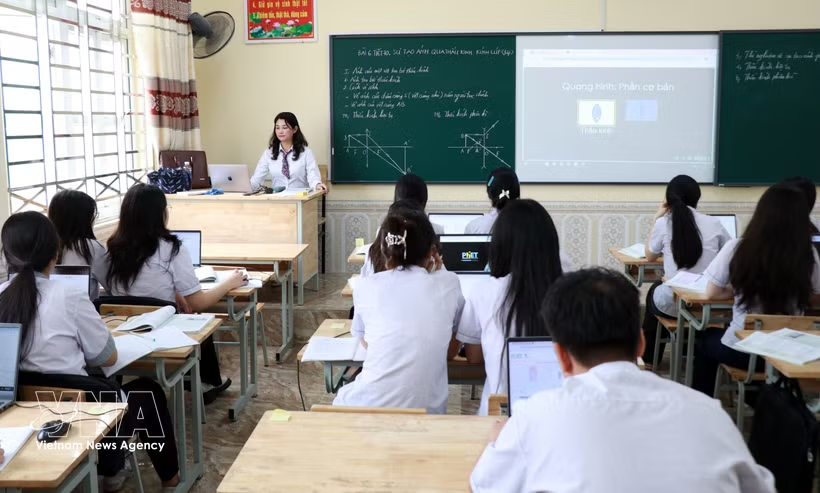
An AI-applied class at Chu Van An Lower Secondary School in Kim Bang ward, Ninh Binh province (Photo: VNA)

Hanoi (VNA) – School students will receive 12 periods of artificial intelligence (AI) education each academic year under a framework recently issued by the Ministry of Education and Training.

The framework aims to develop students’ AI competencies and gradually prepare human resources capable of adapting to rapid advances in science, technology and digital transformation.

The AI education content is structured around four areas corresponding to key AI competencies: human-centred thinking, AI ethics, AI techniques and applications, and AI system design. Human-centred thinking and AI ethics serve as guiding principles to ensure that AI is used safely, responsibly and in line with ethical and legal requirements.

The framework covers two educational stages: basic education, including primary and lower secondary levels, and career-oriented education at upper secondary level.

At the primary level, students will explore simple AI applications and gain an initial understanding of AI’s role in daily life, while learning about personal data protection and copyright.

At lower secondary level, students will learn to use AI tools to create digital products and address learning-related problems as well as study basic AI principles and citizens’ responsibilities in a digital society.

At upper secondary level, students will be encouraged to explore, design and improve simple AI tools through projects, developing problem-solving and creative skills while gaining exposure to potential career paths.

The framework seeks to build AI competency on the foundation of informatics skills and computer science knowledge under the current Informatics curriculum. It will also contribute to developing the qualities and general competencies set out in the 2018 General Education Programme, helping students become active digital citizens capable of using and contributing to AI-based products and solutions effectively, creatively and responsibly.

The AI education programme comprises core and extended content. The core content, designed to ensure essential learning outcomes for all students, will be delivered through AI education topics with 12 periods allocated per class each academic year.

The topics will be incorporated into schools’ education plans and two-session-per-day teaching schedules in ways suited to students’ characteristics and schools’ conditions, without creating excessive pressure or workload. AI content may also be integrated into other subjects and educational activities to reinforce and apply students’ knowledge and skills, without changing or increasing the required learning outcomes of those subjects.

Extended content may be offered beyond the 12-period core programme, depending on students’ needs and abilities and schools’ conditions. It may include clubs, projects, experiential activities, extracurricular programmes and research.

AI teaching will emphasise experience, practice, problem-solving and age-appropriate project-based learning. Ethical issues, potential risks and responsibility in AI use may be addressed through discussions, debates, role-playing and case studies.

The learning process will progress from observation and hands-on experience at primary level to exploration, explanation and verification at lower secondary level, and analysis, critical evaluation and solution development at upper secondary level./.
VNA

See more

Deputy General Director of the Vietnam News Agency Doan Thi Tuyet Nhung (fifth, right) and representatives of regional news agencies and media organisations attend the launch of the Asia-Pacific Media Partnership Organising Committee at the Asia-Pacific Media Forum. (Photo: VNA)

VNA attends Asia-Pacific Media Forum in Shenzhen

Participants in the forum highlighted the need to increase coverage of the region's rapid opening-up and integration, provide comprehensive information on the progress and achievements of cooperation among economies across various fields, and help create a favourable environment for regional development.

Ngo Phuong Ly (right), the spouse of General Secretary of the Communist Party of Vietnam Central Committee and President To Lam, and Kyu Kyu Hla, the spouse of Myanmar President Min Aung Hlaing, visit Van Phuc silk village on September 5. (Photo: VNA)

First ladies of Vietnam, Myanmar visit Van Phuc silk village

Ngo Phuong Ly, the spouse of General Secretary of the Communist Party of Vietnam Central Committee and President To Lam, said the two countries share similarities in silk weaving and can enrich their cultural heritage through exchanges and experience sharing.

Prime Minister Le Minh Hung join students and teachers of the Muong Khuong Inter-level Primary and Secondary Boarding School, Lao Cai province, in the opening ceremony of the 2026–2027 academic year on September 5. (Photo: VNA)

PM urges substantive education reform in 2026–2027 school year

PM Le Minh Hung called on the education sector to continue making strong changes in management mindset and teaching methods, putting learners at the centre, and viewing schools as the foundation, teachers as the driving force, families as a source of support and society as a resource accompanying education development.

General Secretary of the Communist Party of Vietnam Central Committee and President To Lam (Photo: VNA)

Top leader extends message to education sector on new school year

Party General Secretary and President To Lam expressed confidence that with the nation’s traditional fondness for learning, the dedication of teachers and the aspirations of the younger generation, the 2026–2027 academic year will open a new chapter of progress for the country’s education sector.

Students attend the opening ceremony for the 2026–2027 academic year at the primary school campus of the Gia Quat Primary and Secondary School in Hanoi on September 5, 2026. (Photo: VNA)

Students across Vietnam begin 2026–2027 academic year

This milestone school year marks a pivotal transition from laying the groundwork for reform to delivering substantive changes as the country pushes ahead with implementing Politburo Resolution No. 71-NQ/TW on breakthroughs in education and training development.

Team K91 members depart to carry out their mission. (Photo: VNA)

Search efforts continue for Vietnamese fallen soldiers in Cambodia

During the 2026-2027 dry season, Teams K70, K71, K72 and K73 will continue their search and repatriation mission, striving to fulfil the target based on 185 pieces of information concerning 761 graves. Each team is expected to collect at least 100 sets of remains during each deployment.

Mai Nguyen Tuyet Hoa, First Secretary in charge of education affairs at the Vietnamese Embassy in Russia speaks at the closing ceremony (Phôt: VNA)

AI application boosts Russian language training in Vietnam

The programme introduced updated methods for teaching Russian as a foreign language while focusing on the application of digital technology and AI in lesson design to enhance the professional capacity and adaptability of Russian-language teachers amid changes in modern education.

A resident accesses the iHanoi app. (Photo: VNA)

Hanoi launches real-time flood and rainfall map on iHanoi

The map uses a standard colour scale to provide a visual assessment, enabling residents to gauge the level of danger within seconds. The application is expected to strengthen the capital’s disaster response capacity while helping residents plan safer routes during the rainy and stormy season.

Representatives of Naval Region 4 Command present 32 gift packages to the fishermen. (Photo published by VNA)

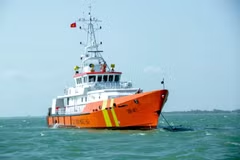
32 fishermen rescued at sea safely return home

Thirty-two fishermen rescued after their fishing vessel, coded QNa 90859 TS, encountered an accident at sea, were safely brought back to their hometown in Nui Thanh commune, the central city of Da Nang.

Dr. Do Xuan Hoang, Chairman of the Union of Vietnamese Organisations in Russia. (Photo: VNA)

Resolution marks new policy approach toward overseas Vietnamese

Chairman of the Union of Vietnamese Organisations in Russia Dr. Do Xuan Hoang said the Politburo’s Resolution 23-NQ/TW on overseas Vietnamese (OV) affairs is timely and more comprehensive, better aligned with the rapid evolution of the Vietnamese community abroad after more than two decades under the Politburo’s Resolution 36-NQ/TW issued on March 26, 2004.

Vietnamese companies showcase tourism in Beijing (Photo: VNA)

Hanoi pitches tourism in Beijing to deepen travel ties

Deputy Director of the Beijing Municipal Bureau of Culture and Tourism Guo Zhuqing said Beijing and Hanoi are key gateways for bilateral cultural and tourism exchange, with conditions in place to boost visitor numbers, build trust and expand business cooperation, thus supporting people-to-people ties.

Students contemplate paintings at the exhibition (Photo: VNA)

Vietnamese in Laos, Singapore honour President Ho Chi Minh on National Day

The display features 50 paintings by the late overseas Vietnamese artist Dao Trong Ly created between 2018 and 2024. Co-hosted by the Vietnamese Embassy in Laos, the Vietnam Cultural Centre in Laos and the Vietnam Fine Arts Museum, it serves as both a cultural highlight for Vietnam’s 81st National Day (September 2) and a bridge for Vietnam-Laos special solidarity.

Standing Deputy Prime Minister Pham Gia Tuc offers incense in tribute to President Ho Chi Minh. (Photo: VNA)

President Ho Chi Minh’s hometown holds ceremony marking his 57th death anniversary

Speaking at the event, Secretary of the Nghe An provincial Party Committee Nguyen Khac Than said commemorating President Ho Chi Minh is not only an expression of gratitude to the beloved leader of the Vietnamese nation, but also an opportunity for officials, Party members and people to better understand their responsibility to carry out his wishes for the country.