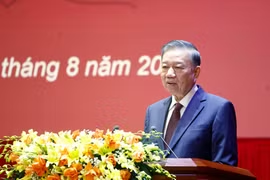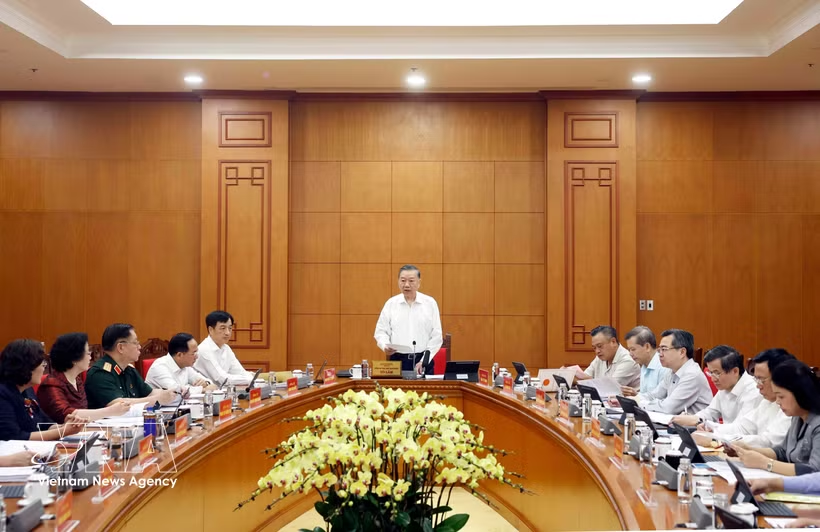
Hanoi (VNA) – General Secretary of the Communist Party of Vietnam Central Committee and President To Lam emphasised the need to adopt a leadership approach that links every task with clear targets, deliverables, and accountability.
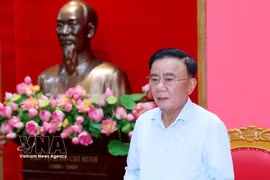
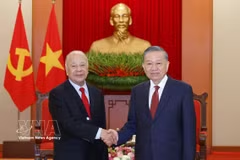
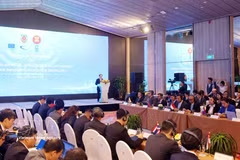
He made the remarks on August 20 while chairing a working session with the Party Central Committee’s Commission for Organisation to discuss a project reviewing the five-year implementation of Resolution No. 28-NQ/TW, dated November 17, 2022, on continuing to renew the methodology of the Party’s leadership and rule over the political system in the new period.
General Secretary and President Lam said the review is an important political task in the building of the Party and the political system. He said it should examine how the Party exercises its leadership and ruling role and how the entire political system translates the Party’s guidelines and policies into action and concrete results.
The goal, he said, is not merely to complete a report or issue another document, but to identify obstacles undermining the Party’s leadership and ruling efficiency and propose appropriate policies and mechanisms to enable improvements, especially amid requirements in the new period.
He stressed the resolution's viewpoints, objectives, and tasks that remain relevant must continue to be implemented seriously and effectively.
The drafting of a new document must not lead to delays in the performance of tasks already assigned under Resolution No. 28-NQ/TW, he said, stressing the need to inherit, supplement and develop this resolution rather than interrupt the renewal process already carried out in previous periods.
The top leader said the consistent principle is to remain steadfast in the Party’s ideological foundation, organisational principles and leadership role while making strong reforms so that leadership becomes more accurate, targeted, scientific, democratic, responsive and effective.
The Party should provide comprehensive leadership without doing the work of other agencies, maintain unified direction while encouraging initiative, strengthen decentralisation alongside strict power control, and ensure that policy decisions are accompanied by implementation and accountability for final results, he said.
The General Secretary and President asked for a review report that must provide a substantive assessment of the resolution implementation nationwide, particularly the performance following the apparatus restructuring.
The assessment should go beyond counting documents, meetings and models to clarify actual changes in leadership methodology, coordination quality, implementation effectiveness and the benefits delivered to the people. It should also identify whether achievements are sustainable and can be maintained and replicated while clearly pointing out shortcomings, their causes, and the responsibilities involved.
He noted that the implementation of the resolution has produced positive changes, but shortcomings remained, including overlapping and excessive documents, unclear tasks, deliverables, deadlines, and responsibilities, and too many meetings with limited effectiveness.
In some cases, agencies have sought opinions on matters within their authority or intervened too deeply in administration and management. Meanwhile, decentralisation has not always been accompanied by sufficient authority, resources and data. Multi-level coordination, policy forecasting and feedback, and outcome assessment also remain weak, he added.
The top leader called for implementation to be identified as a breakthrough and substantive results to serve as the key measure of leadership effectiveness.
He said reforming the Party’s leadership and ruling methodology does not mean changing its fundamental principles or nature, but making leadership more accurate, scientific, democratic and effective.
The central focus, he went on, should be the path from sound policy decisions to substantive results. Implementation itself is an integral part of the Party's leadership and ruling quality.
By 2030, Vietnam should firmly establish a leadership approach based on clear targets, deliverables, and accountability. By 2045, it should develop the Party’s leadership and ruling methodology to a higher level that is scientific, democratic, law-based, modern and responsive, ensuring the political system operates smoothly, effectively and efficiently and creating momentum for the country’s fast and sustainable development towards prosperity and happiness.
General Secretary and President Lam asked the Commission for Organisation to complete the project with quality guaranteed and propose a draft resolution that is concise, focused, and feasible. An accompanying action plan, explanatory report, and list of legal documents requiring amendment or supplementation should also be prepared so that the new resolution can be implemented immediately after its issuance.
The top leader affirmed that reforming the Party’s leadership and ruling methodology is a regular requirement directly linked to its leadership and ruling capacity and combatant strength. The key is not only to formulate sound policies but also to implement them fully, producing concrete changes in practice while maintaining principles and pursuing necessary reforms./.