Amendments to bills aim to close loopholes in criminal laws

The amendments to the Penal Code focus on four major areas - revising and supplementing provisions on offences and penalties; revising provisions on grounds for exclusion, postponement and exemption from criminal liability and the statute of limitations for criminal prosecution; and ensuring consistency, feasibility and sound legislative drafting.

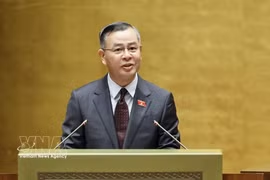
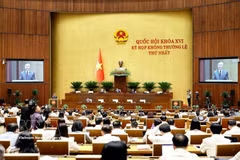
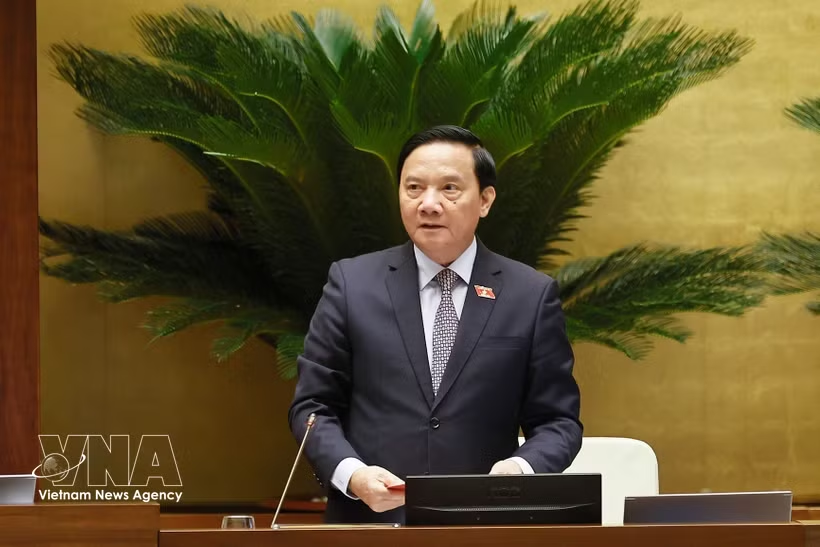
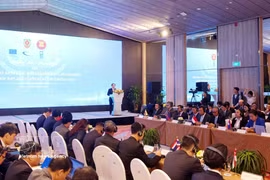
National Assembly Vice President Nguyen Khac Dinh precides over the discussion (Photo: VNA)

Hanoi (VNA) – The National Assembly is scheduled to discuss reports on three draft laws – the revised Penal Code, the revised Criminal Procedure Code, and the revised Law on Organisation of Criminal Investigation Agencies on August 20 as part of its first extraordinary sitting.

The amendments to the Penal Code focus on four major areas - revising and supplementing provisions on offences and penalties; revising provisions on grounds for exclusion, postponement and exemption from criminal liability and the statute of limitations for criminal prosecution; and ensuring consistency, feasibility and sound legislative drafting.

A key proposal is to narrow the scope of application of the death penalty for six offences. The current Penal Code prescribes the death penalty as the highest punishment for 10 offences. The Government proposes abolishing the death penalty for six, namely rebellion; rape of persons under 16; illegal drug trafficking; crimes against humanity; war crimes; and terrorism aimed at opposing the people's administration, which is expected to be incorporated into the offence of terrorism.

The death penalty will remain applicable to treason, murder, terrorism and illegal drug production. The move is intended to institutionalise the Party's policy, align Vietnam's legislation with progressive international trends, and enhance the country's position in international judicial cooperation, extradition and mutual legal assistance in criminal matters.

The draft also broadly doubles fines and monetary thresholds used to determine offences and sentencing brackets, taking into account changes in prices, wages, incomes, per-capita GDP and socio-economic conditions.
vnanet-potal-quoc-hoi-thao-luan-ve-viec-tich-hop-chuong-trinh-muc-tieu-quoc-gia-8966843.jpg
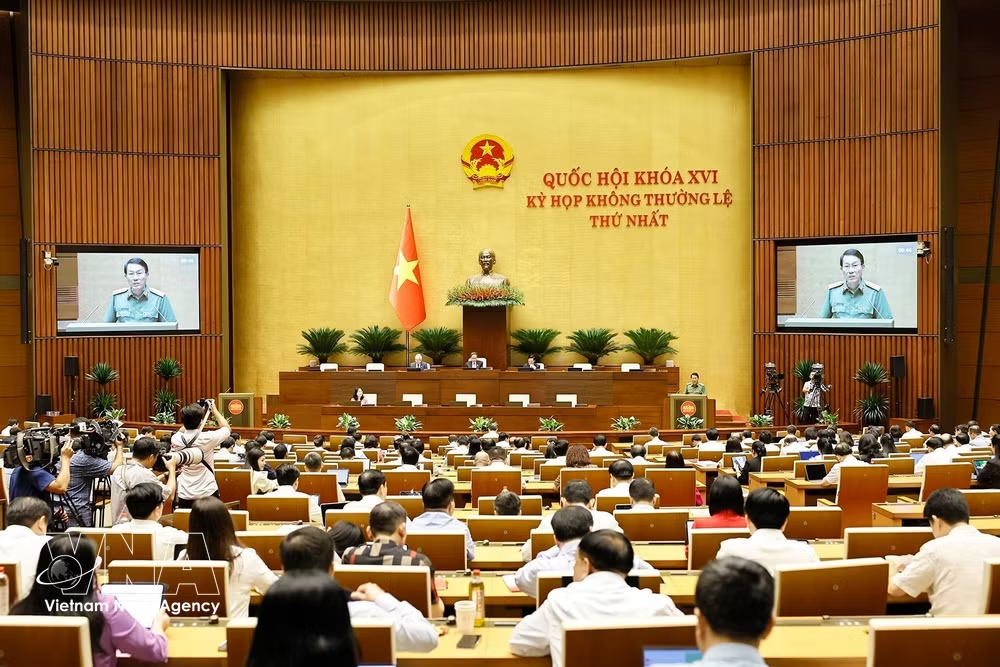
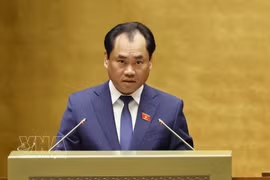
Minister of Public Security Luong Tam Quang delivers the proposal on the draft revised Criminal Procedure Code, and the draft revised Law on Organisation of Criminal Investigation Agencies.
(Photo: VNA)

Notably, it expands grounds for exclusion of criminal liability in research, testing and application of new technologies, as well as controlled testing of new technologies, processes, solutions, products, services and business models in technology development and innovation. Similar provisions would apply to defence and security missions and crime prevention and control by the armed forces.

The draft further introduces provisions allowing the postponement of criminal prosecution to give offenders time to remedy consequences under specified conditions. Accordingly, exemption from criminal liability could apply where a person whose prosecution has been postponed has fully remedied the consequences and generated economic, social, defence or security benefits. During the processing of crime reports and denunciations, criminal liability could also be waived where grounds for exemption exist, helping avoid unnecessary procedural steps while ensuring a humane and humanitarian criminal justice policy.

Nine new offences are also proposed, focusing on areas, including economic management, cybersecurity, high technology, the environment, public safety and the proliferation of weapons of mass destruction. The draft also adds new objective acts to existing offences, particularly those involving information technology, telecommunications networks, economy, trade and intellectual property.

These provisions are aimed at closing loopholes in criminal laws and preventing crimes from going unpunished, while meeting the requirements of international integration and strengthening crime prevention and combat in the new context.

During the morning sitting, the National Assembly also debated in plenary the National Target Programme on cultural and socio-economic development, rural development, and ethnic minority and mountainous areas for 2026-2035, which will integrate four existing national target programmes into a single programme./.
VNA

See more

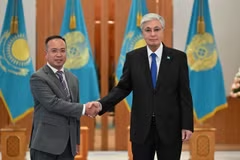
Vietnamese Ambassador to Kazakhstan Nguyen Thanh Le (L) and Kazakh President Kassym-Jomart Tokayev at their meeting on August 19. (Photo published by VNA)

Vietnam seeks to deepen strategic partnership with Kazakhstan

Ambassador Nguyen Thanh Le affirmed that he will work closely with Kazakhstan’s Ministry of Foreign Affairs, ministries, agencies and localities to effectively implement high-level agreements, strengthen political trust and promote cooperation in trade, investment, transport and logistics, tourism, culture, education and people-to-people exchanges.

☀️ Morning digest on August 20

☀️ Morning digest on August 20

Party General Secretary and President To Lam's working session with the Ministry of Culture, Sports and Tourism, the Vietnam International Fisheries Exhibition 2026, and Vietnam advancing to the ASEAN Cup final after beating Malaysia 2-0 in the second leg of semifinals are among news highlights on August 19 evening.

President Ho Chi Minh's Mausoleum attracts a large number of visitors (Photo: VNA)

📝OP-ED: A century of aspirations, a rising Vietnam

Today, Vietnam's mission is to open the doors wider to development, move the country forward and join the ranks of major powers through its own strength. This is also the most practical way to carry forward the spirit of the historic autumn of 1945.

The 16th National Assembly begins the second phase of its first extraordinary session on August 19. (Photo: VNA)

NA begins second phase of first extraordinary session, focusing on land, housing policies

The 16th National Assembly began the second phase of its first extraordinary session on August 19, hearing presentations on policy orientations for drafting the Law on State Budget (consolidated); amending the 2024 Land Law, the 2023 Housing Law, and the Law on Real Estate Business; and the integration of four national target programmes into a single one.

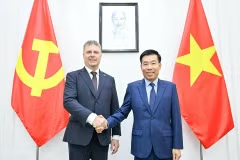
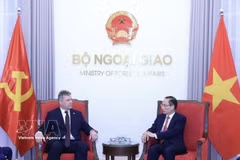
Member of the Communist Party of Vietnam Central Committee and Deputy Foreign Minister Nguyen Manh Cuong (R) meets with Roman Roun, Chairman of the Communist Party of Bohemia and Moravia (KSCM) in Hanoi on August 18. (Source: Baoquocte.vn)

Vietnam, Czech Republic step up effective implementation of Strategic Partnership

The two sides expressed their delight at the positive and substantive development of traditional friendship and multifaceted cooperation between Vietnam and the Czech Republic, and welcomed the elevation of bilateral ties to a Strategic Partnership in January 2025, which has created a new framework and impetus for deeper, more effective and sustainable cooperation.

Politburo member and Minister of Foreign Affairs Le Hoai Trung (R) receives visiting Chairman of the Communist Party of Bohemia and Moravia (KSCM) Roman Roun in Hanoi on August 18 (Photo: VNA)

Vietnam, Czech Republic seek to deepen multifaceted cooperation

Politburo member and Minister of Foreign Affairs Le Hoai Trung affirmed that the Party, State and people of Vietnam have always cherished the valuable support extended by the Communist Party and people of former Czechoslovakia, as well as by the KSCM and Czech people today.

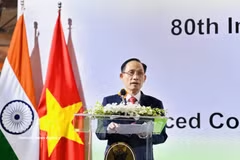
Minister of Foreign Affairs Le Hoai Trung speaks at the event. (Photo: VNA)

Vietnam-India cooperation grows more practical, future-oriented

Vietnam-India relations, founded by President Ho Chi Minh and Indian leaders and nurtured by generations of the two countries, have developed into a special and enduring friendship. Bilateral cooperation has delivered significant and practical benefits, with two-way trade doubling over the past decade, while defence and security cooperation has become increasingly substantive and effective, reflecting high levels of strategic trust.

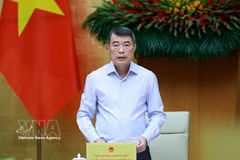
Prime Minister Le Minh Hung speaks at the Government's August law-building session on August 18. (Photo: VNA)

Draft laws must support management reform, stronger decentralisation: PM

Participants looked into 11 draft laws and one draft resolution, including laws amending and supplementing several articles of laws on non-agricultural land use tax and corporate income tax; natural resources tax; securities; accounting and independent auditing; the Labour Code; and laws on archives, gender equality, Red Cross activities and employment.

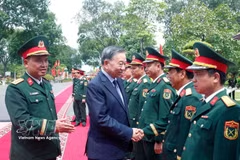
General Secretary of the Communist Party of Vietnam and President To Lam, who is also Secretary of the Central Military Commission, visits Infantry Division 308 of Army Corps 12 under the Ministry of National Defence in Hanoi on August 18 (Photo: VNA)

Top leader visits Infantry Division 308

General Secretary and President To Lam urged the division to preserve its proud tradition and turn it into determination and action, underscoring the need for it to uphold the “vanguard” spirit, especially in building a revolutionary, regular, elite and modern army; training and maintaining combat readiness; advancing science, technology, innovation and digital transformation; observing discipline and law; mastering modern weapons and equipment; and fulfilling its three functions as a combat, working and production force.