NA begins second phase of first extraordinary session, focusing on land, housing policies

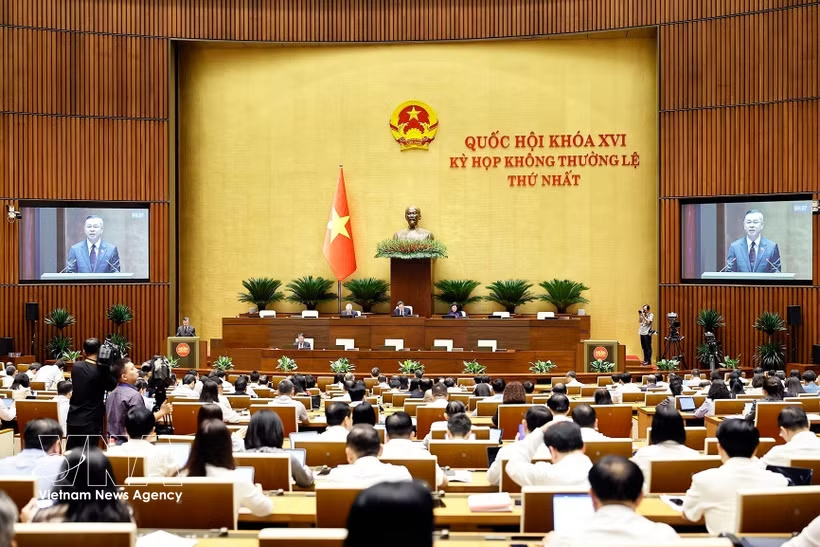
The 16th National Assembly began the second phase of its first extraordinary session on August 19, hearing presentations on policy orientations for drafting the Law on State Budget (consolidated); amending the 2024 Land Law, the 2023 Housing Law, and the Law on Real Estate Business; and the integration of four national target programmes into a single one.

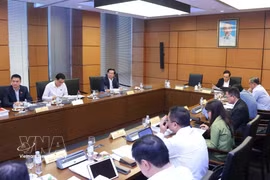
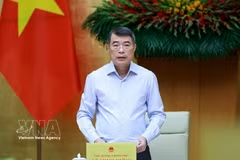
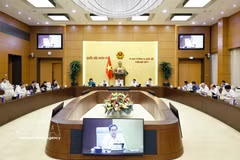
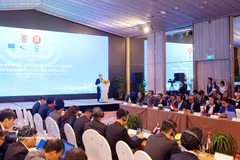
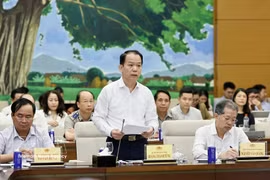
The 16th National Assembly begins the second phase of its first extraordinary session on August 19. (Photo: VNA)

Hanoi (VNA) - The 16th National Assembly began the second phase of its first extraordinary session on August 19, focusing on policy orientations for amendments to key laws on land, housing and real estate business, alongside state budget and national target programmes.

During the working day, the legislature heard presentations on policy orientations for drafting the Law on State Budget (consolidated); amending the 2024 Land Law, the 2023 Housing Law, and the Law on Real Estate Business; and the integration of four national target programmes into a single one.

NA deputies then discussed the issues in groups.

The draft revised Land Law aims to institutionalise the Party’s guidelines on further reforming and improving land institutions and policies, creating new momentum for socio-economic development and meeting growth requirements in the new period. Given its broad scope and direct impact on land users’ rights and obligations as well as people’s legitimate interests, the draft law is expected to be considered under a two-session process to ensure thorough study and discussion.

​The amendments are based on a preliminary review of the implementation of Resolution No. 18-NQ/TW, adopted at the fifth plenum of the 13th Party Central Committee, on continuing to reform and improve institutions and policies, enhancing the effectiveness and efficiency of land management and use, and creating momentum for Vietnam to become a high-income developed country.

The Government has approved seven policy groups for revising the Land Law, focusing on land-use planning and plans; more transparent mechanisms for land allocation, leasing and changing land-use purposes; and improved procedures for land recovery, compensation, support and resettlement to balance the interests of the State, people and investors. Other priorities include reforming land-related financial and pricing mechanisms, clarifying land users’ rights and obligations, accelerating administrative reform and digital transformation, and strengthening decentralisation, inspection, supervision and the handling of violations and disputes.

The draft revised Law on Real Estate Business focuses on reducing investment and business conditions, promoting digital transformation and developing an integrated, interconnected data system. It also seeks to remove practical obstacles and ensure consistency with related laws while improving regulatory mechanisms to support a transparent, efficient and sustainable property market.

Meanwhile, the draft revised Housing Law aims to institutionalise Party orientations on housing and the real estate market and ensure citizens’ right to lawful accommodation; adapt housing policies to the two-tier local administration model; accelerate decentralisation, administrative reform and digital transformation; and ensure consistency across the legal system.

The draft consolidated Law on the State Budget, meanwhile, will combine the Law on the State Budget and the Law on Public Investment to reform public finance management, address overlaps and shortcomings, strengthen decentralisation and fiscal discipline, and improve budget efficiency.

Key provisions include integrating the five-year financial plan with the medium-term public investment plan and incorporating the allocation of public investment plans into annual budget allocation procedures. The draft also clarifies authorities for planning and budget allocation and adds provisions on using increased revenues, contingency funds, and financial reserves to respond to emergencies, while improving year-end budget settlement, carry-over funds and advances./.
VNA

See more

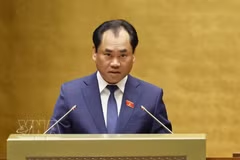
Minister of Agriculture and Environment Trinh Viet Hung presents the Government’s proposals on the amendments to the 2024 Land Law. (Photo: VNA)

Amendments to Land Law aim to achieve three key goals

The Government has identified three major objectives: promptly institutionalising Party policies on land, private-sector development and national digital transformation; addressing urgent practical obstacles to unlock resources and support the goal of double-digit economic growth; and building a modern, streamlined and effective land management system through stronger decentralisation and administrative reform.

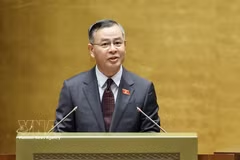
Minister of Finance Ngo Van Tuan speaks at the session (Photo: VNA)

NA considers consolidated law to streamline public finance management

Consolidating the Law on State Budget 2025 and the Law on Public Investment 2024 (amended and supplemented in 2025) is necessary to establish a consistent public finance management mechanism; minimise procedures, time and compliance costs; and improve the mobilisation, management and use of State budget resources to support growth.

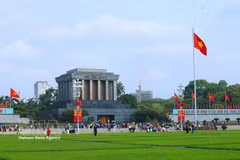
President Ho Chi Minh's Mausoleum attracts a large number of visitors (Photo: VNA)

📝OP-ED: A century of aspirations, a rising Vietnam

Today, Vietnam's mission is to open the doors wider to development, move the country forward and join the ranks of major powers through its own strength. This is also the most practical way to carry forward the spirit of the historic autumn of 1945.

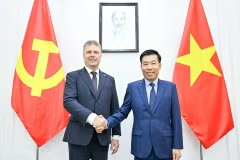
Member of the Communist Party of Vietnam Central Committee and Deputy Foreign Minister Nguyen Manh Cuong (R) meets with Roman Roun, Chairman of the Communist Party of Bohemia and Moravia (KSCM) in Hanoi on August 18. (Source: Baoquocte.vn)

Vietnam, Czech Republic step up effective implementation of Strategic Partnership

The two sides expressed their delight at the positive and substantive development of traditional friendship and multifaceted cooperation between Vietnam and the Czech Republic, and welcomed the elevation of bilateral ties to a Strategic Partnership in January 2025, which has created a new framework and impetus for deeper, more effective and sustainable cooperation.

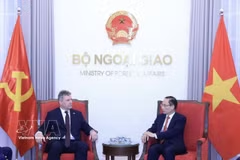
Politburo member and Minister of Foreign Affairs Le Hoai Trung (R) receives visiting Chairman of the Communist Party of Bohemia and Moravia (KSCM) Roman Roun in Hanoi on August 18 (Photo: VNA)

Vietnam, Czech Republic seek to deepen multifaceted cooperation

Politburo member and Minister of Foreign Affairs Le Hoai Trung affirmed that the Party, State and people of Vietnam have always cherished the valuable support extended by the Communist Party and people of former Czechoslovakia, as well as by the KSCM and Czech people today.

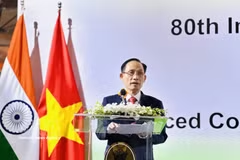
Minister of Foreign Affairs Le Hoai Trung speaks at the event. (Photo: VNA)

Vietnam-India cooperation grows more practical, future-oriented

Vietnam-India relations, founded by President Ho Chi Minh and Indian leaders and nurtured by generations of the two countries, have developed into a special and enduring friendship. Bilateral cooperation has delivered significant and practical benefits, with two-way trade doubling over the past decade, while defence and security cooperation has become increasingly substantive and effective, reflecting high levels of strategic trust.

Prime Minister Le Minh Hung speaks at the Government's August law-building session on August 18. (Photo: VNA)

Draft laws must support management reform, stronger decentralisation: PM

Participants looked into 11 draft laws and one draft resolution, including laws amending and supplementing several articles of laws on non-agricultural land use tax and corporate income tax; natural resources tax; securities; accounting and independent auditing; the Labour Code; and laws on archives, gender equality, Red Cross activities and employment.

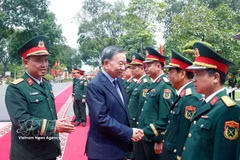
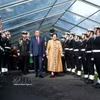
General Secretary of the Communist Party of Vietnam and President To Lam, who is also Secretary of the Central Military Commission, visits Infantry Division 308 of Army Corps 12 under the Ministry of National Defence in Hanoi on August 18 (Photo: VNA)

Top leader visits Infantry Division 308

General Secretary and President To Lam urged the division to preserve its proud tradition and turn it into determination and action, underscoring the need for it to uphold the “vanguard” spirit, especially in building a revolutionary, regular, elite and modern army; training and maintaining combat readiness; advancing science, technology, innovation and digital transformation; observing discipline and law; mastering modern weapons and equipment; and fulfilling its three functions as a combat, working and production force.

An overview of the NA Standing Committee discussion (Photo: VNA)

NA Standing Committee focuses on four major issues in Penal Code revision

According to Deputy Minister of Public Security Le Van Tuyen, the revision focuses on four major areas. These include amending provisions on crimes, revising provisions on penalties, amending regulations on exclusion, postponement, and exemption of criminal liability and the statute of limitations, and revising provisions to ensure sound legislative technique.

A view of the seminar on the glorious 81-year journey of Vietnam’s revolution and vision for entering the era of the nation’s rise. (Photo published by VNA)

Venezuela honours values of Vietnam’s revolution

The images, stories and melodies about Vietnam once again demonstrated that the country is known not only through historic milestones but also remains warmly present in the hearts of its Venezuelan friends.

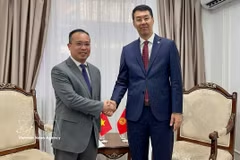
Vietnamese Ambassador Nguyen Thanh Le (L) presents a copy of his credentials to Kyrgyzstan’s Deputy Foreign Minister Meder Abakirov in Bishkek on August 17. (Photo: VNA)

Vietnam, Kyrgyzstan seek to deepen traditional friendship

Vietnam and Kyrgyzstan will make better use of the free trade agreement between Vietnam and the Eurasian Economic Union (EAEU), strengthen business-to-business links and facilitate greater access for each country’s goods to the other’s market.

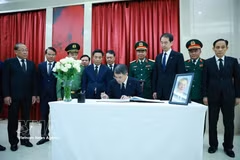
Prime Minister Le Minh Hung writes in the condolence book for former Chinese Premier Zhu Rongji. (Photo: VNA)

Prime Minister Le Minh Hung pays tribute to former Chinese Premier

Affirming Vietnam’s consistent policy of attaching importance and giving top priority to relations with China, PM Le Minh Hung stressed that the attention and practical contributions of generations of leaders from both sides have laid an important foundation for Vietnam and China to continue preserving and advacing their ties towards stable, sustainable development.

The centre area of Viet Yen ward, Bac Ninh province. (Photo: VNA)

Twelve wards established in Bac Ninh

Following the establishment of 12 new wards, Bac Ninh will have 99 commune-level administrative units, comprising 45 wards and 54 communes.

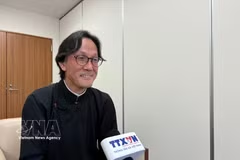
Prof. Shimizu Masaaki from Osaka University of Japan (Photo: VNA)

Vietnam’s foreign policy reflects national identity, resilience: Japanese expert

By remaining steadfast on fundamental principles such as independence, self-reliance and national interests, Vietnam can engage flexibly with individual partners while developing cooperation with as many countries as possible. Such an approach is increasingly relevant in a complex and unpredictable international environment.