Vietnam’s foreign policy reflects national identity, resilience: Japanese expert

By remaining steadfast on fundamental principles such as independence, self-reliance and national interests, Vietnam can engage flexibly with individual partners while developing cooperation with as many countries as possible. Such an approach is increasingly relevant in a complex and unpredictable international environment.

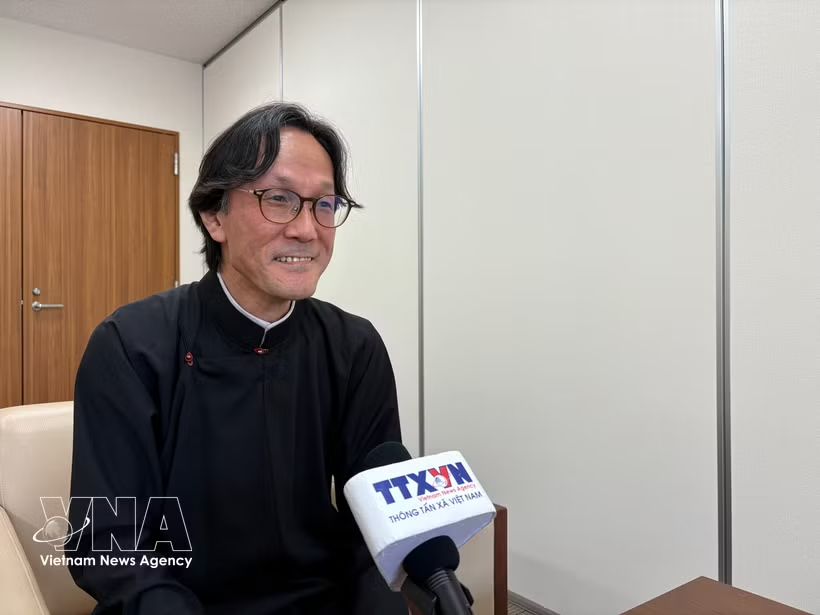
Prof. Shimizu Masaaki from Osaka University of Japan (Photo: VNA)

Tokyo (VNA) – Vietnam’s foreign policy reflects the country’s historical and cultural identity, combining flexibility in dealing with partners with a steadfast commitment to independence, self-reliance and national interests, according to Prof. Shimizu Masaaki from Osaka University of Japan.

Speaking to Vietnam News Agency correspondents in Japan on the occasion of being named a “Vietnamese Language Ambassador”, Shimizu said Vietnam’s foreign policy is closely linked to the characteristics shaped by its history and culture. Throughout its history, the country has interacted with many major powers and diverse cultures while preserving its independence and national identity.

Rather than rejecting outside factors, Vietnam has selectively and flexibly adopted them and adapted them to its own conditions and identity, he noted.

As a researcher of the history of the Vietnamese language, he said the same characteristic can be seen in the language’s development. Vietnamese has absorbed influences from Chinese, French and other languages without losing its distinct identity. Through the selective adoption and Vietnamising of external elements, the language has grown into a rich linguistic culture.

In his view, this demonstrates the resilience and distinctive approach that Vietnam has developed and preserved throughout its history.

Assessing Vietnam’s foreign policy amid global and regional uncertainties, the expert said it is increasingly difficult for any country to rely on a single partner. Given its geographical position and historical background, Vietnam needs to build and maintain relations with many countries.

Shimizu stressed the importance of distinguishing flexibility in diplomacy from a lack of an independent stance. By remaining steadfast on fundamental principles such as independence, self-reliance and national interests, Vietnam can engage flexibly with individual partners while developing cooperation with as many countries as possible. Such an approach is increasingly relevant in a complex and unpredictable international environment.

Beyond state-to-state relations, he highlighted the importance of mutual understanding among peoples, saying that political and economic ties may change according to international circumstances, but trust built between peoples can endure longer.

Regarding his new role as a Vietnamese Language Ambassador, he said learning a foreign language is more than acquiring a communication tool. It helps learners understand how native speakers view the world, the values they cherish and how they build relationships with others.

Although many Vietnamese are living, working and studying in Japan, opportunities for Japanese people to learn Vietnamese and understand Vietnamese culture have yet to match the strong development of bilateral relations, Shimizu said, describing this as an area with considerable potential.

The expert stressed that while diplomacy is often viewed as relations between governments, its deeper foundation is people-to-people connections. Increasing the number of Japanese learning Vietnamese therefore means ensuring more people genuinely understand Vietnam and creating more bridges between the two countries.

Drawing on his research and teaching experience, he observed a distinctive feature of Vietnamese culture: placing importance on relationships with others and keeping flexibility in interacting with others while at the same time maintaining one’s own position and identity.

When communicating in Vietnamese, people are generally mindful of who they are speaking to and of their own position within the relationship, the Japanese researcher said.

He stressed that this cultural trait mirrors Vietnam’s foreign policy – flexible in approach but steadfast in core values.

As Vietnamese Language Ambassador, Shimizu hopes to make Vietnamese more accessible in Japanese society, including among schools, businesses, local communities and families of Vietnamese origin. He expects the language will be recognised as a valuable social and cultural resource capable of connecting the two peoples.

He expressed his hope for more opportunities for Japanese people to engage with Vietnamese language and culture, and that Vietnamese-origin children in Japan will be further supported to appreciate their homeland's language and heritage.

Shimizu affirmed that the Comprehensive Strategic Partnership between Vietnam and Japan is built not only on political and economic cooperation, but also on connections between individuals, adding through Vietnamese, people of the two countries can understand and respect each other and build lasting trust./.

VNA
See more

Prime Minister Le Minh Hung writes in the condolence book for former Chinese Premier Zhu Rongji. (Photo: VNA)

PM Le Minh Hung pays tribute to former Chinese Premier

Affirming Vietnam’s consistent policy of attaching importance and giving top priority to relations with China, PM Le Minh Hung stressed that the attention and practical contributions of generations of leaders from both sides have laid an important foundation for Vietnam and China to continue preserving and advacing their ties towards stable, sustainable development.

The centre area of Viet Yen ward, Bac Ninh province. (Photo: VNA)

Twelve wards established in Bac Ninh

Following the establishment of 12 new wards, Bac Ninh will have 99 commune-level administrative units, comprising 45 wards and 54 communes.

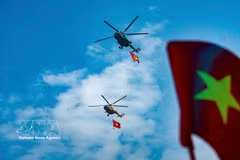
Helicopters conduct aerial rehearsals over Hanoi ahead of the 80th National Day anniversary celebration in 2025 (Photo: VNA)

📝OP-ED: From historic autumn of 1945 to 2045 aspiration

Eighty-one years since the August Revolution of 1945, Vietnam is at the threshold of another transformation, from a developing country to a developed, high-income nation. What links those two autumns is a refusal to bow to adversity, along with the embrace of self-reliance, national solidarity and confidence in the path chosen by the Party and President Ho Chi Minh.

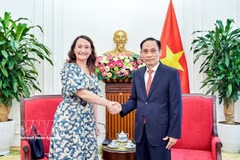
Minister of Foreign Affairs Le Hoai Trung (right) receives Uruguayan Deputy Foreign Minister Valeria Csukasi Cabrera on August 17 (Photo: VNA)

Vietnam treasures traditional friendship with Uruguay: FM

Vietnam highly values Uruguay’s role, position, and contributions to the regional and international communities, as well as the achievements the country has made under the administration of President Yamandú Orsi, said Minister of Foreign Affairs Le Hoai Trung.

President of the National Assembly Tran Thanh Man (right) and Alberto Anaya Gutierrez, General Secretary of the Mexican Labour Party (PT), at their meeting in Hanoi on August 17 (Photo: VNA)

Vietnam, Mexico to enhance exchange of legislative experience

Vietnam and Mexico will strengthen coordination and enhance delegation exchanges between the Vietnamese National Assembly and the Mexican Senate and Chamber of Deputies, while sharing experience in lawmaking and parliamentary activities among committees and promoting the role of the two parliamentary friendship groups.

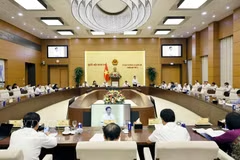
A view of the fifth session of the National Assembly Standing Committee (Photo: VNA)

NA Standing Committee reviews three revised draft laws

The National Assembly (NA) Standing Committee continued its fifth session on August 17, scrutinising three draft laws concerning administrative procedures, telecommunications, radio frequencies and architecture.

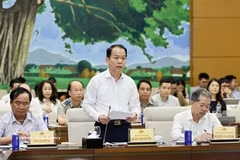
Minister of Justice Hoang Thanh Tung speaks at the discussion (Photo: VNA)

NA Standing Committee reviews draft Law on Urban Development

Speaking at the session, NA President Tran Thanh Man noted that the draft Law on Urban Development was initially designed for Ho Chi Minh City before its scope was expanded to other cities and additional provisions were incorporated. Given the tight timeframe and substantial workload, the NA will make its utmost effort to consider and adopt the contents as scheduled.

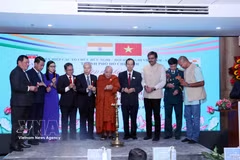
A traditional Indian candle-lighting ceremony opens the gathering. (Photo: VNA)

People-to-people diplomacy deepens Vietnam-India ties

Building on this foundation, the city has strengthened ties with Indian localities. In May, Ho Chi Minh City and Mumbai signed a memorandum of understanding on friendship and cooperation, opening up greater opportunities for collaboration in finance, technology, logistics, urban development, innovation, culture, cinema, tourism and people-to-people exchanges.

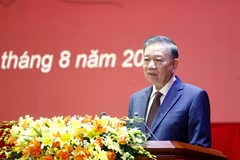
General Secretary of the Communist Party of Vietnam Central Committee and President To Lam addreses the opening ceremony of the first class of a knowledge update and training programme for members of the 14th Party Central Committee in Hanoi on August 17 (Photo: VNA)

Top leader attends opening of knowledge update programme for 14th Party Central Committee members

General Secretary and President Lam stressed that the programme is being held in the first year of implementing the Resolution of the 14th National Party Congress, which set out the goals and tasks for the entire tenure. The Party Central Committee has adopted measures to remove bottlenecks and unlock resources. The decisive task now is to ensure effective implementation by turning policies into feasible programmes, coordinated action and concrete results, thereby translating the Party's will into national development and a better life for the people.

The delegation meets with progressive friends in the US (Photo: VNA)

Vietnam, US strengthen cooperation to ease suffering of AO/dioxin victims

A delegation from the Vietnam Association for Victims of Agent Orange/dioxin's chapter in Ho Chi Minh City (VAVA HCMC) visited the US directly inform American friends about the long-term consequences of AO/dioxin in Vietnam and seek the support of progressive groups, veterans, legal experts and youth organisations in efforts to care for the victims.

Vietnamese leaders send congratulations to Congo on 66th National Day

Vietnamese leaders send congratulations to Congo on 66th National Day

General Secretary of the Communist Party of Vietnam Central Committee and President To Lam on August 15 sent a congratulatory message to President of the Congolese Party of Labour and President Denis Sassou Nguesso on the occasion of the 66th National Day of the Republic of Congo (August 15, 1960–2026).