Hanoi (VNA) – Nearly 17 years since the launch of the “Vietnamese people prioritise Vietnamese goods” campaign, the position of Vietnamese products in the domestic market has improved significantly.
However, amid increasingly fierce global competition, the goal is no longer simply to increase domestic consumption of Vietnamese goods, but to develop strong Vietnamese brands capable of winning consumers through quality, innovation and added value, thereby creating a stepping stone for expansion into international markets.
From prioritising Vietnamese goods to choosing Vietnamese brands
In the early years of the campaign, the main objective was to change consumer perceptions and encourage them to prioritise products made by domestic businesses.
After nearly 17 years, the campaign has brought about positive changes, with Vietnamese goods becoming increasingly prevalent across modern distribution networks and many product groups gradually gaining a firm foothold in the domestic market.
At major retail chains such as Central Retail, WinMart, Saigon Co.op, BRG Mart, Hapro Mart and AEON, Vietnamese products account for a consistently high proportion, particularly in the categories of food, essential consumer goods, apparel and household products. This shows that consumers are increasingly choosing Vietnamese goods not simply out of preference for domestic products, but because their quality has improved.
The market, however, is setting new requirements. Consumers have more choices and higher expectations regarding quality, design, customer experience and corporate responsibility toward the environment and society. This means Vietnamese products can no longer rely on domestic preference without genuine competitiveness.
As Vietnam integrates more deeply into the global economy, high-quality foreign products backed by methodical branding strategies are becoming more popular in the domestic market. To retain market share at home and expand exports, Vietnamese businesses are advised to move beyond price competition and build brands with real value.
Many enterprises have therefore shifted from competing primarily by costs to investing in research and development, digital transformation, green transition and governance capacity.
Le Hong Quang, General Director of MISA Corporation, said that to build national brands and improve competitiveness, businesses must develop internal strength through product quality, innovation and pioneering capacity.
Digital transformation should also be regarded as a key pillar of national branding, he noted, as technology adoption in governance and production can improve productivity, quality and market responsiveness.
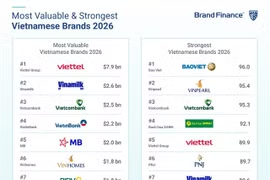
Vinamilk is an example of this approach. The company continues to receive an AAA+ rating from Brand Finance, the highest level for brand strength, while earning recognition for its sustainability and social responsibility programmes. The case demonstrates that a brand can develop sustainably only when it builds trust among domestic consumers.

According to Brand Finance, Vietnam’s national brand value reached approximately 519.6 billion USD in 2025, ranking 32nd among 193 economies worldwide. The result reflects improvements in the economy's image and competitiveness while highlighting the need to develop more Vietnamese brands capable of competing internationally.
Raising competitiveness to reach global markets
Vu Ba Phu, Director-General of the Vietnam Trade Promotion Agency under the Ministry of Industry and Trade, said the focus must now go beyond trade promotion to the development of a national branding strategy, with businesses at its centre. The ministry is working on a strategy for 2026–2035, with a vision to 2045, aimed at increasing the value of “Made in Vietnam” products.
The orientation reflects a shift in the sources of competitiveness. Businesses can no longer rely primarily on production scale or low labour costs, but must strengthen their capabilities in science, technology, innovation, digital transformation, green production and corporate governance.
After more than two decades, the Vietnam National Brand Programme (Vietnam Value) has formed a core group of 190 businesses with 359 products recognised as national brands. These enterprises currently account for nearly 89% of the total value of Vietnam’s most valuable corporate brands, demonstrating that investment in branding is investment in competitiveness.
The Government aims to have around 1,000 enterprises with national brands by 2030, capable of leading value chains and strengthening the economy’s competitiveness. By winning over domestic consumers through genuine capabilities, Vietnamese businesses will establish a solid foundation for reaching global markets and enhancing the standing of Vietnamese goods and the national brand in an increasingly integrated world./.