Vietnam Mission in Geneva hosts hybrid seminar on industrial policy

Huy stressed the need for Vietnam to draw on evidence-based analysis when designing measures to move up global value chains, strengthen domestic supply chains, develop strategic industries and technologies, and make more effective use of foreign investment.

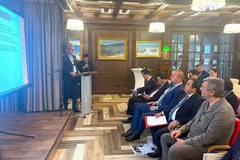
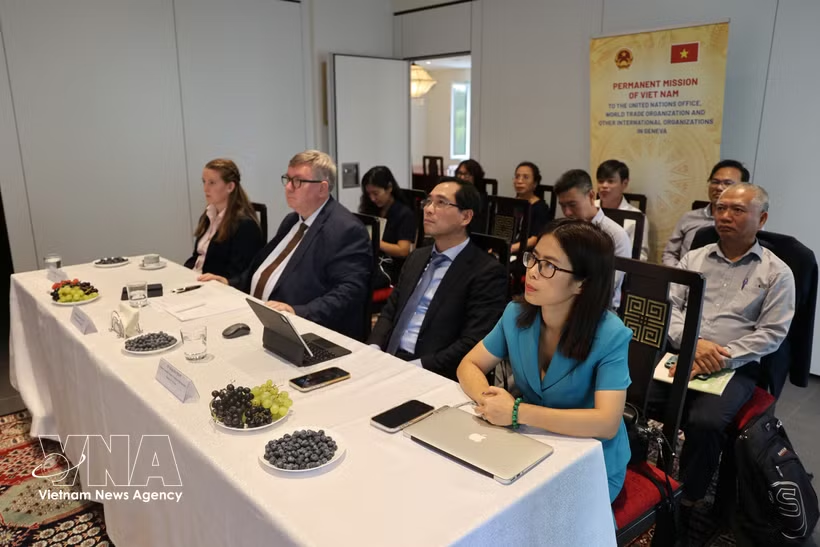
Delegates at the seminar. (Photo: VNA)

Geneva (VNA) - The Permanent Mission of Vietnam to the United Nations (UN), the World Trade Organisation (WTO) and other international organisations in Geneva and the Faculty of Political Science and Humanities of the Foreign Trade University (FTU) on August 17 co-hosted a hybrid seminar on industrial policy.

In his opening remarks, Minister Counsellor and Deputy Permanent Representative of Vietnam in Geneva Pham Quang Huy said industrial policy is not a new issue but has returned to the centre of the economic and trade strategies of major economies.

Subsidies, technology policies, green measures, investment incentives and supply-chain policies are increasingly shaping global competition, he said, adding that for Vietnam, these developments could have a direct impact on exports, investment, industrial competitiveness and the country’s position in global value chains.

Huy stressed the need for Vietnam to draw on evidence-based analysis when designing measures to move up global value chains, strengthen domestic supply chains, develop strategic industries and technologies, and make more effective use of foreign investment. Vietnam also needs to anticipate the opportunities and risks arising from the industrial policies adopted by major economies, he added.

Speaking at the seminar as the keynote speaker, Professor Simon Evenett, founder of the St. Gallen Endowment for Prosperity Through Trade and Professor of Geopolitics and Strategy at the International Institute for Management Development (IMD) in Switzerland, emphasised the growing use of industrial policy by major economies, noting that these countries have greater resources to provide subsidies and large domestic markets to support their policies.
vnanet-potal-phai-doan-viet-nam-tai-geneva-toa-dam-ve-chu-de-chinh-sach-cong-nghiep-8961509.jpg
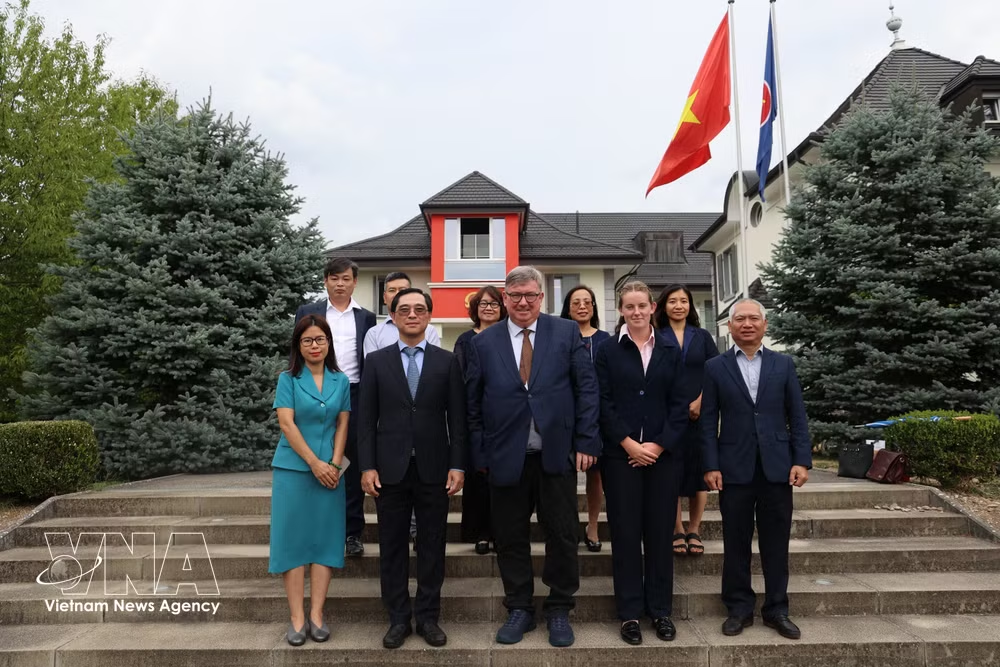
Delegates pose for a group photo with Professor Simon Evenett, founder of the St. Gallen Endowment for Prosperity Through Trade and Professor of Geopolitics and Strategy at the International Institute for Management Development (IMD) in Switzerland. (Photo: VNA)

Drawing on data from Global Trade Alert and practical examples, Evenett highlighted factors that are reshaping the industrial policy in the current global environment. The industrial policy today involves a diverse mix of measures, with a growing use of non-tariff import restrictions alongside the traditional use of subsidies, he said.

Evenett also noted a shift in the motivations behind the industrial policy, with countries increasingly adopting measures linked to national security concerns, while the use of measures related to environmental and green policies has declined.

He also mentioned businesses' management of risks associated with increasingly vulnerable and disrupted supply chains.

The professor further examined arguments concerning market failures and the need for investment coordination, particularly in strategic industries such as semiconductors. He offered policy recommendations for small and medium-sized economies, as well as businesses, amid intensifying geopolitical competition and disruptions to global supply chains.

To design effective policies, policymakers need to understand both decision-making mechanisms and practical difficulties faced by businesses, he stressed.

Analysing the factors determining the success of industrial policy, Evenett recommended that each country choose policies suited to its own circumstances, particularly countries with limited resources.

He also highlighted the need to consider industrial policy from the business perspective. Technological change, geopolitical competition, environmental changes and demographic trends are reshaping business opportunities, requiring industrial policies to adapt accordingly.

Evenett called for policymakers to develop practical knowledge of specific industries and sectors and stressed the importance of cooperation with academia. Regular mechanisms for dialogue between governments and businesses are also needed to address practical business challenges and improve policy responsiveness, he said.

The event was an initiative of the Vietnamese Mission in Geneva and formed part of a series of activities aimed at connecting Vietnamese educational and training institutions with leading lawyers and experts in Switzerland specialising in geopolitics, trade policy, international law and investment.

With its extensive network of international experts, the mission has actively worked with domestic institutions, including academic organisations, to provide professional training and updated knowledge as well as practical international perspectives on key global trade issues.

In 2022, FTU became the only Vietnamese educational institution selected by the WTO to participate in the WTO Chairs Programme for 2022-2026, which supports trade-related capacity building in developing WTO members through leading universities and research institutions./.
VNA

See more

Trains on the elevated section of the Cau Giay – Nhon route in Hanoi provide convenient transportation for local residents. (Photo: VNA)

Multimodal connectivity to drive Vietnam’s transport infrastructure

Under the proposed approach, roads would serve mainly as connectors and for first- and last-mile transport; railways would handle large volumes over long distances; maritime transport would serve import and export cargo; inland waterways would carry large volumes at low cost; and air transport would focus on fast delivery and high-value goods.

Amata Industrial Park in Dong Nai city (Photo: VNA)

Green shift powers investment in southeast Vietnam

The Amata Industrial Park in Dong Nai City, established 32 years ago and covering more than 500ha, is home to over 160 domestic and foreign businesses. Selected in 2020 as one of three national pilot sites for conversion into an eco-industrial park, Amata has raised its compliance with the international eco-industrial park framework from 41% to 86% in 2024, and is working towards becoming Dong Nai's first certified eco-industrial park.

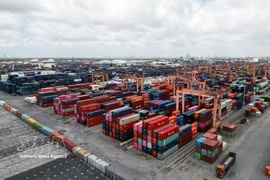
At a port in Ho Chi Minh City (Photo: VNA)

Multi-channel capital mobilisation needed to achieve double-digit growth

The Ministry of Finance estimates development investment for 2026-2030 at a minimum of 38.5 quadrillion VND (1.48 trillion USD), or about 40% of GDP. The state budget is expected to provide only about 20%, or more than 7.7 quadrillion VND, leaving over 80%, or more than 30 quadrillion VND, to be raised from the broader economy. That makes expanding capital mobilisation channels beyond bank credit essential.

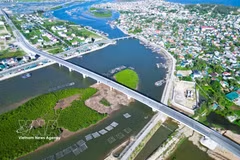
An aerial view of the Nhieu Loc – Thi Nghe area in Ho Chi Minh City. The southern metropolis is home to the Vietnam International Financial Centre. (Photo: VNA)

Vietnam International Financial Centre launches membership registration system

Integrated into the official Vietnam International Financial Centre portal at vifc.gov.vn, the online system for registering and recognising members provides a unified online service channel through which investors, organisations and businesses can complete procedures related to membership, from new registration and recognition to information updates and termination of membership.

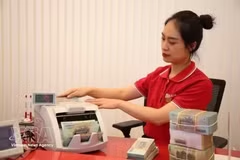
At a tax office in Hung Yen province (Photo: VNA)

Finance ministry moves to cut business costs, spur growth

Tax policy is among the solutions with the most direct impact on companies. Rather than prioritising near-term revenue collection, fiscal policy is being run to help them preserve cash flow, expand production and build more sustainable revenue sources.

In the Kim Long Motor Hue factory (Photo: VNA)

Hue courts capital to turn industrial zones into growth engine

The economic and industrial zones in Hue city host more than 200 active investment projects worth over 152 trillion VND (5.84 billion USD), with 139 already operational. Since the start of 2026, they have generated about 32 trillion VND, contributed 4.2 trillion VND to the state budget and brought in 730 million USD in exports, while employing more than 46,000 workers.

An overview of a meeting between Politburo member and Secretary of the Hanoi Party Committee Tran Duc Thang and representatives of Saint Petersburg businesses. (Photo: VNA)

Saint Petersburg’s metro expertise valuable for Vietnam

As Hanoi implements its master plan with a 100-year vision, in which metro lines are identified as the backbone of the capital city’s transport network, Secretary of the municipal Party Committee Tran Duc Thang met with representatives from several Saint Petersburg companies specialising in urban rail development.

An art performance at 2026 Dak Lak Durian Festival. (Photo: VNA)

Dak Lak Durian Festival seeks to elevate Vietnam’s agricultural brand globally

Dak Lak has about 41,000ha of durian, with this year’s output estimated at nearly 500,000 tonnes. The province has 280 growing-area codes covering around 7,500ha, along with 41 packing facilities approved for export. In 2025, Dak Lak’s durian sector contributed about 1.1 billion USD to the country’s export turnover.

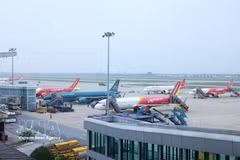
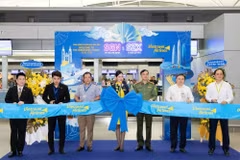
Delegates cut the ribbon to inaugurate the Ho Chi Minh City-Shenzhen direct air route. Photo: baodautu.vn

Vietravel Airlines launches direct Ho Chi Minh City-Shenzhen route

Vietravel Airlines' new route connects Tan Son Nhat International Airport (SGN) in Ho Chi Minh City with Shenzhen Bao'an International Airport (SZX), meeting growing demand for travel between the two markets for investment, trade, tourism and visiting relatives.