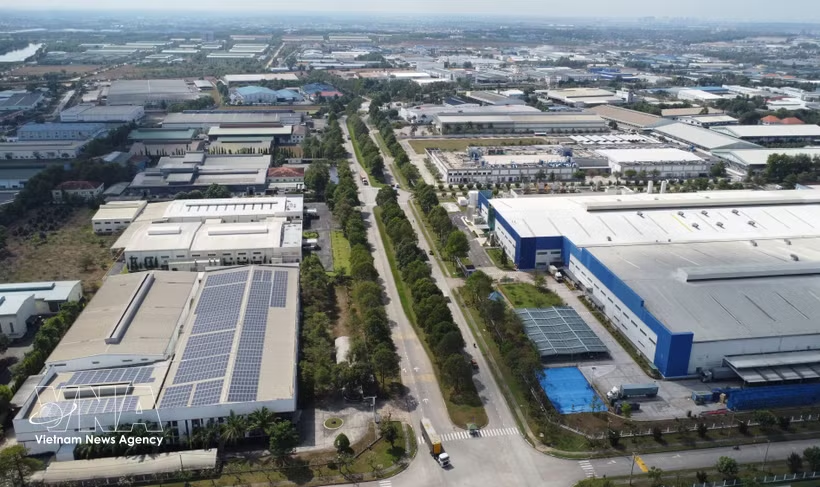
Hanoi (VNA) - The Southeast region is accelerating the shift towards green and smart industrial parks, seeing the transformation as a key lever to boost competitiveness, attract high-quality investment and secure sustainable growth.
The Amata Industrial Park in Dong Nai City, established 32 years ago and covering more than 500ha, is home to over 160 domestic and foreign businesses. Selected in 2020 as one of three national pilot sites for conversion into an eco-industrial park, Amata has raised its compliance with the international eco-industrial park framework from 41% to 86% in 2024, and is working towards becoming Dong Nai's first certified eco-industrial park.
Sonadezi, a major industrial infrastructure developer in the southern region, is also accelerating the green and smart transformation of its 12 industrial parks in Dong Nai, Ho Chi Minh City and Lam Dong. The company aims to embed green economy, circular economy and Net Zero principles across both its own operations and those of tenant businesses.
Dong Nai currently has 44 operating industrial parks out of 58 established, giving it a strong platform to develop eco-industrial, smart and high-tech parks.
Vice Chairman of the municipal People's Committee Nguyen Kim Long said the province's industrial scale, strategic location, land resources and improving transport infrastructure provided major advantages. However, he stressed that these strengths must be matched by new thinking and closer coordination among authorities, infrastructure developers, manufacturers, financial institutions, research bodies and communities.
The city is prioritising selective investment, particularly high-tech projects, while transforming existing industrial parks through energy efficiency, water reuse, waste recycling and industrial symbiosis.
Tay Ninh is pursuing a similar path. The province has 34 industrial parks eligible to receive investment, with an occupancy rate of nearly 70%. Vice Chairman of the provincial People's Committee Huynh Van Son said eco-industrial parks were becoming an important driver for competitiveness and high-quality investment.
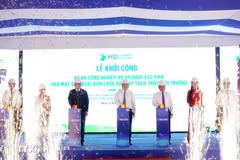
The province is promoting efficient resource use, circular production and digital technologies in industrial infrastructure management. The 400ha Prodezi Industrial Park, backed by around 4.6 trillion VND (176 million USD) in infrastructure investment, has already transitioned towards an eco-industrial model.
From green ambition to action
The Vietnam Chamber of Commerce and Industry (VCCI) said traditional industrial parks had contributed significantly to economic growth and employment but had also created environmental and resource challenges and limited links among businesses.
VCCI Chairman Ho Sy Hung said eco-industrial parks could address environmental concerns while building competitive industrial clusters, strengthening Vietnam's appeal to foreign investors and supporting national green-growth commitments.
The transition, however, remains at an early stage. Of Vietnam's 425 industrial parks, only around 1-2% are moving towards the eco-industrial model. Higher initial investment costs, estimated at 15-30% above conventional parks together with limited incentives, weak resource-sharing mechanisms and slow technological upgrades remain major barriers.
Nguyen Duc Hien, Deputy Head of the Party Central Committee's Commission for Policies and Strategies, called for breakthroughs in institutions, industrial planning, modern park governance and investment attraction.
Dong Nai, he said, already possesses many of the foundations needed for next-generation industrial parks, including a large industrial base, strategic location, multimodal logistics, green-growth orientation, skilled human resources, innovation capacity and digital infrastructure.
Its experience with eco-industrial pilots gives the locality a head start in building greener, smarter and more competitive industrial parks, he added./.