Bac Ninh earmarks over 1.7 billion USD for environmental protection

By 2030, Bac Ninh aims to ensure that all operating industrial clusters and industrial parks have centralised wastewater treatment systems meeting standards, while at least 95% of wastewater in Grade-I urban areas and 70% in Grade-II urban areas is collected and treated to required standards.

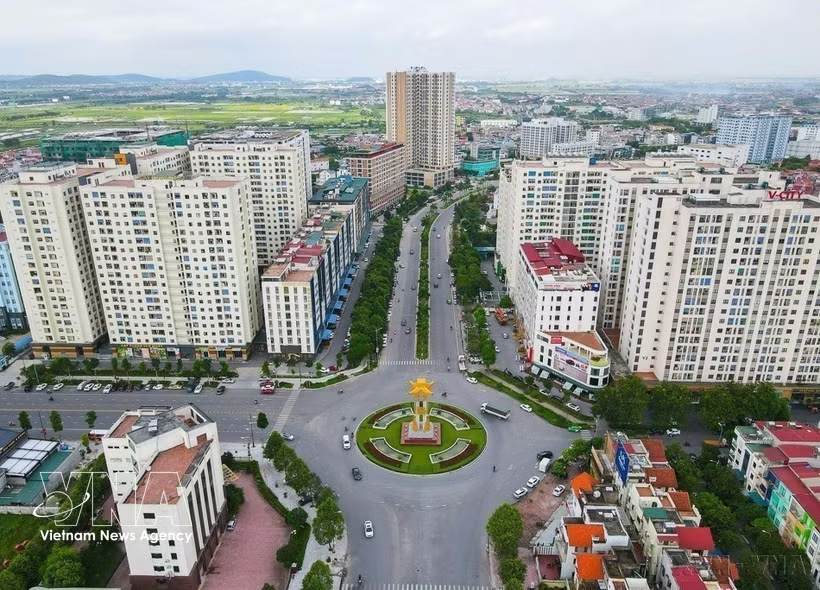
A view of Vo Cuong ward, Bac Ninh province (Photo: VNA)

Bac Ninh (VNA) – Bac Ninh province plans to mobilise more than 44.7 trillion VND (1.71 billion USD) through 2030 for a comprehensive environmental protection programme, targeting pollution hotspots while upgrading environmental infrastructure and promoting a green, low-emission and smart economy, according to Vice Chairman of the provincial People’s Committee Dao Quang Khai.

By 2030, Bac Ninh aims to ensure that all operating industrial clusters and industrial parks have centralised wastewater treatment systems meeting standards, while at least 95% of wastewater in Grade-I urban areas and 70% in Grade-II urban areas is collected and treated to required standards.

The northern province targets cutting outdoor straw burning by at least 80%, ending the operation of substandard small-scale waste incinerators and maintaining 20 automatic air-quality monitoring stations.

The collection and treatment rate for domestic solid waste is expected to reach at least 98.5%, with at least 90% treated using waste-to-energy or advanced technologies. All industrial, hazardous and medical waste generated will be collected and treated in accordance with regulations.

Bac Ninh also plans to develop 2,118 MWp of rooftop solar power, raise renewable energy’s share to 15-20% of total primary energy supply and maintain forest coverage at 30.65% or higher.

To improve water quality, the province will accelerate the construction and expansion of urban and craft-village wastewater treatment plants. Centralised wastewater treatment systems will be completed for four industrial clusters, while polluted rivers, canals, drainage channels and ponds will undergo dredging and water-quality improvement.

For air pollution control, Bac Ninh will conduct comprehensive inventories of emissions from industrial production, craft villages, and transport and construction activities. It will pilot electric bus routes in three Grade-II urban areas and plant at least 50,000 trees annually to expand urban green space.

The locality will also build a map of agricultural soil pollution, identify degraded areas for treatment, and complete the closure and environmental restoration of 50 small waste landfills.

Waste sorting at source will be expanded, alongside efforts to attract investment in large-scale waste treatment and waste-to-energy plants. Bac Ninh will also study technologies to recycle and process ash and slag from waste incinerators and metal craft villages into construction materials.

Digital transformation will be strengthened through a unified provincial environmental database and the application of GIS, IoT and AI for real-time environmental monitoring, forecasting and early warning.

Bac Ninh also plans to develop a 25-ha green and circular economy industrial cluster in Da Mai ward, establish inter-enterprise circular production chains in industrial parks, and assess potential and develop a roadmap for participation in domestic and international carbon credit markets.

Since early 2026, the province has issued plans on domestic solid waste collection, transport, and treatment for 2025-2027, as well as air and surface water quality management for 2026-2030.

It has also intensified pollution prevention and control at high-risk industrial projects and promoted environmental sanitation campaigns involving local communities.

The provincial agriculture and environment sector has also inspected compliance with environmental regulations at centralised wastewater treatment facilities, and monitored pollution risks around Tien Son Industrial Park, while reviewing waste-treatment facilities and environmental registrations.

Bac Ninh has also adjusted its plan for zones handling daily domestic solid waste and instructed communes and wards to strengthen management and prevent environmental violations in the treatment of industrial and domestic solid waste./.
VNA

See more

Dray Sap Waterfall lies within the UNESCO Dak Nong Global Geopark in Nam Da commune, Lam Dong province. (Photo: VNA)

Lam Dong steps up efforts to retain UNESCO global geopark status

Covering nearly 4,760 square kilometres across 22 communes and wards in western Lam Dong (equivalent to 73.1% of the former Dak Nong province's natural area), the geopark was shaped by millions of years of geological activity and successive volcanic eruptions.

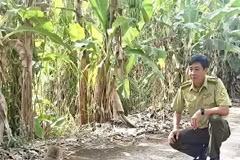
A stump-tailed macaque (Macaca arctoides) is handed over to the Cam Lo–Dong Ha forest ranger station in Quang Tri province on January 27, 2026 (Photo: VNA)

Rare primate handed over to Phong Nha - Ke Bang National Park

A stump-tailed macaque (Macaca arctoides) was handed over to the Centre for Rescue, Conservation, and Development of Creatures under the Management Board of Phong Nha - Ke Bang National Park in Quang Tri province on July 21, for rehabilitation and eventual release into the wild.

Two Red Lories (Eos rubra) found among the 104 wild animals being kept without documentation proving their lawful origin in Phuoc Thanh commune, Tay Ninh province. (Photo published by VNA)

Criminal proceedings launched against case of illegal keeping, trading of 104 wild animals

They recorded a total of 104 wild animals, comprising 92 African spurred tortoises (Geochelone sulcata) of various sizes, six Red Lories (Eos rubra) and six Green-cheeked Parakeets (Pyrrhura molinae). Authorities said the animals are subject to management under Vietnam's forestry legal regulations and are listed in Appendix II of the Convention on International Trade in Endangered Species of Wild Fauna and Flora (CITES).

BUYO Bioplastics' biodegradable plastic products are made from brewer's grains and sugarcane bagasse. (Photo: nhandan.vn)

Vietnam urged to shift from plastic waste treatment to full life-cycle management

For years, efforts to tackle plastic pollution in Vietnam have focused mainly on waste collection, recycling and disposal. However, as sustainable development and green trade standards become increasingly important, specialists argued that a broader approach is needed, covering everything from product design and material selection to production, consumption and recycling.

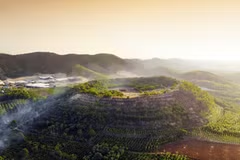
Bang Mo volcano in Lam Dong province (Photo published by VNA)

Lam Dong optimises value of UNESCO Dak Nong Global Geopark

Alongside conservation, Lam Dong aims to tap the geopark's tourism potential through geological, ecological and community-based tourism. Infrastructure and tourism development projects must ensure that heritage values, landscapes and the natural environment are preserved.

Dr. Dang Trung Phuoc (left) is introducing the history and origin of the Pinhey sand dunes (Photo: VNA)

Vietnamese Canadian scientist revives forgotten ecosystems

From restoring an ancient sand dune ecosystem in Canada to promoting the conservation of Vietnam's coastal dunes, native forests and ecological corridors, Vietnamese-born scientist Dang Trung Phuoc has remained committed to using science to revive ecosystems long misunderstood or neglected. His quiet but sustained efforts reflect both a scientist's responsibility to the communities he serves and the enduring commitment of a Vietnamese expatriate to his homeland.

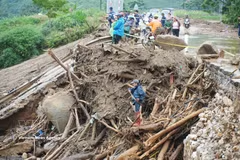
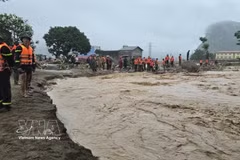
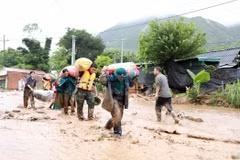
Police and military forces work together to rescue people and assist local residents in affected areas. (Photo: VNA)

PM orders proactive response to heavy rainfall in northern mountainous region

To minimise casualties and damage to public and private property, the PM instructed ministries, sectors and local authorities to strictly implement directions issued by Party General Secretary and State President To Lam, as well as the Government's directives on strengthening disaster prevention and response in 2026.

A view of the Ea So Nature Reserve in Dak Lak province (Photo: VNA)

Rare wild animals released into natural habitat in Dak Lak

Among them are two species classified under Group IB of Vietnam's protected wildlife list, namely the Bengal slow loris (Nycticebus bengalensis) and the Sunda pangolin (Manis javanica). Both are endangered forest species protected under Vietnamese law and are prohibited from commercial exploitation or use.

A large-timber plantation model in Gia Lai province (Photo: VNA)

96-million-USD project promotes agroforestry to cut emissions

The Reduction of Emissions in the Central Highlands and South Central Coast of Vietnam (RECAF) project will run from 2026 to 2031 across the provinces of Dak Lak, Gia Lai, Lam Dong, and Khanh Hoa covering about 145,000ha, according to the International Fund for Agricultural Development (IFAD).